

Sukhoi Su-30
Images

Beriev A-50, Sukhoi Su-27, Sukhoi Su-30


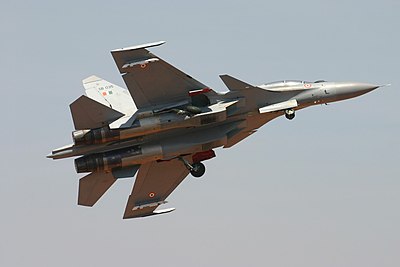


Evolutionary Genesis
The Sukhoi Su-30's lineage traces back to the highly successful Su-27 'Flanker' family, originating as an internal development project within the Sukhoi Design Bureau in the 1980s. Its initial iteration, the Su-27PU, was conceived as a heavy interceptor derived from the two-seat Su-27UB trainer. This foundational design emphasized long-range interception capabilities.
However, the program underwent significant re-evaluation and modernization, culminating in its renaming to Su-30 by the Russian Ministry of Defense in 1996. This transition marked a pivotal shift towards a more versatile, multirole platform. The subsequent divergence into distinct export variants, manufactured by competing entities within the Sukhoi umbrella (KnAAPO and Irkut Corporation), underscores the strategic importance placed on tailoring the aircraft to meet diverse international military requirements and operational doctrines, a testament to its adaptability and market appeal.
Aerodynamic Mastery
The defining characteristic of the Su-30 is its 'supermaneuverability,' a capability that elevates it beyond conventional fighter designs. This advanced agility is achieved through a sophisticated integration of aerodynamic features and propulsion systems. Key to this performance are the canards, small control surfaces positioned forward of the main wings, which enhance pitch control and allow for tighter turns.
Furthermore, many Su-30 variants incorporate thrust-vectoring control (TVC) systems. TVC allows the engine nozzles to swivel, directing the jet exhaust to provide additional control forces, enabling the aircraft to perform extreme maneuvers like the 'Pugachev's Cobra' and the 'Bell.' These capabilities provide a significant tactical advantage in close-range aerial combat, allowing the pilot to maintain optimal firing solutions and evade threats with unparalleled responsiveness. The complex interplay of these elements transforms the Su-30 into an exceptionally agile aerial platform.
Strategic Versatility
The Su-30's design philosophy embraces a 'multirole' concept, enabling it to perform a wide spectrum of missions beyond pure air superiority. This versatility is crucial in modern defense strategies, where a single platform must be capable of air-to-air interdiction, ground attack, reconnaissance, and electronic warfare. The development of specialized export variants exemplifies this adaptability.
KnAAPO produced the Su-30MKK and Su-30MK2, tailored for China and other nations, featuring a robust airframe and payload capacity, sometimes omitting canards for increased ordnance carriage. In contrast, Irkut Corporation developed the Su-30MKI for India, integrating advanced avionics, a long-range phased-array radar, and incorporating canards and thrust-vectoring for enhanced air combat prowess alongside ground-attack capabilities. This strategic segmentation allowed the Su-30 family to penetrate diverse international markets effectively.
Enduring Relevance
As of 2024, the Sukhoi Su-30 remains a vital component of numerous air forces worldwide, including a substantial fleet of over 130 Su-30SM variants operated by the Russian Aerospace Forces. Its continued production and operational deployment underscore its enduring strategic value. The aircraft's all-weather capability, robust airframe, and sophisticated sensor suites ensure its effectiveness in modern operational environments.
The Su-30 serves not only as a primary air defense asset but also as a platform for power projection, capable of undertaking long-range missions. Its presence in the arsenals of nations like India, Algeria, and Malaysia highlights its role in shaping regional military balances and underscores the Sukhoi Design Bureau's lasting legacy in advanced fighter aircraft development. The Su-30 represents a significant chapter in the evolution of combat aviation.
See also
Frequently Asked Questions
What is the Sukhoi Su-30?+
Why is the Su-30 called a "super-maneuverable" fighter jet?+
How does the Su-30 use canards and thrust‑vectoring to fly so well?+
Where does the Su-30 fly in the world today?+
Why are there different Su-30 models like the Su-30MKI and Su-30MKK?+
Based on content from Wikipedia · Licensed under CC BY-SA 4.0