

Space Shuttle Endeavour
Images

Space Shuttle Endeavour Tail Section (1 of 2)

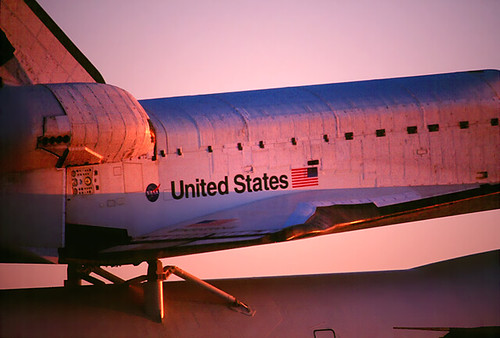


Conception and Construction
Space Shuttle Endeavour (OV-105) represents a unique chapter in NASA's Space Shuttle program, conceived not from an initial design blueprint but as a direct consequence of tragedy. Following the catastrophic loss of the Space Shuttle Challenger in 1986, the United States Congress recognized the imperative to maintain orbital access and authorized the construction of a replacement orbiter. NASA opted for a pragmatic and cost-effective approach: building Endeavour primarily from existing structural spare parts that had been manufactured during the production of its sister ships, Discovery and Atlantis.
This strategy significantly reduced development time and expense, allowing Endeavour to enter service relatively quickly. Its first mission, STS-49, launched in May 1992, marking the beginning of a distinguished career. Endeavour's existence is a testament to NASA's adaptability and determination in the face of adversity, ensuring the continuation of vital space exploration and research.
Operational Excellence
Throughout its operational life, Endeavour undertook 25 missions, accumulating 299 days in space and completing approximately 4,671 orbits of Earth. Its missions were instrumental in advancing scientific knowledge and building critical space infrastructure. A cornerstone of Endeavour's legacy is its pivotal role in the servicing of the Hubble Space Telescope.
Multiple missions involving Endeavour were dedicated to repairing and upgrading Hubble, significantly enhancing its observational capabilities and ensuring its longevity as one of humanity's most important scientific instruments. Furthermore, Endeavour was a key player in the assembly of the International Space Station (ISS). It delivered crucial modules and components, contributing substantially to the construction of this multinational orbital laboratory.
These missions underscored the shuttle's versatility as both a scientific platform and a heavy-lift cargo vehicle, essential for constructing complex structures in orbit.
Technological Marvel
The Space Shuttle orbiter, including Endeavour, was a marvel of aerospace engineering. Designed for reusability, it represented a paradigm shift from expendable rockets. Its complex systems allowed for ascent into orbit powered by its own engines and solid rocket boosters, maneuvering in space using its orbital maneuvering system, and a controlled atmospheric re-entry and glide landing.
The orbiter's thermal protection system, composed of thousands of heat-resistant tiles, was crucial for surviving the extreme temperatures of re-entry. Endeavour's payload bay, capable of carrying large payloads, and its robotic arm, the Canadarm, enabled intricate orbital operations, from satellite deployment to astronaut spacewalks. The shuttle's sophisticated avionics and life support systems ensured the safety and success of its crew during extended missions.
Retirement and Enduring Legacy
Endeavour's final mission, STS-134, concluded in May 2011, marking the penultimate flight of the Space Shuttle program. While Atlantis flew the very last mission (STS-135), Endeavour's retirement signified the end of an era of reusable spacecraft for NASA. Unlike its predecessors, Endeavour was not designed for disassembly or cannibalization but was preserved as a historical artifact.
It is now housed at the California Science Center in Los Angeles, where it is undergoing extensive preparation for public display. This transition from active service to museum exhibit ensures that Endeavour continues to inspire and educate. Its presence serves as a tangible link to humanity's achievements in space exploration, encouraging future generations to pursue careers in science, technology, engineering, and mathematics (STEM) and to dream of the next giant leaps into the cosmos.
Go deeper
Based on content from Wikipedia · Licensed under CC BY-SA 4.0