

Orbit: The Cosmic Dance!
Images

Orbit


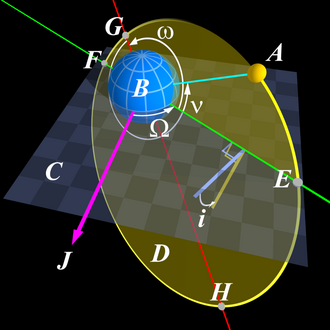

The Geometry of Gravitational Paths
In celestial mechanics, an orbit is defined as the curved trajectory of an object influenced by an attractive force, most commonly gravity. This orbital revolution can describe the path of a planet around a star, a natural satellite around a planet, or an artificial satellite around any celestial body or even a specific point in space like a Lagrange point. While often referring to regularly repeating paths, orbits can also be non-repeating.
For centuries, the dominant model approximated orbits as ellipses, a concept elegantly described by Kepler's laws of planetary motion. These laws, derived from meticulous astronomical observations, detail how planets move at varying speeds and trace out these oval paths with the central body located at one of the two foci of the ellipse. This geometric understanding provided a powerful predictive framework for celestial movements.
From Empirical Laws to Universal Gravitation
The understanding of orbits has evolved dramatically over millennia. Early civilizations observed celestial patterns, leading to complex geocentric models. The Copernican Revolution shifted the paradigm to a heliocentric view, but it was Johannes Kepler's empirical laws of planetary motion (published in the early 17th century) that truly quantified orbital behavior.
He demonstrated that orbits are elliptical, not circular, and established relationships between orbital period and distance. Building upon Kepler's work and extensive observations, Isaac Newton formulated his law of universal gravitation. Newton's theory provided a physical explanation for Kepler's laws, describing gravity as a force that diminishes with the square of the distance between two masses.
This Newtonian framework proved remarkably successful in predicting and explaining the orbits of planets, moons, and comets for centuries, forming the bedrock of classical mechanics.
The Profound Significance of Orbital Dynamics
The study of orbits is not merely an academic pursuit; it is fundamental to our existence and technological progress. Earth's stable orbit around the Sun provides the consistent solar energy input necessary for life, driving our climate and seasons. The Moon's orbit around Earth generates tidal forces, profoundly influencing marine ecosystems and geological processes. On a technological front, understanding and manipulating orbits is critical for space exploration and communication.
Launching satellites into specific orbits allows for global positioning systems (GPS), telecommunications, weather forecasting, remote sensing, and astronomical observation. Precise orbital calculations are essential for spacecraft trajectories, enabling missions to other planets and beyond. The very fabric of modern interconnectedness and our ability to explore the universe hinges on our mastery of orbital mechanics.
Newtonian vs. Relativistic Orbits
For most practical purposes, Newtonian mechanics provides an excellent approximation for orbital motion. It posits gravity as a force acting instantaneously across distance, obeying an inverse-square law. However, Albert Einstein's general theory of relativity offers a more accurate and profound description.
Relativity reinterprets gravity not as a force, but as a manifestation of the curvature of spacetime caused by mass and energy. Objects in orbit are not being pulled by a force; rather, they are following the straightest possible paths, called geodesics, through this curved spacetime. This relativistic view is crucial for highly precise calculations, such as the orbit of Mercury, which exhibits a slight precession not fully explained by Newtonian physics, and is essential for the accuracy of systems like GPS, which must account for relativistic effects on time.
A Universe of Orbits
The concept of orbit permeates the universe. Our solar system is a prime example, with planets, dwarf planets, asteroids, and comets all orbiting the Sun in elliptical paths. Natural satellites, like Jupiter's Galilean moons or Saturn's Titan, showcase complex orbital dynamics around their parent planets.
Beyond natural phenomena, human ingenuity has placed countless artificial satellites into orbit. These range from low Earth orbit (LEO) satellites like the International Space Station, which circles the globe in about 90 minutes, to geostationary orbit (GEO) satellites that remain above a fixed point on Earth's equator, crucial for broadcasting and communication. Even spacecraft on interplanetary missions follow complex orbital trajectories, using gravitational assists from planets to alter their speed and direction, demonstrating the practical application of orbital mechanics in extending humanity's reach into the solar system.
Go deeper
Based on content from Wikipedia · Licensed under CC BY-SA 4.0