

Sikorsky UH-60 Black Hawk
Images

Sikorsky UH-60 Black Hawk - Ejercito De Colombia




Genesis of a Legend
The story of the Sikorsky UH-60 Black Hawk begins in the early 1970s with the U.S. Army's ambitious Utility Tactical Transport Aircraft System (UTTAS) program. The goal was to replace the aging Bell UH-1 Iroquois (Huey) with a more capable, survivable, and versatile helicopter. Sikorsky Aircraft's innovative design, designated YUH-60A, emerged victorious from a rigorous fly-off competition against the Boeing Vertol YUH-61 in 1976.
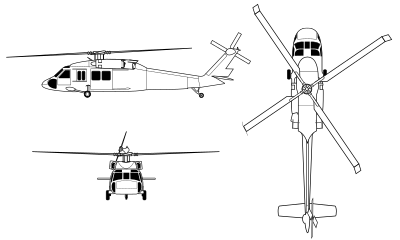
This selection marked a significant shift in Army aviation, prioritizing advanced engineering and enhanced performance. The UH-60A officially entered service in 1979, immediately distinguishing itself with its four-bladed rotor system, twin-engine configuration, and robust airframe. Its design was a departure from previous helicopters, focusing on improved maneuverability, greater lift capacity, and enhanced crew survivability.
The choice to name it after Chief Black Hawk, a respected Native American leader, imbued the aircraft with a sense of heritage and strength, reflecting its intended role as a powerful force.
A Modular Marvel
The true genius of the Black Hawk lies in its inherent modularity and adaptability, allowing it to be configured for an astonishing array of missions. Beyond its primary role as a troop and cargo transport, the UH-60 airframe has been the foundation for specialized variants that have become indispensable to various branches of the U.S. military and allied forces. The development of electronic warfare variants, such as the EH-60, equipped with sophisticated jamming and reconnaissance systems, highlights its capability in the information domain.
For special operations, the MH-60 variants are optimized for infiltration, exfiltration, and precision insertion, often operating in highly clandestine environments. The naval SH-60 Seahawk family, including the MH-60R and MH-60S, showcases its prowess in maritime operations, capable of anti-submarine warfare, anti-surface warfare, and combat search and rescue. Similarly, the HH-60 Pave Hawk and its successor, the HH-60W Jolly Green II, are critical for combat search and rescue, demonstrating the Black Hawk's life-saving potential in the most dangerous scenarios.
This extensive family of variants underscores the Black Hawk's status as a highly adaptable platform, capable of meeting evolving military and humanitarian needs.
Engineering Excellence
The Black Hawk's enduring success is rooted in its sophisticated engineering and robust design. Its twin-engine configuration, typically General Electric T700 turboshaft engines, provides significant power redundancy, ensuring continued flight even if one engine fails. This is crucial for operations in remote or hostile environments where immediate support may not be available.
The four-bladed, rigid rotor system offers superior stability and control compared to earlier two-bladed designs, allowing for precise hovering, rapid acceleration, and agile maneuvering. The airframe itself is constructed from advanced composite materials and high-strength alloys, providing a balance of durability and weight reduction. This robust construction allows the Black Hawk to withstand the stresses of high-G maneuvers and operate effectively in a wide range of environmental conditions, from extreme heat to freezing cold.
Furthermore, ongoing upgrades and modernization programs, such as the UH-60M variant, continuously enhance its capabilities with improved avionics, more powerful engines, and enhanced survivability features, ensuring its relevance for decades to come.
Global Reach and Enduring Relevance in the 21st Century
The Sikorsky UH-60 Black Hawk is not merely an American military asset; it is a globally recognized symbol of aerial capability and reliability. Exported to numerous nations, it serves as a cornerstone of many air forces' rotary-wing fleets. Its production under license in countries like Japan, as the Mitsubishi H-60, further emphasizes its international significance and widespread adoption.
The Black Hawk's operational history is extensive, marked by its participation in virtually every major conflict and humanitarian crisis of the past four decades. From the deserts of the Middle East to the mountains of Afghanistan and the flood-stricken regions of disaster zones, the Black Hawk has consistently proven its worth. Its continued production and ongoing development, including the introduction of newer variants and upgrades, attest to its enduring relevance in the face of evolving geopolitical landscapes and technological advancements.
The Black Hawk remains a benchmark for medium-lift utility helicopters, a testament to its visionary design and Sikorsky's commitment to innovation.
See also
Frequently Asked Questions
What is the Sikorsky UH-60 Black Hawk?+
Why is it called "Black Hawk"?+
How can the Black Hawk be used for different missions?+
What makes the Black Hawk safe if one engine stops?+
When did the Black Hawk first fly?+
Based on content from Wikipedia · Licensed under CC BY-SA 4.0