

Rurik: The Legendary Leader
Images

Brakteat Rurik 9th-century




The Genesis of the Rus'
The narrative of Rurik's invitation to rule Novgorod in 862, as detailed in the Primary Chronicle, is a cornerstone of early East Slavic historiography. This account posits that internal strife among Slavic and Finnic tribes led them to seek external leadership, specifically from the Varangians, a group identified with Norsemen or Vikings. Rurik, described as a Varangian chieftain, accepted this call, establishing his authority and marking the beginning of the Rus' polity.
The term 'Rus' itself is widely believed to derive from the Varangians, suggesting their profound early influence on the region's political and ethnic identity. This tradition positions Rurik not as a conqueror, but as a legitimate, albeit foreign, ruler invited to bring order. The Primary Chronicle's account, while debated by scholars for its historicity and potential later embellishments, serves as the foundational myth for the emergence of a unified state in the region, moving beyond fragmented tribal structures towards a more centralized authority.
Founding the Rurik Dynasty
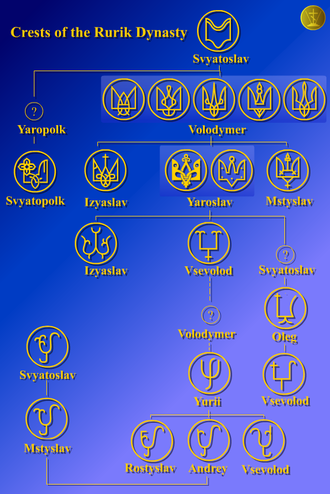
Rurik's most significant historical impact lies in his traditional role as the progenitor of the Rurik dynasty. The Chronicle states that upon Rurik's death in 879, his kinsman Oleg assumed regency for Rurik's young son, Igor. This succession, whether direct or through a close relative, established a precedent for dynastic rule that would endure for an extraordinary period.
The Rurik dynasty went on to govern Kievan Rus', a powerful medieval state, and its successor principalities for over 700 years, finally ending with the death of Tsar Feodor I in 1598. This longevity is remarkable, making Rurik the symbolic, if not strictly historical, founder of the Russian monarchy. The dynasty's long reign provided a crucial element of continuity and stability, shaping the political, social, and cultural landscape of Eastern Europe through numerous epochs, from the early medieval period to the dawn of the Tsardom of Russia.
The Historiographical Debate
The figure of Rurik exists at the intersection of history and legend. While the Primary Chronicle provides a narrative, modern historians grapple with its veracity. Some scholars question whether Rurik was a single historical individual or a composite figure representing the arrival and consolidation of Varangian power.
Others argue for his historicity, pointing to archaeological evidence of Norse presence in the region and the linguistic origins of 'Rus'. Regardless of the precise historical accuracy, Rurik's importance as a foundational myth is undeniable. He embodies the transition from tribal societies to a more organized state, a narrative that served the interests of later rulers seeking to legitimize their authority through ancient lineage.
The debate highlights the challenges of reconstructing early medieval history from limited and potentially biased sources.
Rurik's Enduring Significance
Rurik's traditional role as the founder of the Russian state and monarchy carries profound implications for understanding Russian national identity and political development. His story, whether factual or mythical, provides a clear starting point for the concept of a unified Russian polity. The establishment of a ruling dynasty offered a framework for governance, law, and territorial expansion over centuries.
The Rurik dynasty's long tenure fostered a sense of historical continuity and a tradition of strong, centralized leadership. This legacy has been invoked throughout Russian history to legitimize power and forge a national narrative. Therefore, Rurik, as the symbolic patriarch of this lineage, remains a pivotal figure in the historical consciousness of Russia, representing the very origins of its statehood and its enduring monarchical tradition.
Broader Context
Rurik's story is intrinsically linked to the broader phenomenon of Varangian expansion and the formation of early East Slavic states. The Varangians were not merely raiders; they were also traders who established extensive networks, most notably the 'route from the Varangians to the Greeks,' connecting Scandinavia to the Byzantine Empire via the river systems of Eastern Europe. Rurik's invitation to Novgorod places him at a critical node of this trade route.
His leadership, and that of his successors, helped to consolidate power along these arteries, facilitating the growth of cities like Novgorod and Kyiv. The Rus' state that emerged under the Rurik dynasty became a major power in Eastern Europe, influencing the development of neighboring peoples and states, including the Khazars, the Byzantine Empire, and later, the various principalities that would eventually form modern Russia, Ukraine, and Belarus. Understanding Rurik is thus key to understanding the complex interplay of migration, trade, and state-building that characterized the early medieval period in this vast region.
Go deeper
Frequently Asked Questions
Who was Rurik and why was he important?+
How did Rurik become a king?+
What is the Rurik dynasty?+
Why do some people think Rurik might be a legend?+
How does Rurik's story help us understand Russian history?+
Based on content from Wikipedia · Licensed under CC BY-SA 4.0