

Portia (moon)
Images

Portia (moon)

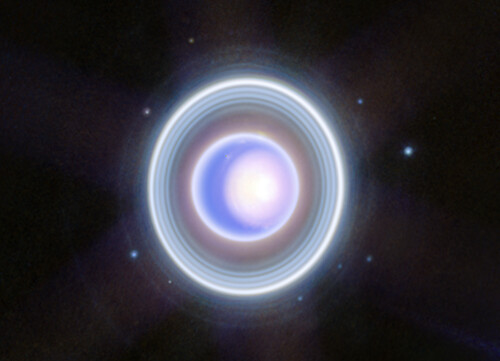


Orbital Mechanics and Physical Characteristics
Portia is one of Uranus's inner moons, a group of small, irregularly shaped satellites that orbit relatively close to the planet. Its orbital period is remarkably short, completing a full revolution in approximately 13.5 Earth hours. This rapid orbit places it well within the Roche limit of Uranus, though it is not currently in danger of being torn apart by tidal forces.
The moon's average orbital radius is about 69,800 kilometers (43,400 miles) from the planet's center. Physically, Portia is characterized by its small size, with a mean diameter of approximately 135 kilometers (84 miles). Its irregular, non-spherical shape is indicative of its low mass and insufficient gravitational pull to achieve hydrostatic equilibrium.
Spectroscopic analysis suggests its surface is composed primarily of rock and ice, with a low albedo, meaning it reflects very little sunlight, contributing to its dim appearance.
Discovery and Its Implications for Uranian System Understanding
The existence of Portia was unknown until the Voyager 2 spacecraft conducted its historic flyby of the Uranian system in January 1986. Prior to this mission, ground-based observations were insufficient to detect such small, faint objects so far from Earth. Voyager 2's advanced imaging system identified Portia as one of at least eleven moons discovered during the flyby.
This discovery was pivotal in revealing the complexity of Uranus's satellite system, which was previously thought to be less populated. The identification of Portia and other inner moons helped scientists begin to map the intricate system of rings and moons, suggesting a dynamic past for Uranus, possibly involving collisions and accretion processes.
Portia's Role in the Inner Uranian Moon System
Portia belongs to a distinct group of five inner moons of Uranus: Cordelia, Ophelia, Bianca, Cressida, and Desdemona, along with Portia itself. These moons orbit within Uranus's main rings and are thought to play a role in maintaining their structure, particularly the epsilon ring. Portia's close proximity to Uranus means it resides within the planet's powerful magnetosphere.
While the exact interactions are complex and subject to ongoing research, the charged particles trapped within the magnetosphere can influence the surface chemistry and evolution of these inner moons. Studying Portia's composition and surface features, though challenging due to its size and distance, provides clues about the primordial materials present during the formation of the Uranian system.
Formation Theories and Comparative Planetology
The formation of Portia and its fellow inner Uranian moons is widely believed to be linked to a significant impact event early in Uranus's history. It is theorized that a large protoplanet collided with Uranus, stripping away a substantial portion of its original icy mantle and forming a debris disk. This disk subsequently re-accreted to form the current system of rings and inner moons, including Portia.
Comparing Portia to similar small, irregular moons around other giant planets, such as Saturn's inner moons or Jupiter's inner satellites, allows planetary scientists to develop broader theories about moon formation and evolution in diverse planetary environments. The study of these seemingly insignificant bodies offers profound insights into the early solar system and the processes that shape planetary systems.
See also
Frequently Asked Questions
What is Portia and where does it orbit?+
How big is Portia compared to places on Earth?+
How fast does Portia go around Uranus?+
How was Portia discovered?+
Why do scientists study Portia?+
Based on content from Wikipedia · Licensed under CC BY-SA 4.0