

Uranus
Images

Uranus



The Enigma of Extreme Axial Tilt and its Consequences
Uranus stands apart in our solar system due to its extraordinary axial tilt of approximately 98 degrees, causing it to orbit the Sun on its side. This orientation is theorized to be the result of a cataclysmic impact event early in its formation, possibly involving a protoplanet of similar mass. This extreme tilt dictates its peculiar seasonal cycle, where each pole endures roughly 42 Earth years of continuous sunlight followed by an equal period of darkness.
This prolonged exposure and absence of sunlight create extreme temperature gradients and unique atmospheric circulation patterns, distinct from the more familiar seasonal changes on terrestrial planets. The magnetic field of Uranus is also unusually oriented, tilted about 60 degrees from its rotational axis and offset from the planet's center, suggesting a complex internal dynamo mechanism.
Composition, Atmosphere, and the Blue Color
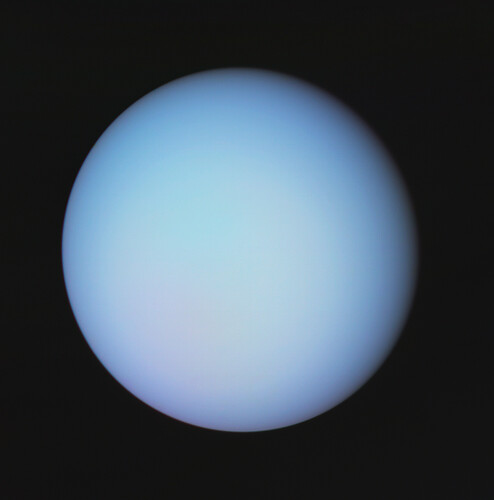
As an ice giant, Uranus's bulk composition differs significantly from gas giants like Jupiter and Saturn. It is primarily composed of 'ices'-volatile substances such as water, ammonia, and methane-surrounding a rocky core. The atmosphere, a relatively thin layer compared to its total mass, is dominated by hydrogen and helium, with methane being the key chromophore responsible for its characteristic blue-green hue.
Methane absorbs light in the red portion of the spectrum, scattering blue light back into space. Despite its seemingly placid appearance, Uranus possesses the coldest atmospheric temperatures in the solar system, reaching as low as -371 degrees Fahrenheit (-224 degrees Celsius) in its upper atmosphere, a phenomenon not fully explained by its distance from the Sun alone.
Discovery and Early Observations
Uranus's discovery on March 13, 1781, by Sir William Herschel was a landmark event, as it was the first planet identified through telescopic observation, effectively doubling the known size of the solar system. Herschel, an accomplished musician and amateur astronomer, initially mistook the object for a comet or a star. His meticulous observations over several months, noting its slow movement against the background stars and its disk-like appearance, eventually led to its classification as a planet.
This discovery challenged existing astronomical models and spurred further exploration and refinement of celestial mechanics, demonstrating the power of observational astronomy and the potential for new celestial bodies to be found.
Voyager 2's Flyby and Modern Understanding
The sole spacecraft to have visited Uranus up close is Voyager 2, which conducted a flyby in January 1986. This mission provided unprecedented data and imagery, revealing that Uranus is not as featureless as it appears. Voyager 2 discovered 10 new moons, studied its faint ring system, and observed atmospheric phenomena, including storms and wind patterns.
The mission's findings significantly advanced our understanding of ice giants, their magnetic fields, and their complex systems of rings and moons. Future missions are being considered to further explore Uranus and its intriguing moons, which may hold clues about the conditions necessary for life.
Significance in Planetary Science and Exoplanet Research
Uranus serves as a crucial case study in planetary science. Its unique composition, extreme axial tilt, and unusual magnetic field provide vital data points for refining models of planetary formation and evolution. As an ice giant, it represents a common type of planet found orbiting other stars, making the study of Uranus essential for understanding the diversity of exoplanetary systems.
By comparing Uranus to other ice giants in our solar system and to exoplanets, scientists can better comprehend the processes that lead to the formation of different planetary architectures and the potential for habitability in diverse cosmic environments. Its study helps us answer fundamental questions about our place in the universe.
Go deeper
Based on content from Wikipedia · Licensed under CC BY-SA 4.0