

Albedo
Images
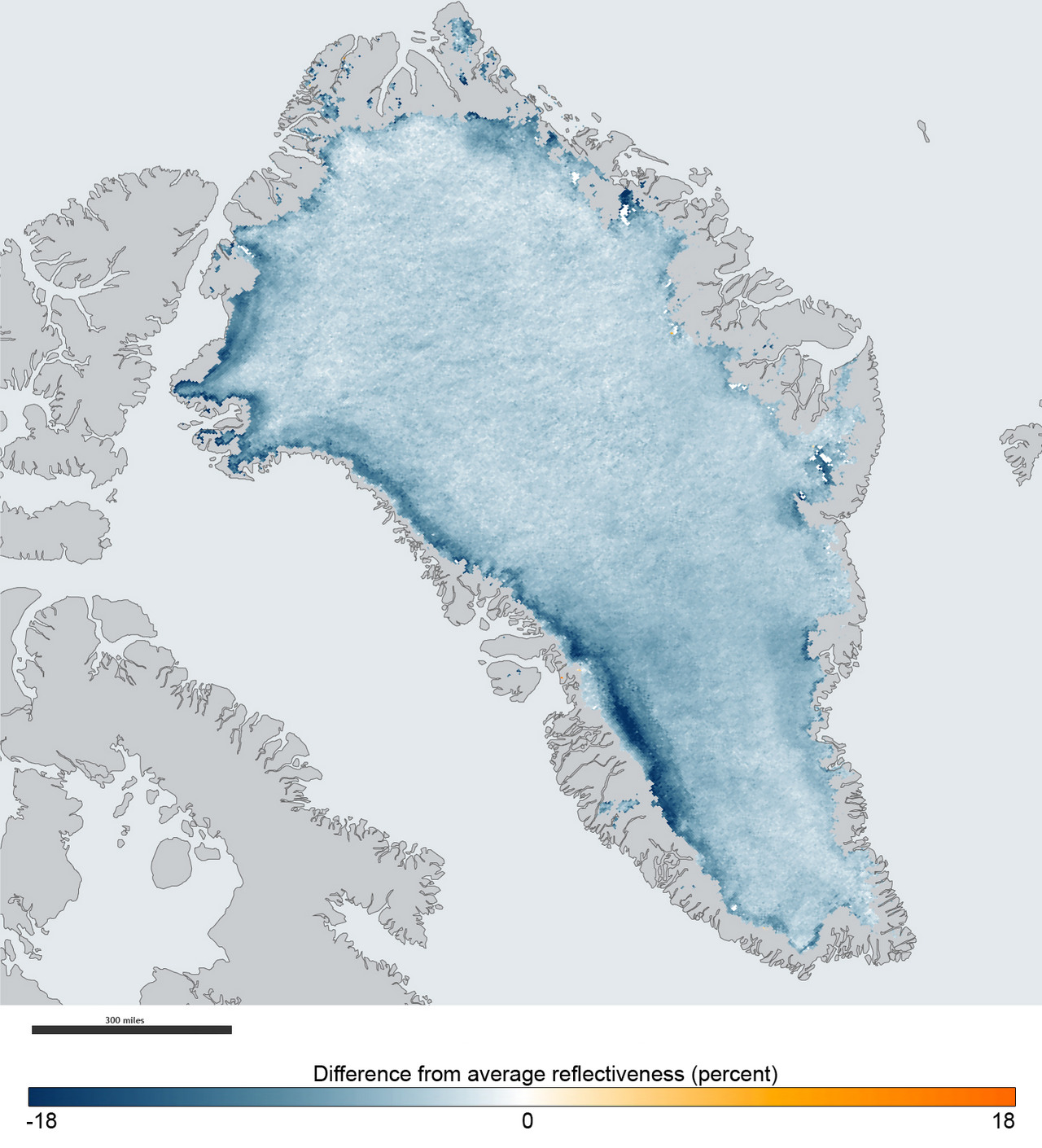
Albedo
Defining Albedo
Albedo, derived from the Latin word for 'whiteness,' is a fundamental physical property quantifying the reflectivity of a surface. Scientifically, it is defined as the fraction of incident solar radiation that is diffusely reflected by a body. This value is dimensionless and ranges from 0, representing a perfect absorber (a black body that absorbs all incident radiation), to 1, signifying a perfect reflector (a white body that reflects all incident radiation).
The surface albedo is formally expressed as the ratio of radiosity (Je) to irradiance (Ee), where both are measured in units of flux per unit area. It's crucial to understand that albedo is not a static property; it is influenced by the spectral and angular distribution of solar radiation, which in turn varies with atmospheric composition, geographic location, and time of day or year. While directional-hemispherical reflectance factor considers a single angle of incidence, albedo integrates reflectance over all solar angles within a specified period, allowing for temporal resolutions ranging from seconds to annual averages.
Unless specified as spectral albedo (for a particular wavelength), it typically refers to the entire solar spectrum, often weighted towards the wavelengths where most solar energy reaches Earth's surface (0.3 to 3 μm), encompassing visible light.
Surface Heterogeneity
Earth's surface exhibits a remarkable range of albedo values, profoundly impacting regional and global energy budgets. Pristine snow and ice cover are characterized by exceptionally high albedos, often exceeding 0.8, reflecting a substantial portion of incoming solar radiation and contributing significantly to planetary cooling. Conversely, dark surfaces like deep oceans, dense forests, and asphalt roads possess low albedos, typically below 0.2, meaning they absorb a large fraction of solar energy, leading to localized warming.
Vegetated surfaces present a complex albedo profile, with deciduous forests generally having higher albedos than coniferous forests due to leaf structure and color. Agricultural lands and grasslands exhibit intermediate albedos, which can vary seasonally with crop cycles and vegetation growth. Even clouds, which are atmospheric phenomena, possess significant albedo, with thick, bright clouds reflecting much more sunlight than thin, high-altitude cirrus clouds.
Understanding these variations is essential for accurate climate modeling and for assessing the impact of land-use changes on Earth's radiative balance.
The Ice-Albedo Feedback
The interaction between ice cover and albedo constitutes one of the most potent positive feedback mechanisms in Earth's climate system: the ice-albedo feedback. As global temperatures rise, polar ice sheets, glaciers, and Arctic sea ice experience accelerated melting. Ice and snow are highly reflective, maintaining a high albedo that helps to keep polar regions cool by reflecting solar energy back into space.
When this ice melts, it exposes darker underlying surfaces, such as open ocean water or land, which have significantly lower albedos. These darker surfaces absorb more solar radiation, leading to increased warming. This amplified warming, in turn, causes further melting of ice, perpetuating and intensifying the cycle.
This positive feedback loop is a major driver of amplified warming in the Arctic and is a critical factor contributing to global climate change, underscoring the sensitivity of Earth's climate to changes in its cryosphere.
Albedo's Role in Climate Science and Future Projections
Albedo is an indispensable parameter in climate science, influencing everything from local weather patterns to global climate dynamics. Climate models rely heavily on accurate albedo data to simulate Earth's energy balance and predict future climate trajectories. Satellite remote sensing has revolutionized our ability to monitor albedo across vast and often inaccessible regions, providing continuous data streams that track changes in surface reflectivity. These observations are vital for validating model outputs and for detecting subtle shifts in Earth's radiative forcing.
Furthermore, albedo considerations are paramount in assessing the climatic impact of human activities, such as deforestation, urbanization, and the development of reflective surfaces like solar panels or white roofs. Understanding how these anthropogenic changes alter surface albedo helps in developing mitigation strategies and in designing more sustainable urban environments. The study of albedo thus bridges fundamental physics with applied environmental science, offering critical insights into the past, present, and future of our planet's climate.
Go deeper
Frequently Asked Questions
What is albedo and why does it matter for Earth?+
Why does snow look so bright?+
How does a dark ocean surface affect the planet’s temperature?+
What happens when ice melts in the Arctic?+
Do clouds reflect sunlight too?+
Based on content from Wikipedia · Licensed under CC BY-SA 4.0