

The Parthenon: A Super Ancient Temple!
Images
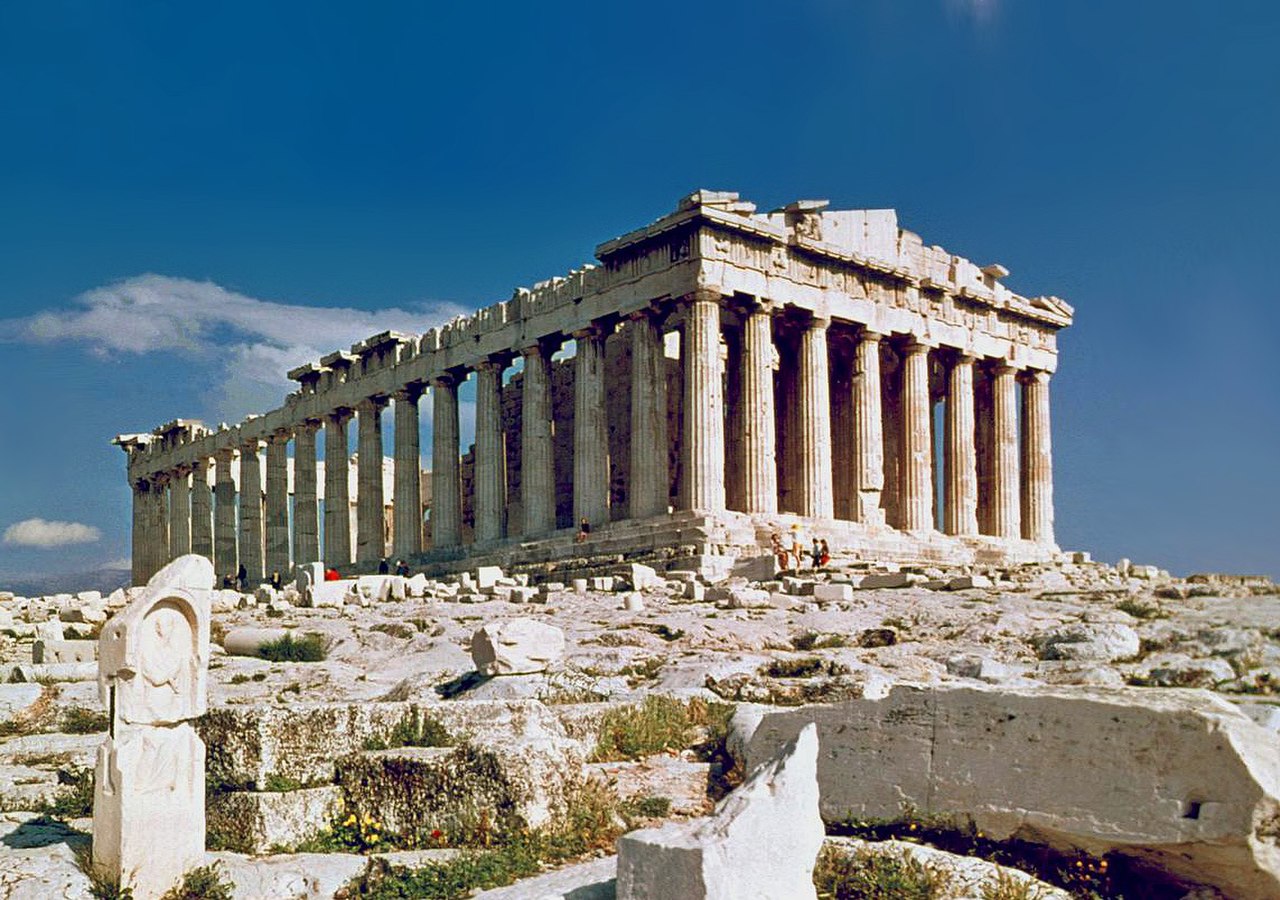
Parthenon
The Parthenon as a Symbol of Athenian Hegemony
The Parthenon, constructed between 447 and 438 BCE on the Acropolis of Athens, stands as the ultimate expression of Athenian power and cultural supremacy during the Classical period. Its construction was funded by the Delian League treasury, a fund originally intended for defense against Persia but redirected by Pericles for ambitious building projects. This monumental temple, designed by Iktinos and Kallikrates, was not merely a religious sanctuary but a potent political statement.
It was dedicated to Athena Parthenos, the city's patron deity, and housed a colossal chryselephantine (gold and ivory) statue of her, crafted by the renowned sculptor Phidias. The sheer scale and opulence of the Parthenon, built with the finest Pentelic marble, projected Athens' wealth, military success, and democratic ideals to the ancient world, solidifying its position as the dominant power in the Aegean.
Architectural Refinements and Optical Corrections
The Parthenon is celebrated for its masterful application of the Doric order, yet it incorporates subtle Ionic elements, creating a unique synthesis that pushed architectural boundaries. The architects employed a series of sophisticated optical refinements to achieve an unparalleled sense of visual harmony and perfection. These include the entasis, a slight convex curve in the shafts of the columns, which prevents them from appearing concave; the inward inclination of the columns; the curvature of the stylobate (the temple's platform) upwards towards the center; and the slight inward lean of the entablature.
These deviations from strict geometric regularity were not errors but deliberate adjustments designed to counteract optical illusions and create a building that appeared perfectly proportioned and dynamically balanced to the human eye. This meticulous attention to detail reflects a profound understanding of aesthetics and human perception.
The Sculptural Program
The Parthenon's sculptural program, largely orchestrated by Phidias, was arguably its most striking feature, serving as a complex visual narrative that reinforced Athenian identity and ideology. The metopes, depicting mythological battles (Gigantomachy, Amazonomachy, Centauromachy, and the Sack of Troy), symbolized the triumph of order over chaos, civilization over barbarism, and by extension, the Greeks over the Persians. The Ionic frieze, running around the inner cella wall, presented a continuous procession, widely interpreted as the Panathenaic Festival, showcasing the unity and piety of the Athenian citizenry.
The pedimental sculptures, depicting the birth of Athena and her contest with Poseidon for patronage of Attica, highlighted the goddess's divine origins and her special relationship with the city. Originally painted in vibrant colors, these sculptures transformed the marble structure into a dynamic, story-telling monument.
Transformation Through History
The Parthenon's history is a chronicle of transformations and destruction. After centuries as a pagan temple, it was consecrated as a Christian church, Hagia Maria, around the 6th century CE, with modifications like the addition of an apse. During the Frankish and Venetian periods, it continued its religious function.
However, its most catastrophic alteration occurred in 1687 during the Morean War when Ottoman forces used it as a powder magazine. A Venetian bombardment ignited the stored gunpowder, causing an explosion that destroyed the central portion of the temple and severely damaged its roof and walls. Subsequent looting, particularly by Lord Elgin in the early 19th century, further depleted its sculptural elements, leading to the ongoing debate surrounding the Parthenon Marbles.
Enduring Influence and Contemporary Relevance
The Parthenon's influence on Western art and architecture is immeasurable. Its classical proportions and aesthetic principles became the benchmark for Renaissance architects and have been emulated in Neoclassical buildings worldwide, including governmental structures and museums, symbolizing democracy, reason, and order. Beyond its architectural impact, the Parthenon remains a potent symbol of cultural heritage and the enduring legacy of ancient Greece.
Its ongoing preservation and the international discourse surrounding the repatriation of its sculptures highlight its continued significance in discussions about cultural identity, historical ownership, and the global appreciation of human artistic achievement. It serves as a tangible link to the intellectual and artistic foundations of Western civilization.
Go deeper
Based on content from Wikipedia · Licensed under CC BY-SA 4.0