

Parinacota Volcano
Images

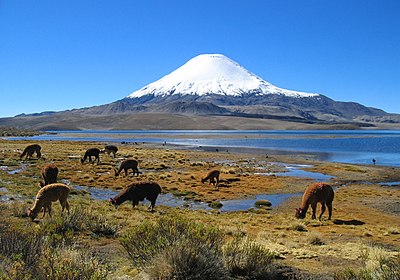
Parinacota volcano chungara lake cl




Geomorphological Significance and Tectonic Setting
Parinacota Volcano is a majestic stratovolcano situated in the central Andes of South America, on the Chile-Bolivia border. It is part of the Andean Volcanic Belt, a consequence of the subduction of the Nazca Plate beneath the South American Plate. This tectonic setting fuels the intense volcanic activity in the region.
Parinacota itself is characterized by its symmetrical cone shape, a classic feature of stratovolcanoes, formed by the accumulation of viscous lava flows, pyroclastic deposits, and ash layers from numerous eruptions. Its summit reaches an impressive 6,436 meters (21,122 feet), making it one of the highest active volcanoes in the world. The surrounding landscape is a testament to its geological history, featuring vast ignimbrite sheets and the stunning, high-altitude Lago Chungará, which was formed by volcanic damming.
The climate is extreme, with polar desert conditions prevailing due to the high elevation and arid environment, supporting specialized flora and fauna.
The Parinacota Ignimbrite
The most significant eruptive event associated with Parinacota Volcano is the massive eruption that produced the Parinacota Ignimbrite, dated to approximately 7,000 years before present. This was a Plinian or Ultra-Plinian eruption, characterized by an extremely powerful ejection of volcanic ash, pumice, and gas. The eruption generated pyroclastic flows that traveled tens of kilometers, blanketing vast areas with volcanic debris.
Estimates suggest the volume of erupted material was in the order of 30 cubic kilometers, placing it among the largest Holocene eruptions in the Andes. The deposits from this event are crucial for paleoclimatic and paleoenvironmental reconstructions, providing a detailed record of the eruption's scale and impact. Studying these ignimbrites allows geoscientists to understand the dynamics of large explosive eruptions and their potential for widespread devastation, informing hazard assessments for similar volcanoes globally.
High-Altitude Biodiversity and Conservation Efforts
The unique environment surrounding Parinacota Volcano, particularly within Lauca National Park, supports a remarkable array of biodiversity adapted to extreme conditions. The Altiplano grasslands are grazed by vicuñas and guanacos, wild relatives of llamas and alpacas, as well as domestic llamas and alpacas. The avifauna is particularly rich, with Lago Chungará serving as a vital habitat for numerous waterbird species, including various types of flamingos, Andean gulls, and coots.
The sparse vegetation, consisting of hardy grasses like Festuca and cushion plants, provides essential food and shelter. Conservation efforts in Lauca National Park aim to protect these fragile ecosystems from human impact, ensuring the survival of these specialized species. The presence of these organisms highlights the resilience of life and the ecological importance of preserving high-altitude volcanic landscapes.
Volcanological Monitoring and Hazard Assessment
Parinacota Volcano is currently considered dormant, with its last significant eruption occurring millennia ago. However, its geological history indicates a potential for future activity. Volcanologists actively monitor Parinacota and surrounding volcanoes in the region using a range of techniques, including seismic monitoring to detect ground tremors, GPS measurements to track ground deformation, and gas emission analysis.
The well-preserved ignimbrite deposits provide invaluable data for hazard modeling, allowing scientists to simulate potential future eruption scenarios and their likely impact zones. This research is critical for developing effective emergency preparedness plans and mitigation strategies for the communities living in proximity to the volcano, ensuring that the lessons learned from past cataclysms can help safeguard present and future populations.
Cultural Significance and Indigenous Heritage
The region surrounding Parinacota Volcano holds deep cultural significance for the indigenous Aymara people who have inhabited the Altiplano for centuries. The volcano itself is often imbued with spiritual meaning, seen as a powerful natural entity. Traditional practices, agricultural methods, and social structures have been shaped by the unique environment and the presence of the volcano.
The Aymara have a long history of coexisting with volcanic landscapes, developing a profound understanding of their natural surroundings. Preserving the cultural heritage of these communities is as important as protecting the natural environment, as their traditions offer unique perspectives on human-environment interactions in challenging terrains. The integration of scientific research with traditional ecological knowledge can provide a more holistic approach to understanding and managing these remarkable landscapes.
See also
Frequently Asked Questions
What is Parinacota Volcano?+
Where is Parinacota Volcano located?+
How tall is Parinacota Volcano?+
Why is Parinacota Volcano important for scientists?+
What animals live near Parinacota Volcano?+
Based on content from Wikipedia · Licensed under CC BY-SA 4.0