

Newry
Images

Newry River




Geopolitical and Environmental Nexus
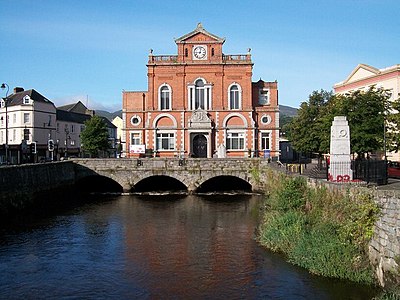
Newry's identity is intrinsically linked to its strategic geographical placement. Situated in Northern Ireland, it uniquely straddles the counties of Down and Armagh, a physical division that hints at its complex historical and administrative landscape. The city's lifeblood is the Clanrye River, a waterway that has historically facilitated trade and settlement.
Its proximity to the border with the Republic of Ireland is not merely a geographical footnote but a crucial element of its strategic importance. Newry lies directly on the primary transportation corridor linking Belfast (approximately 55 km north) and Dublin (approximately 108 km south). This position has historically made it a vital transit point, influencing its development as a market town, a garrison, and a port.
The surrounding environment, characterized by river valleys and fertile lowlands, has supported its agrarian and industrial past, while its location continues to be a key factor in its contemporary economic and logistical relevance. The city's population of 27,913 (2021) reflects its role as a regional center supporting a wider hinterland.
From Abbey Foundations to Canal Engineering
The historical narrative of Newry commences in 1144 with the founding of a Cistercian abbey, establishing it as a significant ecclesiastical and monastic center. This period laid the groundwork for its early development. The subsequent dissolution of the monasteries in the 16th century by English authorities marked a pivotal shift, leading to the construction of Bagenal's Castle on the abbey's site.
This transition underscored Newry's evolving role from a religious enclave to a strategic military and administrative stronghold. Throughout the centuries, Newry cultivated its identity as a bustling market town, a vital hub for commerce and exchange, and a garrison town, reflecting its strategic military importance. A defining moment in its infrastructural history was the opening of the Newry Canal in 1742.
This was a pioneering feat of civil engineering, recognized as the first summit-level canal in Ireland. Its construction revolutionized inland navigation and trade, transforming Newry into a significant port and solidifying its economic importance for generations. This canal system was instrumental in moving goods efficiently between the hinterland and the sea.
Spiritual Significance and Civic Recognition
Newry's status as a cathedral city underscores its enduring religious and cultural importance. It serves as the episcopal seat for the Roman Catholic Diocese of Dromore, signifying its central role in the ecclesiastical administration and spiritual life of the region. This designation highlights a long-standing tradition of religious leadership and community.
In a more contemporary context, Newry achieved a significant milestone in 2002 when it was granted city status. This honor, bestowed as part of Queen Elizabeth II's Golden Jubilee celebrations, was shared with Lisburn. The conferral of city status is a recognition of a settlement's historical depth, its cultural contributions, and its established role as a significant urban center.
It elevates the city's profile, acknowledging its development beyond that of a mere town and affirming its place within the broader civic and administrative framework of Northern Ireland. This dual identity-as a spiritual center and a recognized city-contributes to Newry's unique character.
Contemporary Dynamics
In the 21st century, Newry continues to function as a dynamic urban center with a population of 27,913 (2021). The linguistic landscape is primarily dominated by English, but the presence and cultural significance of the Irish language (Gaeilge) remain strong, reflecting the region's rich linguistic heritage. Many residents maintain fluency or a deep connection to Irish culture.
Economically, Newry has transitioned from its historical roles as a market town and port to a diversified modern economy. Key sectors include retail, professional services, and light industry. Its strategic location continues to be a significant economic driver, facilitating logistics and trade, particularly given its position on the Belfast-Dublin corridor.
The city serves as an employment hub for its surrounding areas, contributing to the regional economy. The community in Newry is characterized by a blend of historical consciousness and forward-looking development, fostering a distinct local identity. The ongoing interplay between its historical legacy and contemporary challenges and opportunities shapes the evolving narrative of this Northern Irish city.
See also
Frequently Asked Questions
Where is Newry located?+
What river flows through Newry?+
Why was Newry called a city?+
What is special about the Newry Canal?+
What is Newry's religious significance?+
Based on content from Wikipedia · Licensed under CC BY-SA 4.0