

Murad III
Images

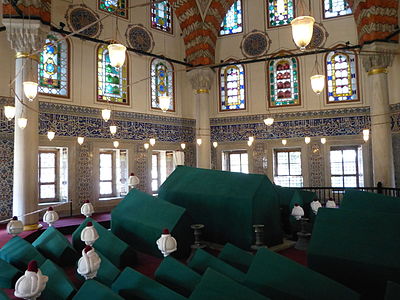
Chamber of Murad III dome (with flash) DSCF1878


The Sultanate as a Crucible
Murad III inherited the vast Ottoman Empire at a pivotal moment, a sprawling entity that commanded immense influence across three continents. His reign was characterized by a continuation of imperial ambitions, most notably through prolonged and draining conflicts with the Habsburgs in the Balkans and Central Europe, and the Safavids in Persia. These wars, while often resulting in territorial adjustments or strategic stalemates, exacted a significant toll on the empire's treasury and manpower.
The temporary subjugation of Morocco as a vassal state exemplifies the empire's reach and its attempts to consolidate power in North Africa, though this control proved ephemeral, with Morocco regaining its independence in 1582. Furthermore, Murad III's administration oversaw the expansion of Ottoman influence along the eastern coast of Africa, underscoring the empire's maritime and commercial interests. This era was not merely about conquest; it was about managing a complex, multi-ethnic empire facing external pressures and internal dynamics, requiring a delicate balance of military might, diplomatic acumen, and administrative oversight.
Diplomatic Threads and Shifting Alliances
In an era of shifting global power dynamics, Murad III's reign saw the cultivation of significant diplomatic ties, most notably with Elizabethan England. This alliance was forged not out of shared cultural values, but from a pragmatic recognition of a common strategic interest: countering the hegemonic ambitions of Spain. Both the Ottoman Empire and England viewed Spain, with its vast colonial empire and powerful navy, as a primary threat to their respective spheres of influence.
This shared antipathy facilitated a period of increased trade and political cooperation, symbolized by the exchange of ambassadors and mutual understanding. The Anglo-Ottoman alliance during this period highlights the complex web of international relations in the late 16th century, where religious and ideological differences often took a backseat to geopolitical expediency. It demonstrates how empires, even those geographically distant and culturally distinct, could find common ground to pursue mutual security and economic advantage against a shared adversary.
The Sultan's Cultural Legacy
Murad III stands out as a notable patron of the arts, a role that significantly contributed to the cultural richness of the Ottoman Empire. His support was not merely passive; he actively commissioned grand artistic projects that served both aesthetic and ideological purposes. The most celebrated of these commissions is the Siyer-i-Nebi, an epic, multi-volume illustrated biography of the Prophet Muhammad.
This monumental work, produced by a team of artists and scholars over many years, is a testament to the sophistication of Ottoman manuscript illumination and calligraphy. Its sheer scale and artistic quality aimed to glorify Islam and the Prophet, while simultaneously enhancing the prestige of the Sultan and his empire. Beyond the Siyer-i-Nebi, Murad III's patronage extended to numerous other illustrated manuscripts, historical chronicles, and architectural projects.
This investment in culture served to solidify the empire's identity, disseminate knowledge, and project an image of power, prosperity, and piety to both its subjects and the wider world.
The Shadow of Inflation and Corruption
Despite outward signs of strength and cultural vibrancy, Murad III's reign was increasingly beset by internal challenges that foreshadowed future difficulties for the Ottoman Empire. The influx of silver from the Americas, while initially a source of wealth, triggered significant inflation across Europe and the Ottoman lands. This economic disruption eroded the purchasing power of fixed incomes, disproportionately affecting soldiers and commoners.
Compounding these economic pressures was a rise in corruption within the administrative and military structures. Officials increasingly exploited their positions for personal enrichment, undermining public trust and the efficiency of governance. These factors contributed to growing unrest, particularly among the Janissaries, who, accustomed to receiving regular pay and privileges, became a volatile force when their economic security was threatened.
The combination of inflation and corruption created a climate of discontent that challenged the Sultan's authority and the long-term stability of the empire.
Enduring Impact and Historical Context
Murad III's sultanate represents a critical juncture in Ottoman history. It was a period where the empire's vast power was both asserted through military campaigns and diplomatic engagement, and subtly eroded by burgeoning global economic forces and internal systemic weaknesses. His active patronage of the arts left an indelible mark on Ottoman cultural heritage, providing enduring examples of artistic excellence and historical narrative.
The challenges he faced, particularly inflation and corruption, were not unique to his reign but became increasingly significant issues that would continue to shape the empire's trajectory in the centuries that followed. Understanding Murad III's rule provides crucial insight into the complex interplay of imperial ambition, international politics, cultural development, and economic realities that defined the late Renaissance and early modern periods.
See also
Frequently Asked Questions
Who was Murad III?+
What wars did Murad III fight?+
Did Murad III have friends from other countries?+
What art projects did Murad III support?+
Did Murad III control Morocco?+
Based on content from Wikipedia · Licensed under CC BY-SA 4.0