

Masamune: The Super Swordsmith!
Images

Tanto - Masamune


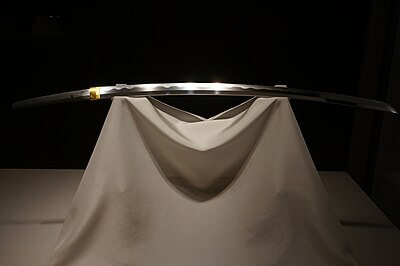


The Genesis of a Master
Gorō Nyūdō Masamune (c. 1264–1343) stands as the zenith of Japanese swordsmithing, a figure whose name is synonymous with unparalleled craftsmanship and artistic vision. Working primarily in Sagami Province during the latter part of the Kamakura period (c. 1288–1328), Masamune honed his skills within the esteemed Sōshū school. His training likely involved absorbing techniques from earlier masters like Saburo Kunimune and Awataguchi Kunitsuna, integrating their knowledge into a unique and revolutionary approach.
While historical records are sparse, the consensus among experts places his most prolific period between 1288 and 1328. The debate surrounding his family name, Okazaki, and its potential fabrication to bolster the Tokugawa family's prestige, highlights the mythic status Masamune achieved, blurring the lines between historical fact and cultural legend. His creations, originally tachi and tantō, were later often transformed into katana through 'suriage' (shortening of the tang), meaning all surviving extant works are typically classified as katana, tantō, or wakizashi.
The Sōshū Style
Masamune's mastery was intrinsically linked to the Sōshū school, which he significantly shaped and elevated. This style is characterized by its robust construction, exceptional balance, and striking aesthetic qualities, particularly its distinctive hamon. The hamon, a visible temper line, is not merely decorative; it is the result of precise differential hardening, where the edge is hardened more than the spine.
Masamune's hamon often featured intricate patterns like 'nie' (fine crystalline structures) and 'nioi' (cloud-like formations), creating a dynamic, almost living surface. This complex interplay of metallurgy and artistry resulted in blades that were not only formidable weapons but also objects of profound beauty, embodying the samurai ideal of martial prowess fused with refined culture. The meticulous folding and forging techniques he employed created a layered steel structure, contributing to both the blade's resilience and its characteristic grain patterns, known as 'hada'.
Enduring Significance
The lasting impact of Masamune's work extends far beyond his lifetime. His swords are considered national treasures in Japan, representing the pinnacle of traditional craftsmanship. The very name 'Masamune' has become a byword for quality and authenticity in the world of Japanese swords.
This reverence is formally recognized through the 'Masamune Prize,' awarded at the Japanese Sword Making Competition to smiths who produce exceptional works, thereby perpetuating his legacy and setting a high standard for contemporary artisans. The prize serves as a tangible link between the historical master and modern practitioners, encouraging the continuation of meticulous techniques and artistic innovation. His influence is so profound that even debated attributions are highly valued, underscoring the cultural weight his name carries.
The Transmission of Genius
Masamune's legacy was not confined to his individual creations; it was actively propagated through his lineage. His son, Hikoshiro Sadamune, emerged as a distinguished swordsmith in his own right, carrying forward the Sōshū tradition. This familial transmission of skill and artistic philosophy is a crucial aspect of understanding Masamune's enduring influence.
It suggests a deliberate cultivation of talent and a deep commitment to preserving and advancing the art of swordsmithing. The success of Sadamune validates Masamune's teaching methods and the inherent strength of the Sōshū school's principles. The continued existence and admiration of swords made by both father and son underscore the robustness of this artistic dynasty and its significant contribution to Japanese cultural heritage.
Masamune in Modern Discourse
In contemporary times, Masamune continues to capture imaginations, transcending historical and cultural boundaries. His name and creations are frequently referenced in literature, film, and video games, often portraying his swords as legendary artifacts with extraordinary powers. This popularization, while sometimes fictionalized, speaks to the enduring mystique and perceived perfection associated with his work.
Academically, Masamune remains a subject of intense study, with ongoing research into his techniques, the provenance of his blades, and his historical context. The meticulous analysis of his swords, including their metallurgical composition and stylistic evolution, contributes to a deeper understanding of medieval Japanese craftsmanship. The ongoing fascination with Masamune highlights his status not just as a historical figure but as a persistent cultural icon whose artistry continues to inspire awe and respect.
See also
Frequently Asked Questions
Who was Masamune?+
What made Masamune's swords so special?+
Where did Masamune make his swords?+
What is the Masamune Prize?+
Did Masamune’s family also make swords?+
Based on content from Wikipedia · Licensed under CC BY-SA 4.0