

Martin Luther King Jr.
Images

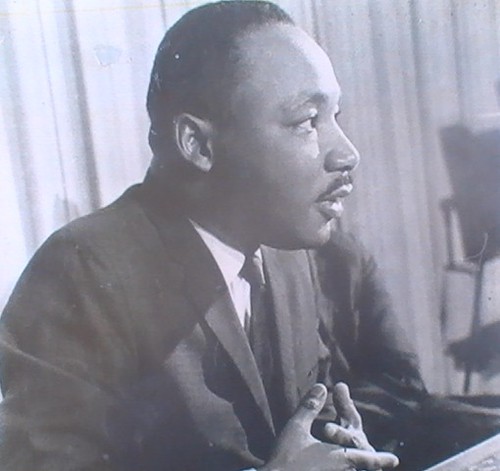
No Known Restrictions: Martin Luther King Press Conference by Marion S. Trikosko, March 26, 1964 (LOC)




The Genesis of a Movement Leader
Martin Luther King Jr.'s emergence as a national figure was not accidental but the result of deep intellectual engagement, spiritual conviction, and a keen understanding of social dynamics. Born into a lineage of pastors, he inherited a tradition of community leadership and oratory. His theological studies provided a framework for his activism, emphasizing love, justice, and the inherent dignity of all human beings.
Witnessing the systemic oppression of African Americans in the Jim Crow South profoundly shaped his worldview. He recognized that the existing legal and social structures perpetuated inequality and that a radical challenge was necessary. His early involvement in the Montgomery Bus Boycott in 1955, sparked by Rosa Parks' courageous act, catapulted him to national prominence, demonstrating his capacity for strategic leadership and his unwavering commitment to nonviolent direct action as a means of social change.
Strategic Nonviolence and Mass Mobilization
King's philosophy of nonviolent resistance was a deliberate and sophisticated strategy, deeply influenced by Gandhi's principles. He understood that confronting violence with violence would only perpetuate the cycle of oppression and alienate potential allies. Instead, he advocated for civil disobedience, boycotts, sit-ins, and marches as powerful tools to expose injustice and create moral pressure.
The Southern Christian Leadership Conference (SCLC), which he co-founded, became a crucial organization for coordinating these efforts across the South. King's ability to mobilize diverse groups of people, from students to clergy, and to articulate their grievances in a compelling manner was central to the movement's success. The Birmingham campaign in 1963, with its dramatic confrontations and King's subsequent arrest and powerful 'Letter from Birmingham Jail,' significantly galvanized national support for civil rights legislation.
The Oratorical Powerhouse
Martin Luther King Jr. possessed an extraordinary gift for oratory, transforming abstract ideals into tangible visions that inspired millions. His speeches were not merely rhetorical flourishes; they were carefully crafted arguments that appealed to both reason and emotion, drawing upon biblical imagery, American democratic ideals, and personal narrative. The 'I Have a Dream' speech, delivered on August 28, 1963, at the March on Washington, stands as a pinnacle of American public address.
Its enduring power lies in its eloquent articulation of the nation's unfulfilled promise of equality and its hopeful projection of a future free from racial division. This speech, broadcast nationally, became a defining moment, solidifying King's place in history and accelerating the push for federal civil rights legislation.
Legislative Triumphs and Enduring Influence
The sustained pressure generated by the Civil Rights Movement, spearheaded by King and numerous other activists, led to landmark legislative achievements. The Civil Rights Act of 1964 outlawed segregation and discrimination in public accommodations and employment, while the Voting Rights Act of 1965 dismantled barriers that had disenfranchised Black voters for decades. These were monumental victories that fundamentally reshaped American society.
Despite facing constant threats and ultimately assassination on April 4, 1968, King's legacy transcends these legislative successes. His unwavering commitment to justice, his philosophy of nonviolent resistance, and his powerful dream continue to inspire contemporary social justice movements worldwide, serving as a constant reminder of the ongoing struggle for equality and human rights.
Beyond the Movement
While primarily celebrated for his role in the Civil Rights Movement, King's vision extended beyond racial equality to encompass broader issues of economic justice and peace. In his later years, he began to address poverty more directly, recognizing its interconnectedness with racial discrimination. His 'Poor People's Campaign' aimed to unite people from all racial backgrounds to demand economic opportunity.
Furthermore, he became an increasingly vocal critic of the Vietnam War, linking the struggle for civil rights at home with the pursuit of peace abroad. This expansion of his focus, though controversial at the time, demonstrated a deepening commitment to a holistic vision of justice and human dignity, cementing his status as a profound moral and political thinker whose ideas remain relevant in addressing contemporary global challenges.
See also
Based on content from Wikipedia · Licensed under CC BY-SA 4.0