

Lockheed F-117 Nighthawk
Images
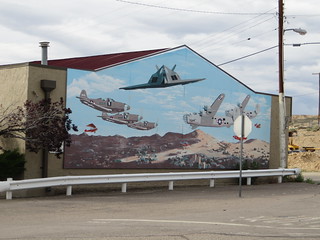
Mural with Stealth Fighter, Tonopah, Nevada


Conceiving the Unseen
The genesis of the Lockheed F-117 Nighthawk lies in the escalating sophistication of Soviet air defense systems during the Cold War. Recognizing the vulnerability of conventional aircraft, the Defense Advanced Research Projects Agency (DARPA) initiated research into low-observable technology. This led to the 'Have Blue' program, a crucial technology demonstrator that validated the theoretical principles of radar evasion through shaping.
In 1978, Lockheed was awarded the contract to develop this concept into a fully operational aircraft, codenamed 'Senior Trend,' which would become the F-117. The development was shrouded in extreme secrecy, conducted by Lockheed's legendary 'Skunk Works' division. The first prototype achieved its maiden flight in 1981 at Groom Lake, Nevada, a location synonymous with clandestine aerospace projects.
The initial operational capability was declared in October 1983, with all aircraft based at the remote Tonopah Test Range Airport. The F-117's existence was so secret that for years, the United States Air Force officially denied its operational status, a testament to the program's black project nature.
The Geometry of Evasion
The F-117's stealth capabilities are a direct result of its radical, faceted design. Unlike traditional aircraft with smooth, aerodynamic curves, the F-117 is composed of numerous flat, two-dimensional surfaces angled to deflect radar waves away from the source. This unique geometry significantly reduces its radar cross-section (RCS) to an astonishing 0.001 square meters, making it appear on radar as small as a bird or even less.
Minimizing its infrared signature was equally critical. The aircraft lacks afterburners, and its engine exhaust is carefully managed through non-circular nozzles that mix hot exhaust gases with cooler ambient air. This, combined with its subsonic speed limitation, prevents the formation of a sonic boom and reduces its thermal footprint.
Aerodynamically, the F-117 is inherently unstable, requiring a sophisticated fly-by-wire flight control system to maintain stable flight. This complex system constantly makes minute adjustments, ensuring controlled flight despite the aircraft's unconventional design.
From Classified Asset to Combat Proven
The F-117 Nighthawk's operational debut was in 1989 during the U.S. invasion of Panama, marking the first time a stealth aircraft was used in combat. However, its capabilities were truly showcased during the Gulf War in 1991. The F-117 flew approximately 1,300 sorties, achieving a remarkable success rate in striking high-value Iraqi targets, including command centers and air defense sites, with precision.
Its ability to penetrate heavily defended airspace undetected was a strategic advantage. The aircraft also participated in conflicts in Yugoslavia, where one was famously shot down by a surface-to-air missile (SAM) in 1999, highlighting the evolving nature of air defense. It continued to serve in Operations Enduring Freedom and Iraqi Freedom before its official retirement by the USAF in 2008, largely superseded by more advanced stealth platforms like the F-22 Raptor.
Despite its retirement from combat, a portion of the F-117 fleet has been maintained in airworthy condition for specialized testing and training roles.
Redefining Air Combat
The F-117 Nighthawk was not designed as an air superiority fighter but as a dedicated precision strike platform. Its performance in air combat maneuvering was deliberately secondary to its stealth and attack capabilities. Equipped with advanced digital navigation and attack systems, including thermal imaging and laser designators, it could accurately deliver ordnance day or night.
The F-117's existence and operational success fundamentally altered military doctrine, proving the viability and strategic advantage of stealth technology. It forced adversaries to rethink their air defense strategies and spurred the development of countermeasures. Its legacy extends beyond its operational service; it served as a crucial stepping stone, paving the way for subsequent generations of stealth aircraft and influencing the design philosophy of modern military aviation.
The F-117 remains an iconic symbol of innovation and a testament to the power of clandestine research and development in shaping the future of warfare.
See also
Frequently Asked Questions
What is the Lockheed F-117 Nighthawk?+
How does the F-117 hide from radar?+
When did the F-117 first fly?+
Did the F-117 ever fly in battle?+
Why was the F-117 retired?+
Based on content from Wikipedia · Licensed under CC BY-SA 4.0