

Kenpo
Images

Empty hands kenpo salut


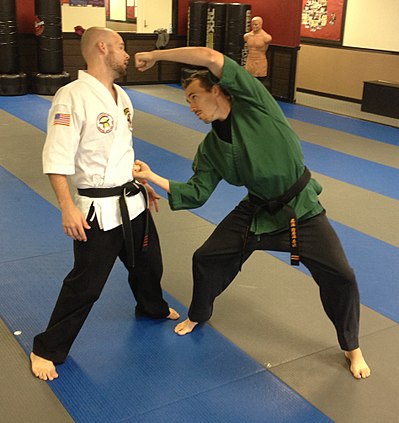


The Genesis of Kenpo
Kenpo, as a distinct martial art system, emerged not from ancient traditions but from the innovative mind of William K.S. Chow in mid-20th century Hawaii. Chow, a student of various martial arts including Chinese Kenpo, recognized the need for a system that was both highly effective for self-defense and adaptable to modern contexts.
He meticulously studied and synthesized techniques from diverse origins, including Karate, Kung Fu, and Judo, to create a cohesive and dynamic art. This process involved not just borrowing techniques but understanding their underlying principles and integrating them into a logical framework. The result was a system that prioritized efficiency, speed, and practicality, moving away from purely ritualistic or overly complex movements.
Kenpo's development in Hawaii, a crossroads of cultures, mirrors its own fusion of global martial arts influences, making it a unique product of its time and place. This deliberate construction by Chow laid the foundation for what would become a globally recognized martial art.
The Mechanics of Motion
The distinctive characteristic of Kenpo lies in its sophisticated approach to movement and power generation. It masterfully blends linear and circular motions, allowing for seamless transitions between offensive and defensive actions. Linear movements, such as direct punches and thrusts, are designed for speed and penetration, aiming to strike an opponent quickly and decisively.
Complementing these are circular movements, which are used for evasion, redirection of force, and setting up subsequent linear attacks. This interplay creates a fluid, unpredictable, and highly effective fighting style. Kenpo also emphasizes the concept of 'mass' and 'momentum' transfer, where power is generated from the ground up, channeled through the core, and delivered through the extremities.
Techniques are often executed in rapid succession, forming 'combinations' that can overwhelm an opponent's defenses. The system's focus on anatomical striking points and leverage further enhances its practical application in real-world self-defense scenarios, making it a scientifically approached martial art.
Beyond Combat
While Kenpo is renowned for its combat effectiveness, its philosophy extends far beyond mere physical confrontation. The practice instills a profound sense of discipline, respect, and self-awareness. Students are taught to cultivate mental fortitude, learning to remain calm and focused under pressure, a skill transferable to all aspects of life.
The rigorous training regimen demands perseverance and dedication, fostering resilience and a strong work ethic. Kenpo also emphasizes the importance of ethical conduct and self-control, promoting the idea that martial arts should be used only for self-protection and the defense of others. This holistic approach aims to develop well-rounded individuals who are not only physically capable but also mentally sharp, emotionally balanced, and morally upright.
The journey through Kenpo is as much about self-discovery and personal growth as it is about mastering martial techniques.
The Evolution and Global Reach of Kenpo
Since its inception, Kenpo has evolved and diversified, leading to various distinct styles, such as American Kenpo Karate, Kenpo Jiu-Jitsu, and Tracy Kenpo. These variations, while sharing core principles, often incorporate unique training methodologies and philosophical nuances. The art's practical nature and adaptability have contributed to its widespread popularity, with dojos established across continents.
Kenpo practitioners engage in a range of activities, from traditional forms practice and self-defense drills to competitive sparring and even demonstrations. The art continues to be a relevant and dynamic force in the martial arts world, attracting individuals seeking effective self-defense, physical conditioning, and personal development. Its ongoing adaptation ensures its continued relevance in contemporary society, reflecting its founders' vision of a practical and evolving martial art.
See also
Frequently Asked Questions
What is Kenpo?+
Why did William K.S. Chow create Kenpo?+
How do Kenpo moves use linear and circular motions?+
What are the benefits of practicing Kenpo?+
What are some different styles of Kenpo?+
Based on content from Wikipedia · Licensed under CC BY-SA 4.0