

Japanese Giant Salamander
Images

Japanese Giant Salamander Exhibit




Morphology and Evolutionary Significance
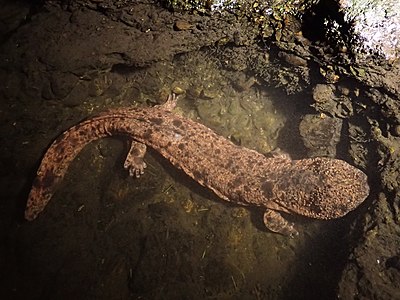
The Japanese giant salamander (Andrias japonicus) is a remarkable example of evolutionary persistence. As the third-largest living amphibian, surpassed only by its close relatives, the Chinese giant salamander (Andrias davidianus) and the South China giant salamander (Andrias sligoi), it represents a lineage that has survived for millions of years. Its morphology is characterized by a flattened body, a broad, rounded head, and a powerful, paddle-like tail, adaptations for a fully aquatic lifestyle.
The skin is loose and wrinkled, aiding in cutaneous respiration and providing camouflage against the riverbed. Its small, lidless eyes are positioned dorsally, allowing it to survey its surroundings while remaining mostly submerged. The species' scientific name, Andrias japonicus, reflects its genus and its endemic status to Japan.
Its existence provides invaluable insights into the evolutionary history of salamanders and the broader amphibian class, offering a living window into ancient ecosystems.
Geographic Distribution and Habitat Specificity
Andrias japonicus is endemic to Japan, primarily inhabiting the western regions of Honshu, Japan's largest island. Smaller, fragmented populations are also found on Shikoku and northern Kyushu. This species exhibits a strong preference for clean, cold, fast-flowing rivers and streams with abundant rocky substrates and deep pools.
These specific habitat requirements are crucial for their survival, providing essential shelter from predators and strong currents, as well as suitable breeding grounds. The clarity and oxygenation of the water are critical indicators of habitat health, making these salamanders highly sensitive to environmental changes. Their restricted distribution and specialized habitat needs make them particularly vulnerable to anthropogenic impacts such as dam construction, water pollution, and habitat fragmentation, which have led to significant population declines.
Ecological Role and Conservation Imperatives
As apex predators within their aquatic environments, Japanese giant salamanders play a critical role in regulating populations of fish, aquatic insects, and other invertebrates. Their presence is a bioindicator of healthy river ecosystems. The designation of Andrias japonicus as a Special Natural Monument in 1951 underscores its cultural and ecological significance in Japan.
However, despite this protection, the species faces severe threats. Habitat degradation, including river channelization and the construction of hydroelectric dams, has reduced and fragmented their living spaces. Pollution from agricultural runoff and industrial waste further compromises water quality.
Introduced species, such as the American bullfrog, can compete for resources or prey on young salamanders. Effective conservation strategies must address these multifaceted threats through habitat restoration, pollution control, management of invasive species, and continued public education to foster a sense of stewardship for this irreplaceable natural heritage.
Historical Context and Scientific Exploration
The scientific understanding of the Japanese giant salamander began in earnest in the early 19th century. Philipp Franz von Siebold, a German physician and naturalist serving the Dutch East India Company, played a pivotal role. Stationed at Dejima, the Dutch trading post in Nagasaki, Siebold collected numerous specimens of Japanese flora and fauna, including an individual of Andrias japonicus.
This specimen was transported to Leiden, Netherlands, in the 1820s, where it was formally described and cataloged by European scientists. This marked the initial introduction of the species to Western science. The Japanese name, 'ōsanshōuo' (オオサンショウウオ), literally translating to 'giant salamander,' highlights its imposing presence in local folklore and natural history long before its international recognition.
The ongoing study of this species continues to inform our understanding of amphibian biology and the unique biodiversity of Japan.
See also
Frequently Asked Questions
What is the Japanese giant salamander?+
Where does it live?+
Why is it important to rivers?+
Why is it endangered?+
How can we help protect it?+
Based on content from Wikipedia · Licensed under CC BY-SA 4.0