

Hosni Mubarak
Images

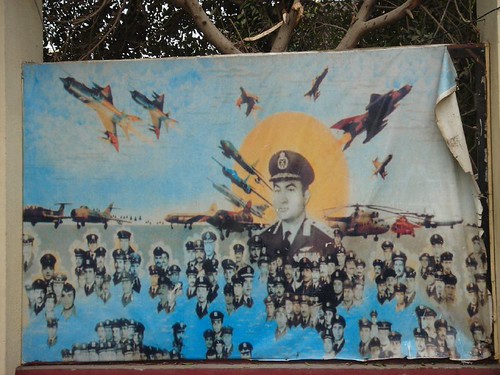
Mohammed Hosni Mubarak painted portrait _DDC3034




Military Career and Rise to Power
Born on May 4, 1928, in Kafr El-Meselha, Egypt, Muhammad Hosni El Sayed Mubarak began his path to national leadership through the military. After leaving the Military Academy in 1949, he joined the Air Force Academy, earning a commission as a pilot officer in 1950. His career was marked by extensive training, including specialized instruction in the Soviet Union, where he mastered jet bombers like the Ilyushin Il-28 and Tupolev Tu-16.
By 1972, he had risen to become the Commander of the Egyptian Air Force. During the 1973 Yom Kippur War, Mubarak gained significant national acclaim for his leadership during the surprise attack on the Suez Canal. This military prestige served as a springboard for his political career.
In 1975, President Anwar Sadat appointed him as Vice President. In this role, Mubarak became a key figure in government, participating in sensitive negotiations and representing Egypt on the world stage. Following the assassination of President Sadat in 1981, Mubarak assumed the presidency, beginning a tenure that would last for nearly thirty years.
Presidency and Foreign Policy
Mubarak’s presidency was defined by a complex balance of regional diplomacy and international alliances. One of his most significant achievements was the reinstatement of Egypt’s membership in the Arab League in 1989, which had been suspended following the 1979 Camp David Accords. By moving the league's headquarters back to Cairo, Mubarak re-established Egypt as a central power in the Arab world.
His foreign policy was characterized by a pragmatic approach; he maintained the peace treaty with Israel while simultaneously acting as a mediator in the Israeli-Palestinian conflict. During the 1991 Gulf War, Mubarak solidified Egypt’s international standing by joining the allied coalition to remove Iraqi forces from Kuwait, a move that resulted in significant debt forgiveness for Egypt. Despite his diplomatic efforts, his relationship with the United States and other Western powers was often complicated by his government's internal policies and his cautious approach to regional conflicts, including his opposition to the 2003 invasion of Iraq.
Domestic Governance and Security
Domestically, Mubarak’s administration focused on economic development and the expansion of state services, including housing, medicine, and clothing production. However, his governance was heavily influenced by his military background and a deep-seated concern for national security. Having witnessed the assassination of his predecessor, Mubarak expanded the state security apparatus, including the State Security Investigations Service.
Throughout his tenure, he maintained a continuous state of emergency, which granted security forces broad powers. While supporters pointed to the stability and economic growth achieved during his rule, critics and human rights organizations raised serious concerns regarding the use of detention, the suppression of political opposition, and reports of systemic abuse by security services. Mubarak’s political control was further reinforced through a series of single-candidate referendums, though he eventually held the country's first multi-party election in 2005 under pressure from the United States.
The 2011 Revolution and Legal Challenges
The political landscape shifted dramatically in early 2011 during the Egyptian revolution. Following 18 days of widespread demonstrations, Mubarak resigned on February 11, 2011, transferring power to the Supreme Council of the Armed Forces. This event marked the end of his thirty-year rule.
In the aftermath, Mubarak faced unprecedented legal challenges. He became the first Arab leader to be tried in his own country in an ordinary court of law, facing charges related to the deaths of protesters during the revolution. His legal journey was lengthy and complex, involving multiple trials, a life sentence in 2012, and a subsequent overturning of that sentence by the Court of Cassation.
In 2015, he and his sons were convicted on corruption charges, but he was eventually acquitted of the most serious charges by the Court of Cassation in 2017 and released from detention.
Legacy and Final Years
Following his release in 2017, Mubarak lived a relatively private life until his death on February 25, 2020, at the age of 91. He was honored with a military funeral and buried in a family plot outside of Cairo. His legacy remains a subject of significant historical analysis.
As the longest-serving Egyptian ruler since Muhammad Ali Pasha, his influence on the nation’s political, military, and social structures was profound. Historians often debate the balance between the stability he provided during his long presidency and the systemic issues that eventually led to the 2011 revolution. His life serves as a case study in the complexities of leadership, the evolution of modern Middle Eastern politics, and the challenges of maintaining power in a rapidly changing global environment.
As of October 2026, his tenure continues to be a primary reference point for understanding the trajectory of 20th and 21st-century Egyptian history.
Go deeper
Based on content from Wikipedia · Licensed under CC BY-SA 4.0