

Helena of Constantinople
Images

Statue of Helena of Constantinople detail




The Rise of Helena
Helena's origins are debated, but she is widely believed to have been born in the Roman province of Bithynia, possibly in the town of Drepanum, around 250 AD. Her social standing in her early life is unclear, with some sources suggesting a humble background, perhaps as an innkeeper's daughter, while others point to a more established, though not aristocratic, family. She married Constantius Chlorus, a Roman officer who would eventually become Emperor Constantius I.
Their union produced Constantine the Great, a figure who would fundamentally alter the course of Roman and Christian history. Helena's role as the mother of such a pivotal emperor elevated her status within the empire.
When Constantius I died in 306 AD, Constantine succeeded him. He demonstrated immense respect and affection for his mother, bestowing upon her the title of Augusta, the highest honor for an imperial woman, effectively making her an Empress. This was not merely a symbolic gesture; Constantine relied on Helena's counsel and entrusted her with significant responsibilities.
Her position as Augusta during Constantine's reign, particularly as he navigated the complex religious and political landscape of the early 4th century, made her a powerful and influential figure, a matriarch whose presence lent legitimacy and gravitas to the imperial court.
The Imperial Pilgrimage
In her later years, likely in her 70s, Helena embarked on a monumental pilgrimage to the Holy Land, a journey that would have profound and lasting consequences for Christianity. This was not a solitary venture but a grand imperial expedition, supported by her son, Emperor Constantine, who had famously legalized and later embraced Christianity. Helena's primary objective was to locate and venerate significant Christian relics, most notably the True Cross, believed to be the instrument of Christ's crucifixion.
This pilgrimage was a landmark event in the development of Christian sacred geography. Helena's presence and patronage in the Holy Land led to the identification and development of key biblical sites. Under her direction, significant churches were commissioned and built, including the Church of the Holy Sepulchre in Jerusalem, marking the traditional site of Christ's crucifixion and burial, and the Church of the Nativity in Bethlehem, marking his birthplace.
These basilicas became major centers of Christian worship and pilgrimage, solidifying the Holy Land's status as the spiritual heart of Christendom and influencing the devotional practices of Christians for centuries to come.
The Discovery of the True Cross
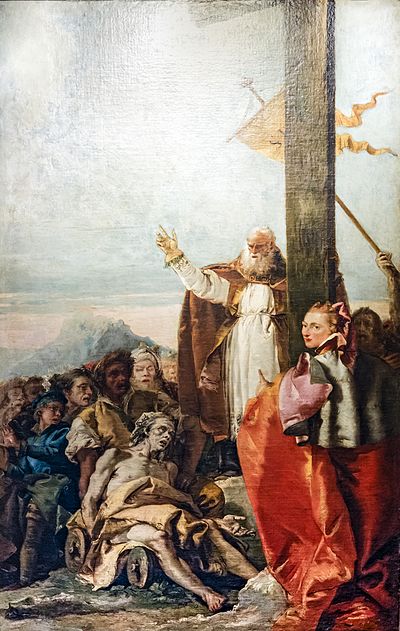
The quest for the True Cross is one of the most celebrated episodes of Helena's life. Tradition holds that upon arriving in Jerusalem, Helena's team undertook extensive excavations, reportedly at the site of Golgotha. They unearthed a tomb and discovered three crosses. The challenge then became identifying which of the three was the True Cross.
According to the most popular accounts, a miraculous test was employed: a seriously ill woman was brought into the presence of each cross, and upon contact with the True Cross, she was instantly cured.
This discovery was of immense theological and cultural significance. The True Cross became the most revered relic in Christendom, a tangible link to the central event of Christian salvation. Helena ensured that portions of the relic were enshrined in Jerusalem and sent back to Rome, where they were housed in the Basilica of the Holy Cross of Jerusalem.
The veneration of the True Cross spurred the broader practice of relic veneration, deeply embedding it into Christian devotion and art. Helena's role in this discovery cemented her status as a saint and a pivotal figure in the history of Christian faith and practice.
Helena's Enduring Legacy
Helena's influence extends far beyond her role as the mother of Constantine or her famous pilgrimage. She is remembered as a devout Christian whose personal piety and charitable endeavors profoundly impacted the early Church. Her patronage of religious sites and her role in promoting Christian veneration of relics helped to shape the religious identity and practices of the burgeoning Christian empire.
She is recognized as a saint in both the Roman Catholic and Eastern Orthodox traditions, celebrated for her faith, her compassion, and her significant contributions to Christianity.
Her legacy is a complex tapestry woven from her imperial status, her deep personal faith, and her monumental discoveries. She represents a crucial link between the Roman imperial world and the Christianization of Europe. Helena's life story serves as a powerful testament to the impact an individual, particularly a woman of influence, could have on shaping religious and cultural landscapes, leaving an indelible mark on history that continues to resonate today.
See also
Frequently Asked Questions
Who was Helena of Constantinople?+
Where was Helena born?+
Why did Helena go on a pilgrimage to the Holy Land?+
How did Helena find the True Cross?+
What churches did Helena help build?+
Based on content from Wikipedia · Licensed under CC BY-SA 4.0