

George Washington Bridge
Images

George Washington Bridge Construction circa 1930, 1 of 2




Conception and Construction
The genesis of the George Washington Bridge lies in the early 20th century's burgeoning demand for trans-Hudson River crossings. Proposed in 1906, the ambitious project faced decades of planning and political negotiation before New York and New Jersey legislatures authorized its construction in 1925. Groundbreaking occurred in September 1927, initiating a four-year construction period that culminated in its ceremonial dedication on October 24, 1931, and opening to traffic the following day.
Designed by O.H. Ammann, the bridge was a marvel of its time, boasting the longest main span in the world upon its completion, a record it held until 1937. Its construction spurred significant development in Bergen County, New Jersey, transforming Fort Lee into a vital gateway.
The World's Busiest Bridge
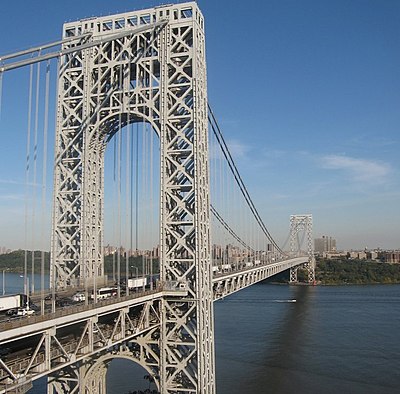
The George Washington Bridge holds the distinction of being the world's busiest motor vehicle bridge, a title earned through its immense capacity and strategic importance. In 2019 alone, it facilitated over 104 million vehicle crossings. This staggering volume is managed by its unique double-deck design, featuring a total of 14 vehicular lanes – eight on the upper level and six on the lower.
This makes it the only suspension bridge globally with such a high number of traffic lanes. The bridge's ability to adapt is evident in its history; the upper deck was widened from six to eight lanes in 1946, and the entire six-lane lower deck was constructed beneath the original span between 1959 and 1962 to accommodate escalating traffic demands.
A Multifaceted Transportation Hub
While its primary function is vehicular transport, the George Washington Bridge serves as a multifaceted transportation hub. It is a critical artery for major highways, including Interstate 95 (I-95) and U.S. Routes 1/9, connecting the Northeast corridor.
Furthermore, the upper deck accommodates pedestrian and bicycle traffic, offering scenic views and a recreational pathway. The bridge's eastern terminus integrates seamlessly with the Trans-Manhattan Expressway, linking to other major expressways. Its ownership by the Port Authority of New York and New Jersey underscores its role in regional planning and economic vitality, facilitating the movement of goods and people essential for the metropolitan area's functioning.
Engineering Prowess and Enduring Legacy
The George Washington Bridge stands as a testament to 20th-century engineering ambition and ingenuity. Its construction involved innovative techniques for its era, particularly in the design and erection of its massive towers and the intricate suspension system. The bridge's aesthetic, characterized by its clean lines and imposing towers, has made it an iconic landmark.
Its continuous adaptation, from widening the upper deck to adding the lower deck, highlights a proactive approach to infrastructure management in response to evolving transportation needs. The bridge's enduring legacy is not just in its structural achievements but in its indispensable role as an economic engine and a symbol of connectivity for millions.
See also
Frequently Asked Questions
What is the George Washington Bridge?+
How many cars cross the bridge each year?+
Why does the bridge have two decks?+
Where does the bridge go?+
When was the bridge built?+
Based on content from Wikipedia · Licensed under CC BY-SA 4.0