

Suspension bridge
Images

Suspension Bridge from Leigh Woods


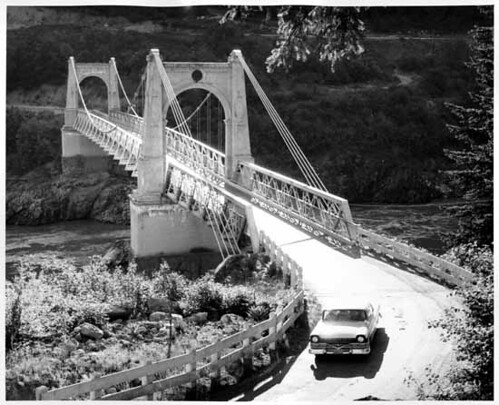
The Anatomy of a Span
Suspension bridges represent a pinnacle of structural engineering, characterized by their ability to achieve extraordinary spans. The fundamental principle involves supporting the bridge deck not from below, but from above, via a network of high-strength cables. Two primary components are essential: the main suspension cables and the vertical suspender cables, also known as hangers.
The main cables, typically made of thousands of steel wires bundled together, are draped over tall towers and anchored securely at each end of the bridge. These anchors are massive structures, often embedded deep within the bedrock, designed to withstand the immense tensile forces generated by the bridge's load. The deck, which carries traffic, is then suspended from these main cables by the vertical suspenders.
This arrangement allows the deck to be relatively light and flexible. The towers act primarily as compression members, transferring the tension from the main cables to the ground. This system efficiently converts the dead load (the weight of the bridge itself) and live load (traffic) into tension in the main cables and compression in the towers, enabling spans that are unachievable with other bridge types.
The upward curvature of the main cables is critical, as it allows the vertical suspenders to effectively transfer the deck's load into tension.
A Legacy of Crossing
The lineage of suspension bridges stretches back millennia, originating with rudimentary structures in mountainous regions. Ancient peoples utilized natural materials like vines and bamboo to create simple suspension bridges, demonstrating an early understanding of tension-based support. These early forms, lacking vertical suspenders, often featured a significant sag in the main ropes, resulting in a challenging, undulating path.
The transition to modern suspension bridges began in the early 19th century with the advent of iron and steel. Engineers like Thomas Telford and John Roebling pioneered the use of wire cables, dramatically increasing the strength and span capabilities. Telford's Menai Suspension Bridge (1826) and Roebling's Brooklyn Bridge (1883) are landmark achievements that showcased the viability and potential of this design.
The development of stronger materials and more sophisticated construction techniques throughout the 20th century led to the construction of increasingly longer and more complex suspension bridges, transforming global transportation networks and becoming iconic symbols of human engineering prowess.
The Physics of Flight
The structural integrity of a suspension bridge is a sophisticated interplay of forces. The primary load-bearing elements are the main suspension cables, which are designed to carry immense tensile stress. When traffic moves across the deck, its weight is distributed to the vertical suspender cables.
Each suspender transmits this load upwards to the main cable at its point of attachment. The main cable, being continuous and draped over the towers, effectively distributes this load along its length. The towers then bear the resultant downward force from the main cables, converting the tension into compression that is transmitted to the foundations.
Crucially, the anchors at each end resist the horizontal pull of the main cables, preventing the towers from being pulled inwards. The aerodynamic design of the deck is also vital, particularly for very long spans, to prevent oscillations caused by wind, which can lead to catastrophic failure, as famously demonstrated by the Tacoma Narrows Bridge collapse. Modern designs incorporate stiffening trusses or box girders within the deck to enhance aerodynamic stability and torsional rigidity.
Societal and Economic Ramifications
Suspension bridges are not merely feats of engineering; they are catalysts for profound societal and economic change. By conquering geographical barriers such as wide rivers, straits, and deep canyons, they unlock new avenues for commerce, communication, and cultural exchange. They facilitate the efficient movement of goods and people, reducing transportation costs and travel times, which in turn stimulates economic growth in previously isolated regions.
The construction of major suspension bridges often becomes a national or regional undertaking, fostering technological innovation and creating employment opportunities. Beyond their practical utility, these structures often achieve iconic status, becoming powerful symbols of a nation's or city's ambition, progress, and identity, drawing tourism and international recognition. Their ability to span vast distances with minimal obstruction also preserves the ecological integrity of waterways and landscapes below, minimizing environmental impact compared to designs requiring extensive in-water piers.
Go deeper
Based on content from Wikipedia · Licensed under CC BY-SA 4.0