

Dominion of India
Images

Hyderabad, Charminar






The Genesis of Sovereignty
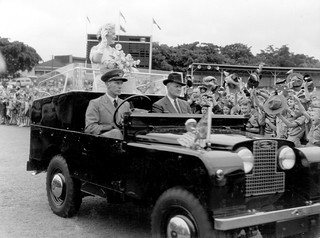
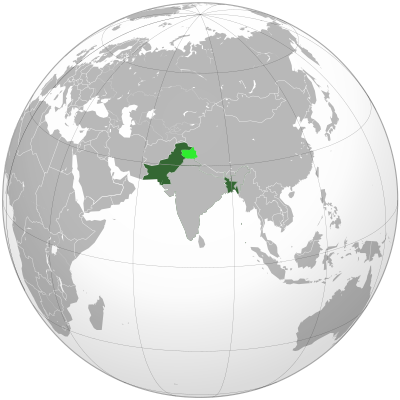
The Dominion of India emerged on August 15, 1947, not as a sudden creation, but as the culmination of a protracted anti-colonial nationalist movement. This transition from the British Raj, an 'informal empire' comprising directly administered territories and princely states under paramountcy, to an independent dominion within the British Commonwealth was a monumental geopolitical shift. The Indian Independence Act of 1947 formalized this, simultaneously creating the Dominion of Pakistan.
The British monarch, previously 'Emperor of India,' relinquished this title, symbolizing the end of imperial authority. While the King remained the nominal head of state, the British government divested all administrative responsibility and dissolved treaty rights with princely states, compelling them to accede to either India or Pakistan. This act of self-determination, however, was immediately shadowed by the immense human cost of the Partition.
Navigating the Aftermath
The birth of the Dominion was tragically marred by widespread religious violence and mass displacement, a direct consequence of the Partition. Between 14 and 18 million people are estimated to have migrated, with over a million lives lost. The nascent government, led by Prime Minister Jawaharlal Nehru and Deputy Prime Minister Vallabhbhai Patel of the Indian National Congress, faced the immediate challenge of restoring order and consolidating the nation. Mahatma Gandhi's non-violent resistance efforts were instrumental in stemming the communal frenzy, though his assassination in January 1948 by Hindu fundamentalists underscored the deep societal divisions.
Patel, in particular, undertook the Herculean task of integrating over 500 princely states into the Indian Union. This complex process, employing diplomacy, economic incentives, and occasionally coercion, was largely successful, though contentious cases like Junagadh, Hyderabad, and especially Kashmir, led to armed conflict and enduring geopolitical disputes with Pakistan.
Laying the Constitutional Foundation
Concurrent with the integration of states and managing post-partition chaos, the Constituent Assembly worked diligently to draft a new constitution for the Republic of India. Drawing inspiration from the Government of India Act 1935, the US Constitution, and the Irish Constitution, the framers aimed to establish a sovereign socialist secular democratic republic. A key objective was to dismantle entrenched social hierarchies; the constitution explicitly abolished untouchability and derecognized caste distinctions, signaling a profound commitment to social justice and equality.
This period also saw the government confronting severe economic challenges, including widespread poverty, with average annual incomes being extremely low. Efforts were initiated to address the low literacy rates and to improve the status of women, laying the groundwork for future legislative reforms like the Hindu Code Bills.
Socio-Economic Realities and the Path to Republic
The Dominion of India inherited a nation grappling with profound socio-economic disparities. The government commissioned studies to document the demographic upheaval and the pervasive poverty. In 1949, the average annual income was estimated at a mere Rs. 260 (equivalent to about $55 USD at the time, or roughly Rs. 28,720 in 2023 terms), with a significant portion of the population earning far less.
Literacy was alarmingly low, with the 1951 census reporting 23.54% for men and a stark 7.62% for women. The government recognized the need for comprehensive development and began formulating policies to uplift marginalized communities and empower women. The Dominion of India served as a crucial transitional phase, a period of intense nation-building and reform, culminating in the adoption of the Constitution and India's transformation into a republic on January 26, 1950, with a President as the head of state.
See also
Frequently Asked Questions
What was the Dominion of India?+
Why did India split into India and Pakistan?+
How did the new government keep the country together?+
What did the constitution do for people?+
What were some problems the new country faced?+
Based on content from Wikipedia · Licensed under CC BY-SA 4.0