

Comet Hale–Bopp
Images

Comet Hale Bopp


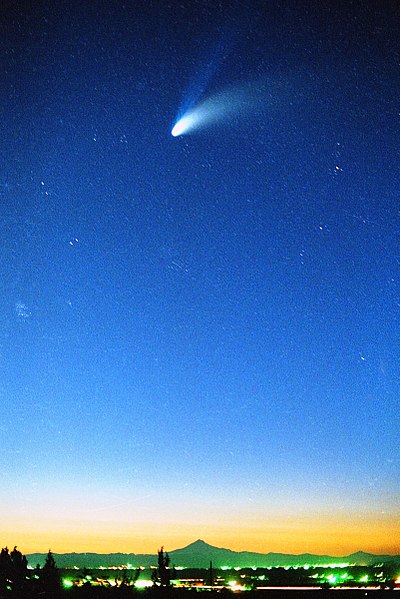

Discovery and Early Observations
Comet Hale–Bopp, designated C/1995 O1, was first independently discovered on July 23, 1995, by two amateur astronomers, Alan Hale and Thomas Bopp. Hale observed it from Cloudcroft, New Mexico, while Bopp spotted it from the desert near San Manuel, Arizona. Their separate observations, made before the comet was visible to the naked eye, marked the beginning of one of the most widely observed cometary events of the 20th century.
The initial discovery was significant because it allowed astronomers ample time to prepare for its close approach to Earth. Unlike many comets whose brightness is difficult to predict, Hale–Bopp's trajectory and composition suggested it would be a spectacular object, a prediction that would be dramatically fulfilled.
The Spectacle of Perihelion
Comet Hale–Bopp reached its perihelion, the closest point to the Sun in its orbit, on April 1, 1997. By this time, it had become an exceptionally bright object, reaching an apparent magnitude of approximately -1.8. This made it easily visible to the naked eye, outshining many stars.
What set Hale–Bopp apart was its unprecedented duration of naked-eye visibility. It remained a prominent object in the night sky for a record-breaking 18 months, significantly longer than the previous record holder, the Great Comet of 1811. This extended period allowed for extensive observation by both professional and amateur astronomers, as well as providing a shared celestial spectacle for the general public worldwide, solidifying its status as the 'Great Comet of 1997'.
Nucleus Size and Composition
The extraordinary brightness and long visibility of Comet Hale–Bopp are attributed to its remarkably large nucleus. Estimates suggest the nucleus was approximately 60 kilometers (37 miles) in diameter, making it one of the largest cometary nuclei ever observed. This massive size meant it contained a vast reservoir of volatile ices and dust.
As it approached the Sun, these materials sublimated, producing extensive coma (the fuzzy atmosphere around the nucleus) and two distinct tails: a dust tail and an ion (or gas) tail. The dust tail, yellowish and curved, consisted of particles reflecting sunlight, while the blue ion tail was composed of gases ionized by solar radiation and pushed away by the solar wind.
Scientific Significance and Legacy
Comet Hale–Bopp provided invaluable scientific data. Its large size and active nature allowed for detailed studies of cometary composition, structure, and dynamics. Observations revealed the presence of various organic molecules, providing insights into the chemical precursors that may have been delivered to early Earth.
Furthermore, the comet's extended observation period facilitated numerous studies, including the detection of new molecules and isotopes, and helped refine our understanding of the Oort Cloud, the distant reservoir from which long-period comets originate. The legacy of Hale–Bopp extends beyond its scientific contributions; it served as a powerful reminder of the dynamic and awe-inspiring nature of our solar system, fostering public interest in astronomy and space exploration.
See also
Frequently Asked Questions
What is Comet Hale–Bopp?+
Why was Comet Hale–Bopp so bright?+
How long could people see Comet Hale–Bopp with their eyes?+
What were the two tails of Comet Hale–Bopp?+
Who discovered Comet Hale–Bopp?+
Based on content from Wikipedia · Licensed under CC BY-SA 4.0