

Comets: Speedy Space Snowballs!
Images

Comet 67P on 26 October (B) - NAVCAM

![Comet 67P on 26 February - NAVCAM [D]](https://live.staticflickr.com/8666/16487619587_cb6ab7a240_n.jpg)


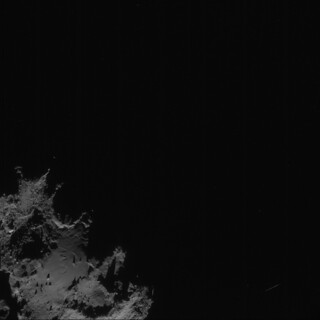


![Comet 67P on 26 February - NAVCAM [B]](https://live.staticflickr.com/8615/16693578441_c8bb85fb02_n.jpg)
The Nature of Comets
Comets are celestial bodies composed of a nucleus, coma, and tail(s). The nucleus, often termed a 'dirty snowball,' is a heterogeneous mixture of ice (water, carbon dioxide, methane, ammonia, etc.), dust, and rocky material. Its size typically ranges from a few hundred meters to tens of kilometers in diameter, with irregular shapes.
Upon approaching the Sun, solar radiation initiates sublimation, transforming the nucleus's ices directly into gas. This process releases trapped dust particles, forming a tenuous atmosphere known as the coma, which can expand to hundreds of thousands of kilometers. The coma is the brightest part of a comet and can be observed from Earth.
The interaction of the solar wind and solar radiation with the coma's gases and dust generates the characteristic tails.
From the Outer Solar System
The vast majority of comets originate from two primary reservoirs in the outer solar system: the Kuiper Belt and the Oort Cloud. The Kuiper Belt, a disc-shaped region extending beyond Neptune, contains numerous icy bodies, including short-period comets with orbital periods of less than 200 years. The Oort Cloud, a hypothetical spherical shell of icy planetesimals, is thought to surround the solar system at distances of up to 50,000-100,000 AU (astronomical units).
Long-period comets, with orbital periods ranging from thousands to millions of years, are believed to originate from the Oort Cloud. Gravitational perturbations, primarily from passing stars or giant molecular clouds, are responsible for dislodging these icy bodies from their distant orbits and sending them on trajectories towards the inner solar system.
The Spectacle of Tails
The iconic tails of comets are a direct consequence of their proximity to the Sun. As a comet approaches the Sun, solar ultraviolet radiation causes the sublimation of volatile ices in the nucleus, releasing gas and dust. This material forms the coma.
Two distinct tails are typically observed: the dust tail and the ion (or gas) tail. The dust tail, composed of solid particles, is generally curved and follows the comet's orbital path, reflecting sunlight and appearing yellowish. The ion tail, consisting of ionized gases, is pushed directly away from the Sun by the solar wind and solar radiation pressure, appearing straight and bluish due to the emission of light by excited ions.
The morphology and length of these tails vary significantly depending on the comet's composition, its distance from the Sun, and solar activity.
Cosmic Archives
Comets serve as invaluable 'time capsules,' preserving material from the primordial solar nebula. Their composition offers direct insights into the chemical and physical conditions that prevailed during the formation of the solar system approximately 4.6 billion years ago. Studying cometary ice, dust, and organic molecules can help scientists understand the building blocks of planets and the potential delivery mechanisms of volatiles, including water, to early Earth.
This has significant implications for astrobiology, as comets may have played a crucial role in seeding the nascent Earth with the necessary ingredients for life. Furthermore, cometary impacts have been hypothesized as a potential source of organic compounds and water on Earth, influencing the planet's habitability and the evolution of life.
Notable Comets and Modern Research
Throughout history, comets have captured human imagination, with notable examples like Halley's Comet, which has been observed for centuries and has a predictable 75-76 year orbit. More recently, comets like Hale-Bopp (1995-1997) and NEOWISE (2020) have provided spectacular displays. Modern astronomical research utilizes advanced telescopes and space missions to study comets in detail.
Missions like Rosetta, which orbited and landed on Comet 67P/Churyumov-Gerasimenko, have provided unprecedented data on cometary composition, structure, and activity. Ongoing research focuses on understanding cometary evolution, their role in the solar system's dynamical history, and their potential contribution to the origins of life.
See also
Frequently Asked Questions
What is a comet made of?+
Why do comets have tails?+
Where do comets come from?+
How do comets help us learn about the early solar system?+
What happens when a comet gets close to the Sun?+
Based on content from Wikipedia · Licensed under CC BY-SA 4.0