

Big Bud 747
Images
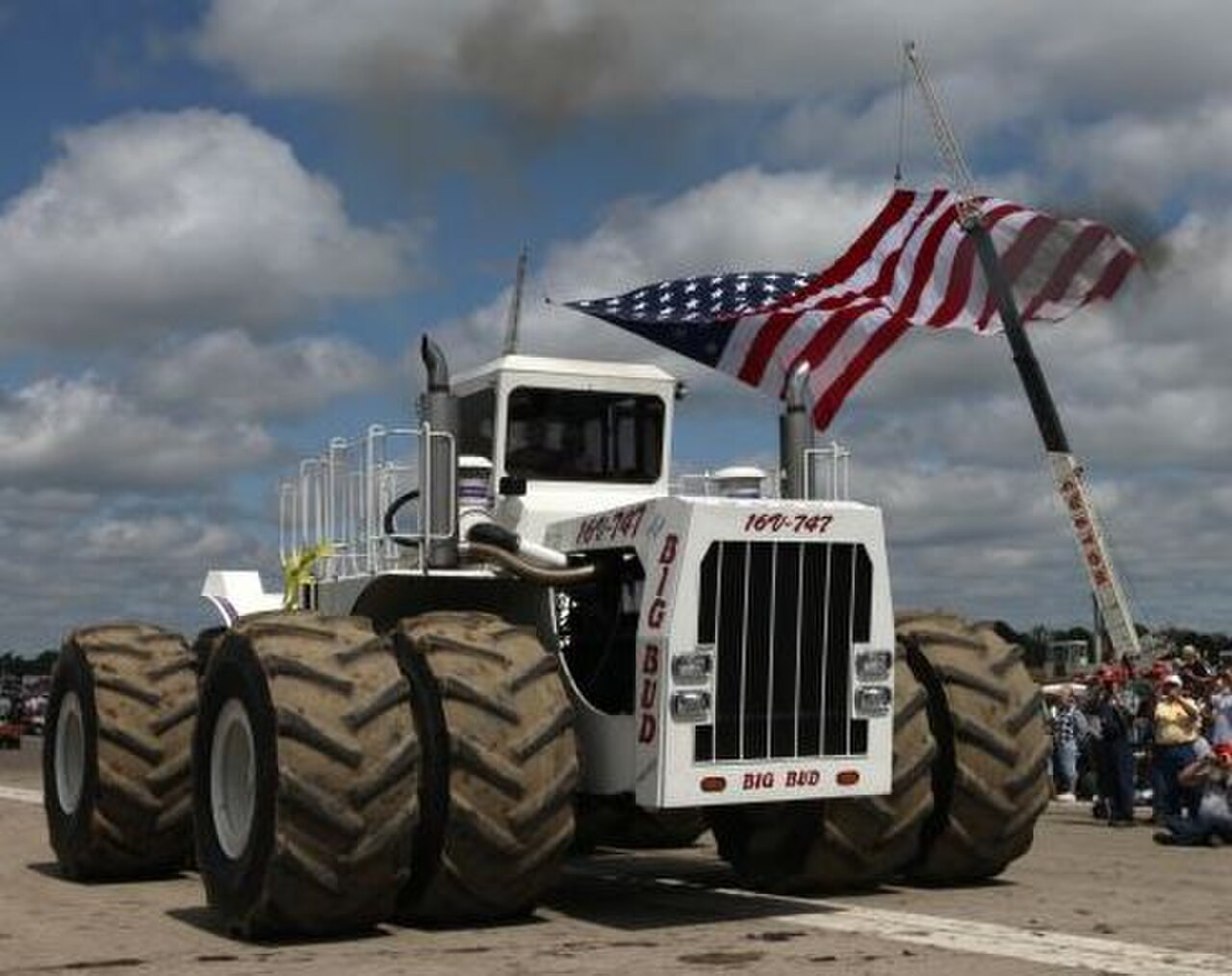
Big Bud 747
Genesis of a Colossus
The Big Bud 747, manufactured in 1977 by the Big Bud Tractor Company in Havre, Montana, stands as a monumental testament to agricultural engineering ambition. Commissioned by a California farmer, the 747 was not merely an incremental improvement; it was a radical departure, designed to redefine the limits of farm machinery. Its creation was driven by the need for unprecedented power and efficiency on vast tracts of land, particularly for deep plowing operations.
The decision to build a tractor of this magnitude was a bold one, requiring custom fabrication and a deep understanding of the stresses and demands placed upon such a colossal machine. The 747's design philosophy centered on raw power, durability, and the capacity to perform tasks far beyond the scope of conventional tractors of the era, solidifying its status as the 'World's Largest Farm Tractor'.
Powerhouse Engineering
At the heart of the Big Bud 747 lies its formidable 1100 horsepower engine, a custom-built powerhouse that dwarfs contemporary agricultural engines. This immense power output is channeled through a robust drivetrain designed to withstand extreme torque. The tractor's articulated chassis, a key feature for maneuverability despite its size, allows it to navigate fields with surprising agility.
Its sheer mass, coupled with the powerful engine, provides the necessary traction for deep tillage operations, enabling it to pull massive implements that would be impossible for smaller machines. The engineering involved in the 747 was not just about scale but about creating a functional, albeit gargantuan, tool capable of performing demanding agricultural tasks efficiently. This focus on brute force and specialized application cemented its reputation as a unique engineering feat.
Beyond the Scale
The Big Bud 747's significance extends beyond its impressive dimensions and horsepower. It represented a peak in the pursuit of mechanization, showcasing the potential for technology to dramatically increase agricultural productivity. For large-scale farming operations, the efficiency gains offered by such a powerful machine could translate into reduced labor costs, faster planting and harvesting cycles, and the ability to cultivate more land.
The 747 became an icon, symbolizing human ingenuity and the relentless drive to overcome the challenges of feeding a growing global population. While its extreme size and cost made it a niche machine, its existence pushed the envelope of what was considered achievable in tractor design, influencing future developments in heavy-duty agricultural equipment and inspiring awe in its sheer capability.
The Big Bud Legacy
The Big Bud 747 is the most famous member of a family of exceptionally large tractors built by the Sherman brothers. These custom-built machines were designed to meet the specific, high-demand needs of large-scale agricultural operations. The 747, in particular, was a bespoke creation for a farmer requiring unparalleled plowing capacity.
While the era of such extreme custom builds for individual farmers has largely passed due to economic factors and advancements in modular, high-horsepower production tractors, the Big Bud legacy endures. These machines continue to be celebrated at tractor shows and agricultural events, serving as tangible links to a period of bold experimentation in farm machinery. Their continued operation and public display underscore their historical importance and their lasting appeal as symbols of power and innovation in agriculture.
See also
Frequently Asked Questions
What is the Big Bud 747?+
Why was the Big Bud 747 built so big?+
How does the Big Bud 747 move around its huge size?+
What happened to tractors like the Big Bud 747 after it was built?+
How did the Big Bud 747 help farmers?+
Based on content from Wikipedia · Licensed under CC BY-SA 4.0