

Baltic Languages: Secret Codes of the North!
Images

English-Official and functional


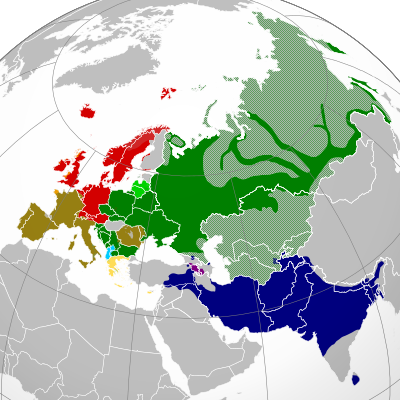


The Genesis and Divergence of Baltic
The Baltic languages represent a unique and relatively conservative branch of the Indo-European language family, forming the Balto-Slavic subgroup alongside the Slavic languages. Their origins trace back to Proto-Baltic, a hypothetical common ancestor whose precise reconstruction is debated but is understood to have diverged from Proto-Indo-European. The Baltic branch itself is typically bifurcated into West Baltic and East Baltic.
West Baltic languages, such as Old Prussian, Yotvingian, and Curonian, are now extinct, with Old Prussian being the best-documented and considered by many scholars to have retained the most Proto-Baltic characteristics. Its extinction in the 18th century marked the end of this linguistic lineage. The East Baltic branch, however, thrives with Lithuanian and Latvian as its primary living representatives.
The status of Latgalian and Samogitian remains a point of discussion, with some classifying them as distinct languages and others as dialects of Latvian and Lithuanian, respectively, highlighting the fluid nature of linguistic boundaries.
Linguistic Conservatism and Innovation
A fascinating aspect of the Baltic languages, particularly Lithuanian, is their remarkable linguistic conservatism. They have retained numerous features of Proto-Indo-European that have been lost in most other branches. This includes complex inflectional systems and archaic phonological features, making them invaluable for historical linguists reconstructing Proto-Indo-European.
For instance, Lithuanian preserves a dual number and a rich system of noun and verb declensions and conjugations. However, this conservatism is balanced by unique innovations that distinguish them from other Indo-European languages. The development of Baltic languages was influenced by their geographical isolation and interactions with neighboring language groups, leading to distinct phonological shifts and lexical developments that differentiate them even from their closest relatives, the Slavic languages.
The Challenge of Mutual Intelligibility
Despite their shared ancestry, modern Lithuanian and Latvian are not mutually intelligible. This lack of mutual understanding is a product of centuries of separate development, influenced by different historical trajectories and external linguistic pressures. For a significant period, the Baltic linguistic area may have extended further east, possibly reaching the Ural Mountains, but this influence waned.
The erosion of mutual intelligibility accelerated as each language developed its own unique innovations and absorbed loanwords from distinct sources. Lithuanian, for example, has significant lexical influence from Polish and German, while Latvian has borrowed from Estonian, German, and Russian. These numerous 'false friends' and differing semantic developments create substantial barriers to comprehension between speakers of the two languages, illustrating how language can diverge even within closely related groups.
Cultural Significance and Modern Relevance
The Baltic languages are more than just communication tools; they are vital carriers of cultural identity and historical memory. Their preservation is a point of national pride for Lithuanians and Latvians. The study of these languages offers profound insights into the history of Eastern Europe, migration patterns, and the evolution of linguistic structures.
In an increasingly globalized world, the continued vitality of Lithuanian and Latvian underscores the importance of linguistic diversity. They serve as living links to ancient European heritage, providing a unique window into the past that written records alone cannot fully capture. Their existence challenges the notion of linguistic convergence and highlights the enduring power of distinct cultural narratives embedded within language.
See also
Frequently Asked Questions
What are Baltic languages?+
Why can Lithuanian and Latvian speakers not easily understand each other?+
Which old Baltic language is the best known today?+
How do Lithuanian and Latvian keep old words from very long ago?+
Are there other Baltic languages besides Lithuanian and Latvian?+
Based on content from Wikipedia · Licensed under CC BY-SA 4.0