

Y-Bridge (Zanesville, Ohio)
Images

Y-Bridge




Geographical Ingenuity
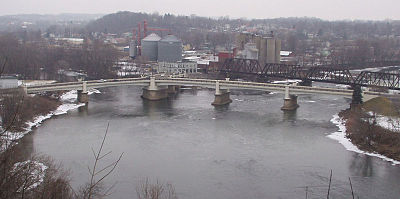
The Y-Bridge in Zanesville, Ohio, is a prime example of how human engineering can adapt to and enhance natural geography. It is strategically situated at the confluence of the Licking and Muskingum Rivers, two significant waterways that shape the local landscape. This meeting point creates a unique topographical condition where a single structure can efficiently serve multiple directional traffic flows.
The bridge's distinctive Y-shape is not merely aesthetic; it is a functional solution to the challenge of crossing both rivers simultaneously from a central point. This design allows it to carry U.S. Route 40, a historic and vital east-west corridor, along with Linden Avenue, thereby integrating disparate parts of the city and facilitating regional connectivity.
The choice of this location underscores the bridge's role as a nexus, connecting not just landmasses but also diverse transportation networks.
A Century of Service
Erected in 1902, the Y-Bridge stands as a testament to early 20th-century civil engineering and urban planning. Its construction marked a significant advancement in Zanesville's infrastructure, replacing an earlier, less efficient bridge. The decision to build a three-way bridge was driven by the need to optimize traffic flow and connectivity at the river confluence, reflecting a growing understanding of the importance of integrated transportation systems.
Over its more than 120-year history, the bridge has witnessed immense societal and technological changes, yet it continues to fulfill its original purpose. Its longevity speaks to the quality of its construction and the enduring relevance of its design in facilitating commerce, commuting, and community interaction within Zanesville and beyond.
Socio-Economic Impact
The Y-Bridge is far more than a piece of infrastructure; it is a fundamental component of Zanesville's socio-economic fabric. As a key artery for U.S. Route 40, it channels significant vehicular traffic, supporting local businesses and the broader regional economy.
Its role in connecting residential areas with commercial centers and employment hubs is critical for the daily lives of Zanesville's inhabitants. Furthermore, its unique architectural form has made it a recognizable landmark, contributing to the city's identity and potentially drawing tourism. The bridge's continued functionality ensures the seamless movement of goods and people, underpinning the economic vitality and social cohesion of the community it serves, demonstrating how a single structure can have such a profound and lasting impact.
Architectural Significance and Engineering Prowess
The Y-Bridge is celebrated for its distinctive architectural form, a rare example of a three-way bridge design. This unconventional shape is a direct response to the specific geographical conditions of the Licking and Muskingum River confluence. The engineering challenge lay in creating a stable and robust structure capable of supporting heavy loads while accommodating three distinct traffic approaches converging at a single point.
The materials and construction techniques employed in 1902 were state-of-the-art for their time, emphasizing durability and functionality. The bridge's enduring presence and operational capacity are a testament to the foresight and skill of its designers and builders, solidifying its status as a significant historical monument and an enduring symbol of Zanesville's innovative spirit in overcoming geographical obstacles.
Modern Relevance and Preservation Challenges
In contemporary times, the Y-Bridge continues to play a vital role in Zanesville's transportation network, despite the evolution of road systems and the advent of newer construction methods. Its historical significance has led to its recognition as a landmark, prompting considerations for its preservation. Maintaining such an aged structure presents ongoing challenges, requiring regular inspections, repairs, and adaptations to meet modern safety standards and traffic demands.
The bridge serves as a tangible link to the past, offering insights into historical transportation solutions. Balancing its historical integrity with the practical needs of a modern city is a continuous effort, highlighting the complex relationship between heritage preservation and functional infrastructure development in urban environments.
See also
Frequently Asked Questions
What is the Y-Bridge in Zanesville, Ohio?+
Why does the Y-Bridge look like a Y?+
How does the Y-Bridge help people in Zanesville?+
When was the Y-Bridge built?+
Where is the Y-Bridge located?+
Based on content from Wikipedia · Licensed under CC BY-SA 4.0