

Wuppertal
Images

List, 2efs and Dijus in Wuppertal




The Wupper Valley's Embrace
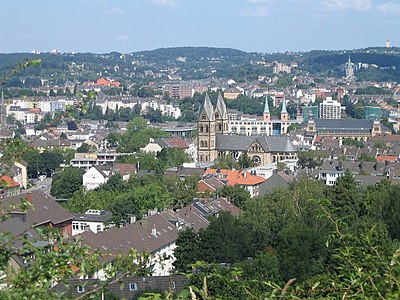
Wuppertal's defining characteristic is its dramatic geography: a long, narrow city dramatically sculpted by the Wupper River. This unique topography, nestled between steep slopes and dense woodlands, shapes the city's urban fabric and its perception of size. The valley setting, historically a challenge for expansion, has fostered a distinctive urban morphology where the city sprawls along the riverbanks.
This geographical constraint has also contributed to Wuppertal's reputation as Germany's greenest city, with an impressive two-thirds of its municipal area dedicated to parks and natural landscapes. The proximity to major urban centers like Cologne, Düsseldorf, and Essen places Wuppertal within a significant economic region, yet its distinct valley environment provides a unique counterpoint to the surrounding industrial heartlands.
Forged in Industry
The genesis of Wuppertal lies in the industrial revolution, specifically in the Wupper Valley's role as one of Germany's earliest centers of heavy industry. The city as it exists today was officially formed in 1929 through the amalgamation of five distinct towns: Elberfeld, Barmen, Ronsdorf, Cronenberg, and Vohwinkel. This strategic merger aimed to consolidate industrial power and administrative efficiency.
Initially named Barmen-Elberfeld, the city adopted its current name in 1930, reflecting its geographical identity. This historical context is crucial for understanding Wuppertal's development, as the demands of its burgeoning textile mills and metalworking industries directly influenced its infrastructure and its connection to vital resources like coal from the nearby Ruhr region.
The Schwebebahn
The Wuppertal Schwebebahn, or suspension railway, stands as a testament to the city's ingenuity in overcoming geographical limitations. Constructed between 1898 and 1903, it was a groundbreaking solution to the challenge of building a public transportation system within the confined Wupper Valley. Unlike conventional railways, the Schwebebahn's carriages are suspended from a single elevated rail, allowing it to traverse the densely built-up areas and the river itself without requiring extensive land acquisition.
This innovative design not only facilitated efficient transport for the industrial workforce but also became an enduring symbol of Wuppertal's forward-thinking spirit. It remains one of the oldest electric suspension railways in the world and continues to be a vital part of the city's public transport network.
Wuppertal's Enduring Legacy
Wuppertal's industrial heritage is deeply intertwined with a legacy of significant innovation. The city is renowned as the birthplace of Aspirin, patented by Bayer AG in 1897, a pharmaceutical that revolutionized pain relief globally. Another notable invention is the Vorwerk Kobold vacuum cleaner, a household staple for generations.
Beyond consumer products, Wuppertal is a hub for research and development, hosting institutions like the Wuppertal Institute for Climate, Environment and Energy. This focus reflects a contemporary commitment to addressing global challenges, building upon its historical industrial base to explore sustainable solutions. The city's cultural landscape is also marked by figures like Friedrich Engels, a co-founder of Marxism, who was born in Barmen, adding another layer to its complex historical identity.
Linguistic Diversity and Regional Identity
The linguistic landscape of Wuppertal offers a fascinating glimpse into regional variations within Germany. Due to the city's elongated form stretching across the Bergisches Land, distinct dialects are spoken in its western and eastern communities. In the western parts, such as Vohwinkel, residents speak Bergish varieties of Limburgish, locally referred to as Platt.
Conversely, in the eastern areas, like Langenfeld, Southern varieties of the Westphalian language are prevalent. Locals in these eastern communities even refer to the city as 'Wupperdaal,' highlighting the subtle yet significant differences in language and identity that exist within this single, long city. This linguistic mosaic underscores the historical development and cultural nuances shaped by the region's geography and settlement patterns.
See also
Based on content from Wikipedia · Licensed under CC BY-SA 4.0