

Wild turkey
Images

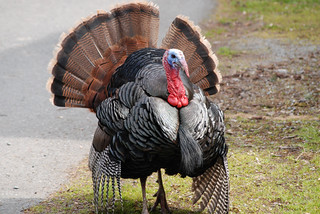
Wild Turkeys displaying for the hens.




Geographic Distribution and Habitat Adaptability
The wild turkey (Meleagris gallopavo) is an upland game bird indigenous to North America, occupying a significant ecological niche across diverse landscapes. Its native range historically spanned from the forests of eastern North America to the arid regions of the Southwest and into parts of Mexico. These birds exhibit remarkable adaptability, thriving in a variety of habitats including deciduous and mixed forests, forest edges, grasslands, shrublands, and agricultural areas.
Their habitat requirements are primarily driven by the availability of food and suitable roosting sites. Forests provide essential cover and perching locations for roosting, offering protection from nocturnal predators, while open areas like meadows, fields, and clearings are crucial for foraging on seeds, nuts, insects, and berries. This ecological plasticity has allowed the wild turkey to persist and, in some areas, expand its range through conservation efforts, demonstrating its resilience as a species.
Understanding their habitat preferences is key to successful wildlife management and conservation initiatives.
Evolutionary Trajectory
The wild turkey is not merely a North American resident; it is the direct progenitor of the domestic turkey (M. g. domesticus), a species that has profoundly impacted global agriculture and cuisine. The domestication process, initiated by indigenous peoples in southern Mexico, involved selective breeding of a specific southern Mexican subspecies of M. gallopavo. This ancient lineage diverged from the ocellated turkey, a distinct species found in the Yucatán Peninsula.
Over millennia, human intervention favored traits such as increased body size, reduced flight capability, and docility, leading to the modern domestic turkey. This evolutionary journey highlights a significant human-animal co-evolutionary relationship, transforming a wild game bird into a cornerstone of food production worldwide. The genetic legacy of the wild turkey is thus woven into the fabric of global food systems, a testament to its biological and economic importance.
Behavioral Ecology and Survival Strategies
Wild turkeys possess a sophisticated suite of behavioral adaptations that ensure their survival in competitive environments. As the heaviest members of the order Galliformes, their physical prowess is notable. While not long-distance flyers, they are capable of powerful, rapid bursts of flight, reaching speeds of up to 55 miles per hour over short distances.
This capability is critical for predator evasion and for reaching safe roosting sites in trees, typically at heights of 10-20 feet, which shields them from ground-based threats like coyotes, bobcats, and foxes. Their sensory perception is highly developed; they possess excellent eyesight, with a visual field of nearly 360 degrees, and acute hearing, allowing for early detection of potential dangers. Furthermore, their cryptic plumage, a mottled pattern of browns, blacks, and grays, provides exceptional camouflage against the forest floor and undergrowth, rendering them nearly invisible when stationary.
These combined traits make the wild turkey a highly successful and elusive creature.
Ecological Role and Conservation Status
Wild turkeys are integral to the health and functioning of North American ecosystems. As omnivores, their diet is diverse, encompassing a wide range of plant matter (seeds, nuts, fruits, buds) and animal matter (insects, spiders, small reptiles, amphibians). This broad dietary spectrum positions them as important seed dispersers and regulators of insect populations.
Their foraging activities can influence plant community structure, and they themselves serve as a crucial prey species for various predators, thus playing a vital role in the food web. Historically, populations experienced significant declines due to habitat loss and overhunting. However, dedicated conservation efforts, including habitat restoration and regulated hunting seasons, have led to remarkable population recoveries in many regions.
The wild turkey's resurgence is often cited as a conservation success story, underscoring the effectiveness of science-based management strategies in restoring wildlife populations and maintaining ecological balance.
Go deeper
Based on content from Wikipedia · Licensed under CC BY-SA 4.0