

White-tailed eagle
Images
![A horned owl and a white tailed eagle, German edition of “A Voyage to Hudson’s Bay...,” H. Ellis, 1750 / Grand-duc et aigle à queue blanche, édition en allemand de « A Voyage to Hudson’s Bay […] », H. Ellis, 1750](https://live.staticflickr.com/6084/6144312374_51bedb00bb_n.jpg)
A horned owl and a white tailed eagle, German edition of “A Voyage to Hudson’s Bay...,” H. Ellis, 1750 / Grand-duc et aigle à queue blanche, édition en allemand de « A Voyage to Hudson’s Bay […] », H. Ellis, 1750
![A horned owl and a white tailed eagle, “Voyage de la baye de Hudson...,” Henry Ellis, 1749 / Grand-duc et aigle à queue blanche, « Voyage de la baye de Hudson […] », Henry Ellis, 1749](https://live.staticflickr.com/6063/6143762791_6479209507.jpg)
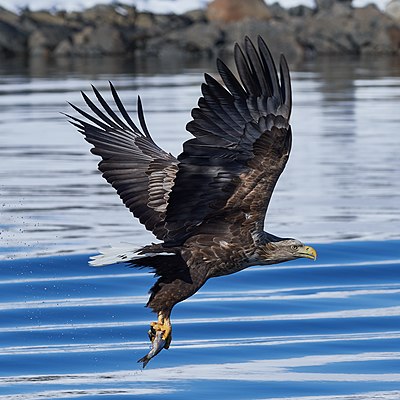


Anatomy and Adaptations of a Top Predator
The white-tailed eagle (Haliaeetus albicilla) is a formidable avian predator, characterized by its immense size and specialized adaptations for a life centered around water. With a wingspan frequently reaching 2.3 meters (7.5 feet) and weighing up to 7 kilograms (15.4 pounds), it is one of the largest birds of prey in its extensive Eurasian range. Its powerful talons, capable of exerting significant grip strength, are perfectly designed for seizing slippery fish from the water's surface, a primary component of its diet.
The eagle's keen eyesight, estimated to be four to eight times sharper than that of humans, allows it to spot prey from great distances while soaring or perched. Its broad wings provide excellent lift for soaring over vast aquatic landscapes, enabling efficient hunting and territorial patrols. The species is part of the genus Haliaeetus, commonly known as sea eagles, distinguished by their piscivorous (fish-eating) habits and preference for coastal or large inland water bodies.
Ecological Niche and Trophic Dynamics
As an apex predator, the white-tailed eagle plays a vital role in regulating populations of its prey species, thereby influencing the structure and health of aquatic ecosystems. Its diet is predominantly piscivorous, with fish constituting the majority of its food intake. However, it is also an opportunistic omnivore and scavenger, readily consuming water birds, small mammals, and carrion.
This dietary flexibility allows it to adapt to seasonal variations in prey availability and exploit resources efficiently. The white-tailed eagle forms a species pair with the bald eagle (Haliaeetus leucocephalus) in North America, occupying a similar ecological niche. The presence and abundance of white-tailed eagles can serve as an indicator of ecosystem health, reflecting the availability of clean water, abundant fish stocks, and suitable nesting sites.
Their predatory pressure helps maintain biodiversity by preventing any single prey species from becoming overly dominant.
Historical Persecution and Modern Threats
The historical trajectory of the white-tailed eagle population is marked by significant human-induced decline. For centuries, direct persecution through hunting and culling, often due to perceived competition with fisheries or simply for sport, decimated their numbers. Furthermore, habitat alteration and destruction, particularly the draining of wetlands and deforestation of old-growth forests essential for nesting, severely impacted breeding success and survival rates.
A more insidious threat emerged in the mid-20th century with the widespread use of persistent organic pollutants and chemical pesticides. These toxins accumulated in the food chain, leading to eggshell thinning, reproductive failure, and direct poisoning of adult eagles. Consequently, the species faced endangerment or extinction in many parts of its historical range, necessitating urgent conservation interventions.
Conservation Triumphs and Ongoing Challenges
The recovery of the white-tailed eagle in many regions represents a significant conservation success story. Following widespread population crashes, concerted efforts by governments, conservation organizations, and dedicated naturalists have led to notable rebounds. These efforts have included implementing legal protections against hunting, establishing protected areas for nesting and foraging, regulating or banning harmful pesticides, and conducting careful reintroduction programs in areas where the species had disappeared.
While many populations have shown remarkable resilience and recovery, ongoing challenges persist. Continued habitat degradation, the potential resurgence of pollutants, and the need for sustained monitoring and management are crucial for ensuring the long-term viability of the white-tailed eagle across its vast range. Their story underscores the interconnectedness of human actions and wildlife survival.
See also
Based on content from Wikipedia · Licensed under CC BY-SA 4.0