

The Western Wall
Images

VP Mike Pence visits the Western wall


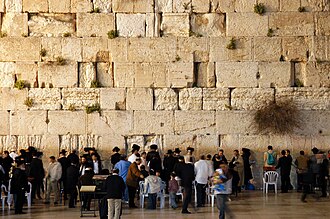

Architectural Legacy and Stratigraphy
The Western Wall is a colossal retaining structure on the western flank of the Temple Mount, a testament to ancient engineering and historical layering. Its most prominent section, the prayer plaza, showcases a remarkable stratigraphy of construction. The lowest courses, massive limestone blocks weighing many tons, are attributed to Herod the Great's ambitious expansion of the Second Temple complex, dating to the late Second Temple period (roughly 20 BCE – 70 CE).
Above these Herodian foundations, courses of medium-sized stones reveal additions from the Umayyad period (7th-8th centuries CE), demonstrating continuous use and adaptation. The uppermost courses, composed of smaller stones, are largely Ottoman-era additions (16th-19th centuries CE), reflecting more recent modifications. The entire retaining wall stretches for 488 meters (1,601 ft), with the prayer section comprising just over half its total height, including subterranean levels that extend deep below the current street level, hinting at the scale of the original construction.
Spiritual Significance and Jewish Practice
Within Judaism, the Western Wall holds unparalleled spiritual significance as the holiest accessible site for prayer. Its sanctity derives from its proximity to the presumed location of the Holy of Holies, the innermost sanctuary of the ancient Jewish Temple, which was destroyed by the Romans in 70 CE. Due to restrictions on entering the Temple Mount platform itself, the Western Wall serves as the primary locus for Jewish worship and pilgrimage.
The practice of placing written prayers or petitions into the wall's crevices is a deeply ingrained tradition, symbolizing a direct appeal to the divine. Historically, the term 'Wailing Wall' emerged among Christians, referencing the sorrowful lamentations of Jews who were often barred from Jerusalem except for specific mourning days, like Tisha B'Av, when they could approach the remnants of their destroyed Temple.
Interfaith Significance and Historical Tensions
The Western Wall is also revered in Islam as the 'Buraq Wall' (Ḥā'iṭ al-Burāq). Islamic tradition holds that the Prophet Muhammad tethered his celestial steed, the Buraq, to this wall during his miraculous Night Journey to Jerusalem before ascending to heaven. This dual sacredness has historically positioned the wall as a point of both reverence and contention.
The wall forms the western boundary of the Haram al-Sharif, which includes the Dome of the Rock and the Al-Aqsa Mosque. The Status Quo regulations, established over centuries and confirmed by international commissions, have long recognized the right of Jewish prayer and pilgrimage at the site, even while it was under Muslim administration as part of the Haram. This delicate balance has frequently been tested, particularly with the rise of modern political movements.
Geopolitical Flashpoint and Modern Relevance
In the 20th century, the Western Wall became a potent symbol in the burgeoning Zionist movement and a focal point of Arab-Jewish tensions. Concerns that Jewish prayer and access at the wall could be interpreted as asserting sovereignty over the Temple Mount led to significant friction and outbreaks of violence, most notably the 1929 riots. Following the 1948 Arab-Israeli War, Jordan controlled East Jerusalem, and Jews were completely excluded from the Old City, including the Western Wall, for 19 years.
This period of enforced absence intensified its symbolic importance. After Israel gained control of the site in the 1967 Six-Day War, the adjacent Moroccan Quarter was controversially demolished to create the expansive Western Wall plaza, facilitating greater access and public prayer, but also altering the historical urban fabric and continuing to shape the geopolitical narrative surrounding Jerusalem.
Preservation and Access Challenges
The Western Wall, particularly its subterranean sections and the 'Little Western Wall,' presents ongoing archaeological and preservation challenges. The 'Little Western Wall,' a smaller, exposed segment, is significant for retaining much of its original Herodian stonework and is believed by some to be even closer to the Holy of Holies. Access to deeper, unexcavated sections, such as Warren's Gate, has been restricted for centuries, with partial excavations only occurring in the 20th century.
Managing the immense flow of visitors, ensuring the preservation of the ancient stones, and navigating the complex religious and political sensitivities surrounding the site remain critical aspects of its contemporary stewardship.
Go deeper
Frequently Asked Questions
What is the Western Wall and why is it special?+
Why do people put prayers in the wall's cracks?+
Who built the different parts of the wall and when?+
Why is it called the Wailing Wall by some people?+
How long is the Western Wall and how big is it?+
Based on content from Wikipedia · Licensed under CC BY-SA 4.0