

Mount Edziza's Fiery Mountain Adventures!
Images
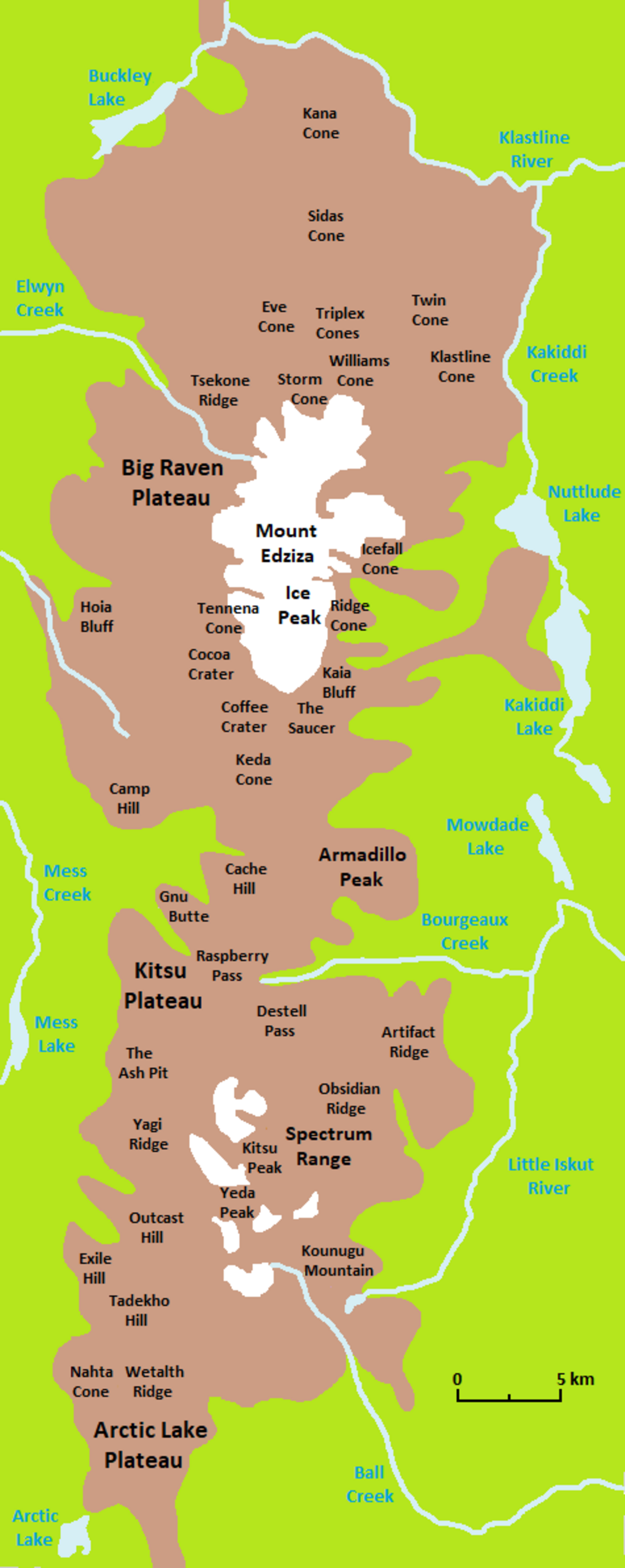
MEVC map


Chronology of Eruptions
The Mount Edziza volcanic complex (MEVC) in British Columbia, Canada, presents a remarkable geological narrative spanning over 7 million years, characterized by five distinct cycles of magmatic activity. These cycles, each representing a period of renewed magma generation and eruption, have progressively diminished in output, with each subsequent cycle producing less volcanic material than its predecessor.
The first cycle, occurring between 7.5 and 6 million years ago, laid down the Raspberry, Little Iskut, and Armadillo formations. The second cycle, from 6 to 1 million years ago, saw three distinct eruptive periods marked by the Nido, Spectrum, and Pyramid formations. The third cycle, around 1 million years ago, is represented by the Ice Peak, Pillow Ridge, and Edziza formations.
The fourth cycle, between 0.8 and 0.2 million years ago, produced the Arctic Lake, Klastline, and Kakiddi formations, also through three eruptive phases. The most recent, fifth cycle began at least 20,000 years ago and may still be active, marked by the Big Raven Formation. This phased development highlights the complex and long-term nature of volcanic systems.
Petrogenesis and Volcanic Morphology
The MEVC is a testament to the diverse processes of magmatic differentiation occurring within underground reservoirs. The complex has erupted a wide array of volcanic rocks, including basalt, trachybasalt, benmoreite, tristanite, mugearite, trachyte, and rhyolite. The latter six rock types are products of varying degrees of fractional crystallization and other differentiation processes, where minerals crystallize and are removed from the melt, altering its chemical composition.
This petrogenetic diversity is reflected in the varied volcanic morphologies observed. The extensive, highly mobile lava flows have built a volcanic plateau covering approximately 1,000 km², forming the base of the complex. Eruptions have also generated cinder cones, stratovolcanoes, subglacial volcanoes (formed during glacial periods), shield volcanoes, and lava domes, showcasing a broad spectrum of volcanic eruption styles and magma viscosities.
The Obsidian Legacy
A particularly significant aspect of the MEVC's volcanism is the formation of at least 10 distinct flows of obsidian. This volcanic glass, known for its sharp fracture properties, was a highly prized raw material for indigenous peoples in prehistoric times. Archaeological evidence indicates that obsidian from Mount Edziza was quarried and expertly knapped to produce a variety of tools and weaponry.
This resource played a crucial role in the subsistence and technological development of ancient cultures in the region. The distribution and use of this obsidian provide valuable insights into prehistoric trade networks, technological capabilities, and the deep historical relationship between human societies and their volcanic environment.
Contemporary Hazards and Environmental Impact
The ongoing geological activity of the Mount Edziza volcanic complex, even if currently quiescent, carries significant implications for the present and future. Renewed effusive volcanism could result in substantial lava flows that could impinge upon and potentially block local streams, leading to significant alterations in hydrological systems and local ecosystems. More critically, a resurgence of explosive volcanism poses a substantial threat to regional air traffic.
The dispersal of volcanic ash across northwestern Canada could disrupt flight paths, necessitate widespread cancellations, and pose a serious risk to aircraft engines, underscoring the need for continued monitoring and hazard assessment of this active volcanic region.
See also
Frequently Asked Questions
What is Mount Edziza and why is it called a super volcano?+
How many times has Mount Edziza erupted and what are the cycles?+
What kinds of rocks does Mount Edziza make?+
Why was obsidian from Mount Edziza important to ancient people?+
What could happen if Mount Edziza erupts again?+
Based on content from Wikipedia · Licensed under CC BY-SA 4.0