

University of Chicago Law School
Images

The Wayside



Geographic and Academic Context
The University of Chicago Law School is strategically situated within the University of Chicago, a private research institution renowned for its interdisciplinary approach and rigorous academic standards, located in the vibrant metropolis of Chicago, Illinois. This geographic placement is more than just an address; it situates the Law School within a rich ecosystem of intellectual inquiry, fostering collaborations across departments and encouraging a holistic understanding of law's societal impact.
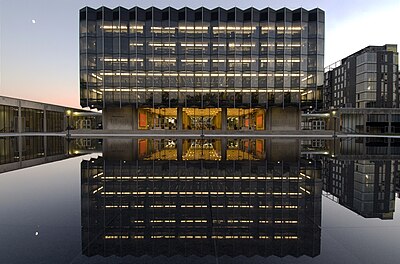
Chicago itself, a global hub for finance, culture, and policy, provides a dynamic backdrop for legal studies, offering students and faculty access to a wide array of legal practice, governmental institutions, and public discourse. The city's distinct four-season climate mirrors the often-contrasting and evolving nature of legal interpretation and application, demanding adaptability and resilience from its scholars. The Law School's physical presence on campus, particularly its distinctive Saarinen-designed building, serves as a landmark of its commitment to both architectural excellence and cutting-edge legal thought.
Architectural Evolution
The physical evolution of the University of Chicago Law School reflects its growth and changing academic philosophy. Initially housed in Stuart Hall, a structure characterized by its Gothic architectural style, the school occupied a space that evoked tradition and historical gravitas. This Gothic design, with its emphasis on soaring verticality and intricate stonework, symbolized a deep connection to the historical development of legal institutions.
However, in 1959, the Law School relocated to a building designed by the celebrated Finnish-American architect Eero Saarinen, situated across the picturesque Midway Plaisance. Saarinen's modernist design represented a forward-looking vision, emphasizing clean lines and functional spaces conducive to contemporary legal scholarship. The building has undergone significant expansions and renovations, notably in 1987 and 1998, with a major renovation in 2008 that meticulously preserved Saarinen's original structural integrity.
This ongoing adaptation ensures the building remains a state-of-the-art facility while honoring its architectural heritage, symbolizing the school's blend of tradition and innovation.
A Legacy of Legal Titans and Influential Thinkers
The University of Chicago Law School boasts a faculty roster that reads like a who's who of legal scholarship and public service. Its professors are not merely educators but leading authorities whose work profoundly shapes legal discourse. Figures like Cass Sunstein, Richard Posner, and Richard Epstein are consistently ranked among the most cited legal scholars of the 20th and 21st centuries, their theories and analyses forming the bedrock of modern legal thought in areas ranging from administrative law to torts.
The school's influence extends beyond academia; it has been a formative environment for individuals who have reached the highest echelons of government and the judiciary. Notably, former U.S. President Barack Obama served on the faculty, bringing his experience as a community organizer and constitutional scholar to his teaching. Furthermore, the school has been a training ground and intellectual home for U.S.
Supreme Court Justices, including Antonin Scalia, John Paul Stevens, and Elena Kagan, whose judicial decisions and legal philosophies have had a lasting impact on American jurisprudence. This concentration of intellectual capital creates an unparalleled environment for legal education and research.
Comprehensive Legal Education
The University of Chicago Law School offers a robust curriculum designed to cultivate critical thinking, analytical rigor, and a deep understanding of the law. Its flagship program is the Juris Doctor (J.D.), which enrolls over 600 students annually, preparing them for diverse legal careers. Beyond the J.D., the school provides advanced graduate programs tailored for legal professionals and aspiring academics.
The Master of Laws (LL.M.) program allows practicing lawyers to deepen their expertise in specific legal fields or explore international law. For those pursuing a career in legal scholarship, the Doctor of Juridical Science (S.J.D.) offers an intensive doctoral program focused on original legal research. This multi-tiered educational structure ensures that students at all levels engage with complex legal issues, contribute to scholarly debate, and develop the sophisticated skills necessary to navigate the evolving legal landscape and address contemporary societal challenges.
Economic and Societal Impact
While the University of Chicago Law School is primarily an educational institution, its impact resonates deeply within the economic and governmental spheres. Graduates and faculty members frequently occupy influential positions in government, shaping public policy and legal frameworks. The school's emphasis on economic analysis of law, a hallmark of its intellectual tradition, has had a significant influence on regulatory policy and corporate governance.
Faculty members often serve as advisors to governmental bodies, think tanks, and international organizations, contributing their expertise to critical policy debates. The alumni network is extensive, with graduates holding leadership roles in major law firms, corporations, non-profit organizations, and public service. This pervasive influence underscores the Law School's role not just as a place of learning, but as a vital engine for shaping legal practice, economic development, and public administration both nationally and internationally.
See also
Frequently Asked Questions
Where is the University of Chicago Law School located?+
What makes the law school's building unique?+
Who are some well-known teachers at the law school?+
Why do many people study at the University of Chicago Law School?+
How does living in Chicago help law students?+
Based on content from Wikipedia · Licensed under CC BY-SA 4.0