

Tupolev Tu-95
Images

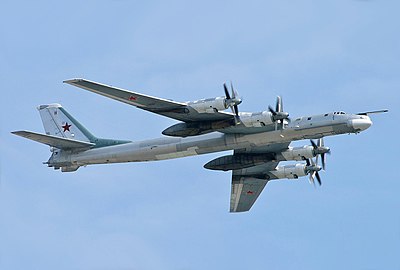
Tupolev Tu-95 Strategic Bomber.




Genesis of a Cold War Icon
The Tupolev Tu-95, designated 'Bear' by NATO, emerged from a pivotal moment in aviation history. First flown in 1952, its development was driven by the Soviet Union's need for a long-range strategic bomber capable of reaching targets deep within enemy territory. While jet propulsion was gaining traction, the Tupolev design bureau made a deliberate choice to utilize powerful turboprop engines.
This decision was rooted in the desire for superior fuel efficiency and range at high subsonic speeds, crucial for intercontinental missions. The resulting aircraft, powered by four Kuznetsov NK-12 engines, each driving a pair of contra-rotating propellers, was a marvel of engineering. The NK-12 remains the most powerful turboprop engine ever put into production.
The aircraft's distinctive swept-back wings, set at a 35-degree angle, were an innovative feature for a propeller-driven aircraft of its size, contributing to its aerodynamic efficiency and high subsonic speed, which was comparable to early jet bombers. Its entry into service in 1956 marked the beginning of a long and storied operational career.
The Roar of the Bear
The Tu-95's most defining characteristic, beyond its sheer size, is its formidable acoustic signature. It is widely recognized as one of the loudest military aircraft in existence. This notoriety stems directly from its unique propulsion system.
The NK-12 engines are incredibly powerful, but it is the speed of the propeller tips that generates the intense noise. These tips achieve supersonic speeds, creating a continuous sonic boom effect that propagates over vast distances. This acoustic signature, while a byproduct of its design, has become an unmistakable identifier.
Furthermore, the contra-rotating propeller arrangement is a sophisticated solution to mitigate the torque produced by such powerful engines, improving stability and efficiency. The swept-wing design, unusual for propeller-driven aircraft built in large numbers, was essential for achieving higher speeds and better handling characteristics, allowing the Tu-95 to remain a viable platform even as jet technology advanced.
A Versatile Airframe
The Tu-95's robust airframe proved to be remarkably adaptable, leading to the development of several significant variants. The most prominent is the Tu-142, a dedicated maritime reconnaissance and anti-submarine warfare aircraft. This variant features a strengthened airframe, extended range, and specialized equipment for operating over vast oceanic expanses.
Another notable derivative was the Tu-114, a luxurious passenger airliner. The Tu-114 was one of the fastest propeller-driven airliners ever produced, capable of speeds that rivaled early jet airliners of its era. It showcased the potential for high-speed, long-distance travel using turboprop technology.
These diverse applications highlight the fundamental strength and flexibility of the original Tu-95 design, demonstrating its ability to serve multiple critical roles within the Soviet and later Russian aerospace forces.
Enduring Relevance
The continued operational status of the Tu-95 into the 21st century is a testament to its enduring capabilities and the strategic doctrines it serves. Despite the prevalence of advanced jet bombers and stealth technology, the Tu-95 remains a key component of Russia's long-range strike capability. Its ability to carry a significant payload of cruise missiles allows it to project power over intercontinental distances.
The aircraft has undergone numerous upgrades throughout its service life, enhancing its avionics, electronic warfare systems, and weapon compatibility, ensuring its relevance in modern conflict scenarios. Its first documented combat use in 2015, launching cruise missiles against targets in Syria, demonstrated its continued operational viability. With projections indicating service until at least 2040, the Tu-95 stands as a unique example of a propeller-driven strategic bomber that has successfully navigated the technological evolution of military aviation for nearly a century.
See also
Frequently Asked Questions
What is the Tupolev Tu-95 and why is it called "Bear"?+
Why does the Tu-95 make so much noise?+
How does the Tu-95 stay in the air for so long?+
What are the different versions of the Tu-95, like the Tu-142 and Tu-114?+
Is the Tu-95 still used today and why?+
Based on content from Wikipedia · Licensed under CC BY-SA 4.0