

Tibet: The Roof of the World!
Images

Tibet



The Tibetan Plateau
Tibet, encompassing the vast Tibetan Plateau, represents the highest and largest terrestrial plateau on Earth. Its average elevation of 4,380 meters (14,000 feet) creates an environment of extreme conditions: thin atmosphere with low oxygen levels, intense solar radiation, and harsh, cold temperatures. This unique geography is bordered by the formidable Himalayas to the south, which host Mount Everest, the planet's highest peak at 8,848 meters (29,000 feet).
The plateau's immense scale and altitude have profoundly influenced its biodiversity, leading to the evolution of highly specialized flora and fauna. The region's hydrology is also critical, as it is the source of many of Asia's major rivers, including the Yangtze, Yellow, Indus, and Brahmaputra, making its ecological health a matter of regional and global significance. The stark beauty of its landscapes, from arid steppes to glacial mountains, is a testament to nature's resilience in extreme settings.
A Complex History
The historical narrative of Tibet is multifaceted. Emerging as a powerful empire in the 7th century, it once extended its influence across vast swathes of Central Asia. However, internal divisions led to its fragmentation by the 9th century.
For centuries, Tibet developed a unique political and religious system, with Lhasa serving as its spiritual and administrative center. The region's relationship with neighboring powers, particularly China, has been a recurring theme. Following the Xinhai Revolution in 1912, Tibet declared independence, though this was not internationally recognized.
In the mid-20th century, following the establishment of the People's Republic of China, Tibet was incorporated into the PRC. This integration, particularly after the 1959 uprising, led to significant political and social restructuring, with the establishment of the Tibet Autonomous Region and the incorporation of eastern Tibetan areas into neighboring Chinese provinces. The ongoing debate surrounding Tibet's status and governance continues to be a significant geopolitical issue.
Biodiversity Under Pressure
The Tibetan Plateau is home to a remarkable array of wildlife adapted to its challenging environment. The yak (Bos grunniens), a domesticated bovine, is central to Tibetan culture, providing essential resources like milk, meat, and fiber, and serving as a beast of burden. Wild yaks are also found, though their populations are more vulnerable.
The Tibetan antelope (Pantholops hodgsonii), or 'chiru,' is renowned for its exceptionally fine wool, which unfortunately made it a target for poaching, leading to its classification as Near Threatened. The elusive snow leopard (Panthera uncia) is a keystone predator, perfectly camouflaged for its rocky, mountainous habitat. Other notable species include the Tibetan wild ass (Equus kiang), various species of pikas, and numerous high-altitude birds.
Conservation efforts are crucial to protect these species from threats like habitat loss, climate change, and human encroachment.
Cultural Resilience and Modern Dynamics
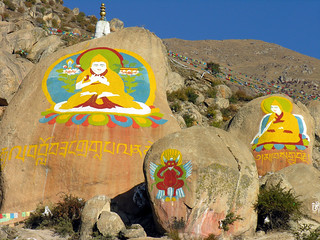
Tibetan culture is deeply intertwined with Tibetan Buddhism, which permeates art, philosophy, medicine, and daily life. Monasteries are not only religious centers but also repositories of cultural heritage. Traditional architecture, often featuring a blend of Indian and Chinese influences, is evident in its sacred sites.
Staple foods like tsampa (roasted barley flour), yak products, and butter tea are vital for sustenance in the high-altitude climate. In recent decades, Tibet has seen a rise in tourism, contributing to its economy but also raising questions about cultural preservation and environmental impact. The region faces ongoing discussions about cultural identity, religious freedom, and the balance between economic development and the maintenance of its unique heritage, making it a subject of continuous study and international attention.
Go deeper
Frequently Asked Questions
What makes Tibet the 'Roof of the World'?+
Why do animals in Tibet have special adaptations?+
Where does the water for many Asian rivers come from in Tibet?+
What is the yak and why is it important to Tibetans?+
How does Tibet's high altitude affect the air we breathe?+
Based on content from Wikipedia · Licensed under CC BY-SA 4.0