

How New Animals Are Born!
Images
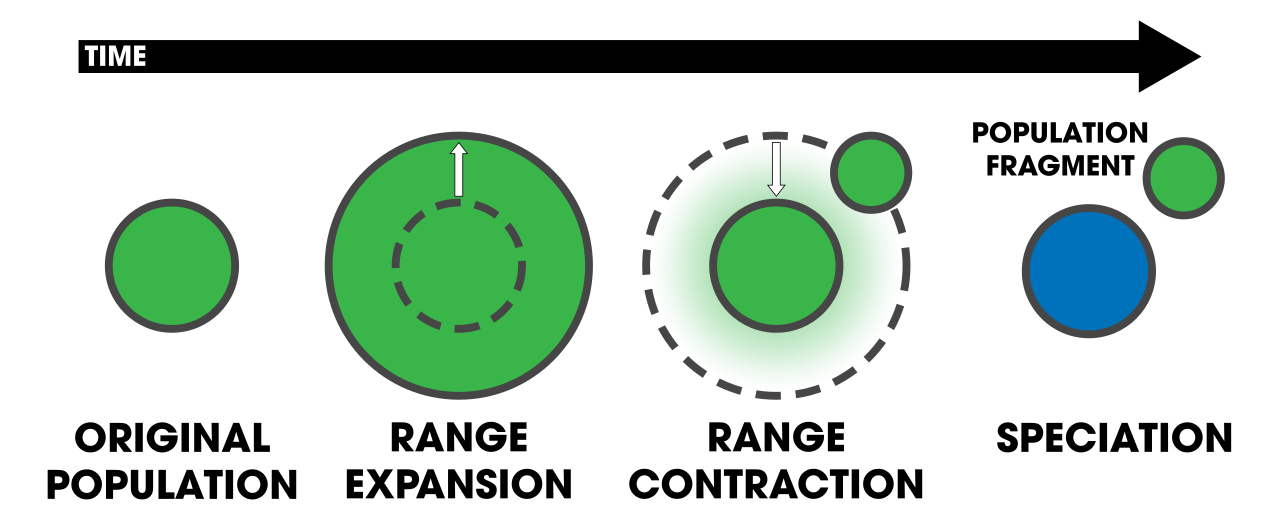
Centrifugal Speciation Schematic



The Genesis of Novelty
Speciation represents the cornerstone of macroevolutionary change, describing the process by which populations diverge to become distinct biological species. This divergence is fundamentally characterized by the development of reproductive isolation, preventing gene flow between nascent species. The concept was significantly advanced by Charles Darwin, who, in 'On the Origin of Species,' posited natural selection as a primary driver, though he also grappled with the complexities of sexual selection.
Orator F. Cook formally introduced the term 'speciation' in 1906, distinguishing cladogenesis (lineage splitting) from anagenesis (evolution within a lineage). Understanding speciation is crucial for comprehending the vast tapestry of life, from the smallest microbes to the most complex ecosystems, and it forms the bedrock of phylogenetic studies and biodiversity assessments.
It is not merely a historical event but an ongoing process shaping life's future trajectory.
Geographic Frameworks
The geographical context in which populations diverge plays a critical role in the speciation process, leading to several recognized modes. Allopatric speciation, arguably the most common, occurs when populations are geographically separated, preventing gene flow. This separation can be caused by vicariance events (e.g., continental drift, mountain formation) or dispersal events (colonization of new habitats).
Peripatric speciation is a subtype where a small new population is isolated at the periphery of the main population, often subject to strong founder effects and genetic drift. Parapatric speciation occurs when populations are adjacent but experience limited gene flow due to environmental gradients or partial geographic barriers, leading to divergence in areas of contact. Sympatric speciation, the most debated, proposes that new species can arise within the same geographic area as the parent species, often driven by factors like disruptive selection, host shifts, or polyploidy.
Mechanisms of Divergence
The divergence that ultimately leads to speciation is driven by a complex interplay of evolutionary forces. Natural selection favors adaptations to specific environments, leading to distinct traits in isolated populations. Genetic drift, particularly potent in small, isolated populations (as in peripatric speciation), can lead to the fixation of alleles that may contribute to reproductive isolation, even if they are not directly adaptive. Sexual selection can also play a significant role, with preferences for certain traits or mating behaviors evolving independently in diverging populations, creating pre-zygotic isolation.
Furthermore, hybridization, while sometimes a dead end, can also be a pathway to new species, especially if hybrid offspring exhibit novel adaptations or if their genetic makeup is stabilized through mechanisms like polyploidy. The development of pre-zygotic barriers (preventing mating or fertilization) and post-zygotic barriers (reducing hybrid viability or fertility) are the hallmarks of completed speciation.
Contemporary Relevance and Future Directions in Speciation Research
Speciation research continues to be a vibrant field, integrating genomics, molecular biology, and ecological studies to unravel its complexities. Advances in DNA sequencing allow scientists to track genetic changes associated with divergence and identify the genes responsible for reproductive isolation. Studying contemporary speciation events, such as those occurring in rapidly evolving organisms like cichlid fish or fruit flies, provides invaluable insights into the immediate drivers of divergence.
The implications of speciation extend beyond theoretical biology; understanding how new species form is critical for predicting the impacts of climate change, habitat fragmentation, and invasive species on biodiversity. It also informs conservation strategies, helping us to identify and protect nascent species or unique evolutionary lineages before they are lost. The ongoing exploration of speciation promises to deepen our understanding of life's resilience and its remarkable capacity for innovation.
Go deeper
Frequently Asked Questions
What is speciation?+
How can animals become new species when they live in the same place?+
Why do animals that are far apart become different species?+
What role does chance play in making new species?+
Can animals that mix still become a new species?+
Based on content from Wikipedia · Licensed under CC BY-SA 4.0