

Sovereign Military Order of Malta
Images

Embassy of the Sovereign Military Order of Malta in Prague (1)


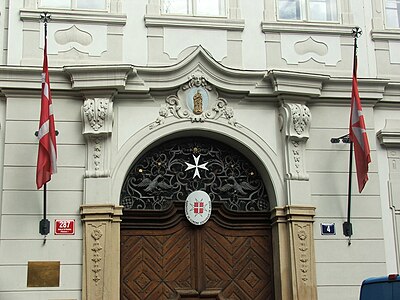


From Crusader Hospitals to Diplomatic Powerhouse
The Sovereign Military Order of Malta (SMOM), officially the Sovereign Military Hospitaller Order of Saint John of Jerusalem, of Rhodes and of Malta, represents a remarkable continuity of institutional identity spanning nearly a millennium. Its origins trace back to the Blessed Gerard's founding of the Knights Hospitaller around 1099 in the Kingdom of Jerusalem, initially as a charitable organization dedicated to operating hospitals for pilgrims and the sick.
As the geopolitical landscape of the Levant shifted, the Order transformed, becoming a significant military force during the Crusades, defending its territories on Rhodes and later Malta. The loss of these physical strongholds in the 18th century did not diminish the Order's core identity or its unique standing in international law. Today, it functions as a Catholic lay religious order, led by an elected Prince and Grand Master, whose motto, 'Tuitio fidei et obsequium pauperum' ('Defence of the faith and assistance to the poor'), encapsulates its dual historical mission: spiritual defense and practical aid to the vulnerable.
The Paradox of Non-Territorial Sovereignty
Perhaps the most intriguing aspect of the SMOM is its status as a sovereign entity under international law, despite possessing no sovereign territory. This unique position grants it privileges typically reserved for nation-states, such as the ability to enter into treaties, maintain diplomatic relations with 115 countries, issue its own passports, currency, and postage stamps, and enjoy extraterritoriality for its headquarters in Rome. This sovereign status is not merely symbolic; it is crucial for the Order's operational effectiveness.
It allows the SMOM to conduct its extensive humanitarian activities across borders with a degree of independence and neutrality, facilitating access to conflict zones and disaster areas where state actors might face greater political hurdles. Its government structure mirrors that of a state but incorporates specific elements reflective of its religious and chivalric nature, blending secular governance with the ethos of a religious order.
A Global Network of Humanitarian Action
In the contemporary world, the Order of Malta's primary focus is on global humanitarian assistance. Through its operational arm, Malteser International, and a vast network of national associations, it deploys approximately 52,000 medical and auxiliary staff, supported by 100,000 volunteers, in over 120 countries. Their work spans a wide spectrum of needs, addressing the plight of children, the homeless, the disabled, the elderly, refugees, and those afflicted by diseases such as leprosy.
The Order's commitment to aiding victims of natural disasters, epidemics, and war, irrespective of ethnicity or religion, underscores its dedication to universal human dignity. This profound dedication led to the granting of permanent observer status at the United Nations General Assembly in 1994, placing it in the company of other influential non-state entities like the International Olympic Committee and the International Committee of the Red Cross.
Evolving Membership and Enduring Chivalric Ideals
The composition of the Order's membership has evolved significantly since its inception. Historically, high-ranking positions, including those of officers, were often reserved for individuals demonstrating noble lineage, reflecting its chivalric and aristocratic roots. This requirement persisted until the late 20th century.
However, recognizing the need for broader participation in its humanitarian mission, the Order established pathways for individuals without aristocratic backgrounds to ascend to its highest ranks. This inclusivity ensures that the Order can draw upon a wider pool of talent and dedication, fostering a contemporary expression of its ancient ideals. The membership, comprising about 13,500 Knights, Dames, and Chaplains, including a core group of 33 professed religious Knights of Justice, collectively embodies the Order's enduring commitment to faith and service to the poor.
See also
Frequently Asked Questions
What is the Sovereign Military Order of Malta?+
How can the Order have a country but no land?+
Who leads the Order?+
What kind of help does the Order give to people?+
Why does the Order have a special place at the United Nations?+
Based on content from Wikipedia · Licensed under CC BY-SA 4.0