

Skara Brae
Images
![Orkney Islands [GB], 2004, Skara Brae.](https://live.staticflickr.com/3213/2288813029_5f891825c2.jpg)
Orkney Islands [GB], 2004, Skara Brae.


![Orkney Islands [GB], 2004, Skara Brae.](https://live.staticflickr.com/2286/2289602132_51e2b0fba4.jpg)


![Orkney Islands [GB], 2004, Skara Brae.](https://live.staticflickr.com/7429/12842080445_cd41c10d3c.jpg)


Architectural Ingenuity and Domestic Life in Neolithic Orkney
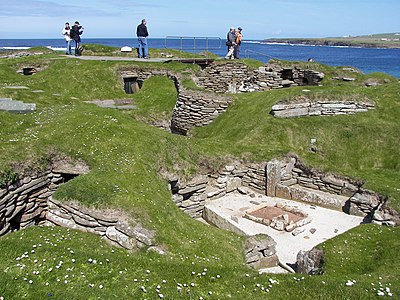
Skara Brae stands as a testament to the sophisticated domestic architecture and social structures of Neolithic Europe. Located on the windswept coast of Orkney, this settlement comprises ten clustered houses constructed from locally quarried flagstones. These structures are remarkable not only for their material but also for their innovative design.
The houses are built into artificial earthen dams, providing crucial insulation against the harsh climate and structural support for the stone walls. Internally, the dwellings reveal a surprising level of domestic planning, featuring integral stone furniture such as beds, dressers, and hearths. The presence of a primitive yet effective drainage system, with water used to flush waste into a communal drain leading to the sea, demonstrates an advanced understanding of sanitation and resource management for the period.
This level of detail allows for a vivid reconstruction of daily life, suggesting a community that valued comfort, order, and communal well-being within their dwellings.
Chronology and Societal Context of a Flourishing Village
Occupied for an extended period, from approximately 3180 BC to 2500 BC, Skara Brae represents a significant phase in the Neolithic era in Britain. Its longevity indicates a stable and successful community that thrived for over six centuries. This period was characterized by the widespread adoption of agriculture and the development of more complex social hierarchies.
The clustered nature of the houses at Skara Brae suggests a close-knit community, possibly with strong kinship ties. While the exact social organization remains a subject of study, the uniformity in house design and the shared infrastructure like the drainage system point towards a degree of communal cooperation and potentially a shared leadership structure. The village's existence predates monumental structures like Stonehenge and the Great Pyramids of Giza, placing it among the earliest examples of permanent, complex human settlements in Northern Europe and offering a crucial benchmark for understanding societal development in the region.
The Significance of Skara Brae as a World Heritage Site
Skara Brae's designation as part of the 'Heart of Neolithic Orkney' UNESCO World Heritage Site underscores its global historical importance. Its unparalleled state of preservation, often likened to the 'Scottish Pompeii,' is its most striking feature. Unlike many archaeological sites that are fragmented or heavily eroded, Skara Brae provides an almost complete village layout, allowing for an exceptionally detailed study of Neolithic domestic life, technology, and settlement patterns.
This intactness offers invaluable insights that cannot be gained from less-preserved sites. It serves as a vital educational resource, enabling scholars and the public alike to connect directly with the past. The site’s significance extends beyond its physical remains; it represents a crucial link in the chain of human history, illustrating the ingenuity and adaptability of early societies in challenging environments.
Discovery, Preservation Challenges, and Modern Relevance
The rediscovery of Skara Brae in 1850, triggered by a severe storm, is a dramatic chapter in its history. The tempest stripped away centuries of sand and turf, revealing the remarkably preserved stone structures beneath. This event highlights the dual nature of the environment: it can both conceal and reveal archaeological treasures.
Today, the very coastal location that protected Skara Brae for millennia now presents a significant threat. Coastal erosion, exacerbated by climate change and rising sea levels, poses an ongoing risk to the site's integrity. Historic Environment Scotland, in collaboration with various partners, employs sophisticated monitoring and conservation techniques to mitigate these threats.
The ongoing efforts to preserve Skara Brae are not merely about protecting ancient stones; they are about safeguarding a tangible connection to our collective human heritage and understanding the enduring challenges of balancing preservation with the forces of nature.
See also
Based on content from Wikipedia · Licensed under CC BY-SA 4.0