

Sergey Prokudin-Gorsky
Images
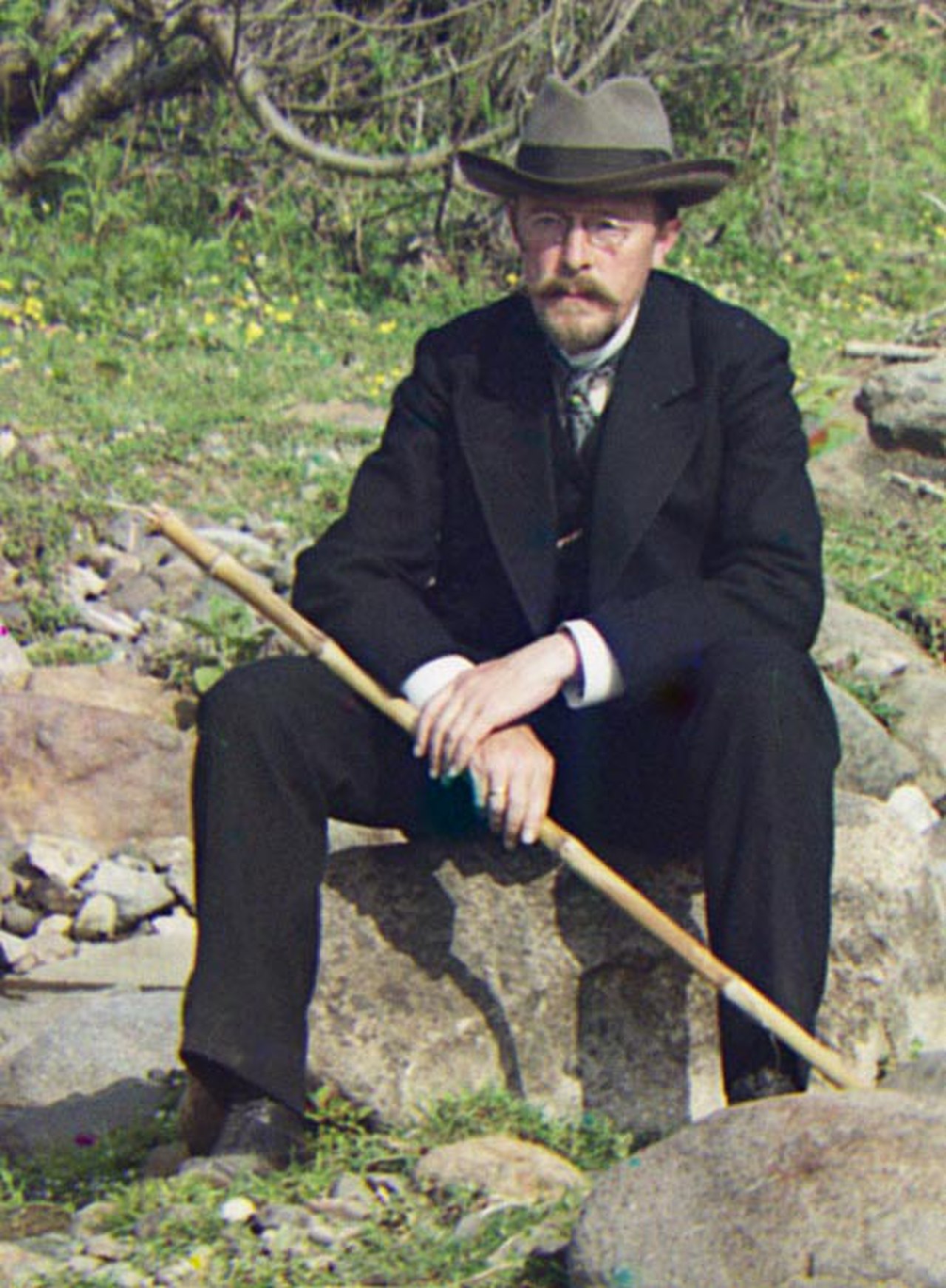
Sergey Prokudin-Gorsky
From Chemistry to Color
Born in 1863 into a noble family in the Russian Empire, Sergey Prokudin-Gorsky initially pursued a career in chemistry, studying under renowned scientists like Dmitri Mendeleev. His early work focused on the chemical properties of light-sensitive materials, laying the foundation for his later photographic innovations. Dissatisfied with the limitations of monochrome photography, Prokudin-Gorsky became captivated by the nascent field of color reproduction.
He dedicated himself to developing a practical and effective method for capturing the world in its full chromatic spectrum. This involved extensive research into additive color mixing and the development of specialized filters and photographic plates, a process that demanded both scientific rigor and artistic sensibility. His early experiments, presented at scientific congresses, demonstrated his growing mastery over this complex technology.
The Technical Marvel
Prokudin-Gorsky's most significant contribution was his pioneering three-strip color photography process. This method, based on the principle of additive color synthesis, involved using a modified camera to expose three successive black-and-white images onto a single glass plate or film. Each exposure captured the scene through a different colored filter: red, green, and blue.
To view the final color image, these three monochrome negatives were projected simultaneously through corresponding colored filters onto a screen. The overlapping beams of light recreated the original scene with remarkable fidelity for the era. This technically demanding process required precise alignment and careful exposure control, making Prokudin-Gorsky's ability to produce thousands of such images a testament to his dedication and skill.
He even developed portable darkrooms and specialized lighting equipment to facilitate his fieldwork.
A Photographic Expedition Across a Colossus
Between 1909 and 1915, Prokudin-Gorsky undertook an ambitious, government-sponsored project to document the vast and diverse Russian Empire. Traveling extensively by train, boat, and even on horseback, he journeyed from the Baltic Sea to the Ural Mountains, and from the Arctic Circle to the borders of Persia. His photographic expeditions captured a staggering array of subjects: the intricate architecture of ancient churches, the rugged beauty of the Caucasus Mountains, the daily lives of peasants and factory workers, the vibrant traditions of various ethnic groups, and the burgeoning industrial landscape.
His work was not merely artistic; it served as a crucial visual record, intended to showcase the empire's grandeur and complexity to its citizens and the world, particularly in the lead-up to potential societal upheaval.
Preserving a Vanishing World
The collection of over 2,000 color photographs created by Prokudin-Gorsky represents an unparalleled historical and cultural treasure. These images offer a unique and intimate perspective on a Russia on the cusp of profound change, capturing a world that would soon be irrevocably altered by revolution and war. His work provides invaluable insights for historians, sociologists, and art enthusiasts, allowing for a deeper understanding of the empire's diverse peoples, landscapes, and material culture.
The Library of Congress acquired a significant portion of his collection, ensuring its preservation and accessibility. Prokudin-Gorsky's legacy lies not only in his technical mastery of early color photography but also in his foresight as a visual chronicler, preserving a vanishing era with breathtaking clarity and color.
Beyond the Lens
Following the Russian Revolution in 1917, Prokudin-Gorsky found himself exiled from his homeland. He eventually settled in Paris, France, where he continued his scientific work, though he was unable to fully recreate the scale of his Russian photographic endeavors. He passed away in 1944, leaving behind a remarkable body of work that has only grown in appreciation over time.
His photographs are now celebrated not just as technical achievements but as vital historical documents that bring the past to life with an immediacy that monochrome images cannot match. They serve as a powerful reminder of the transformative potential of photography as a tool for documentation, education, and cultural preservation, bridging the gap between generations and offering a vivid glimpse into a bygone world.
See also
Frequently Asked Questions
What did Sergey Prokudin-Gorsky invent that made color photography possible?+
How did Prokudin-Gorsky take color pictures before color film existed?+
Where did Prokudin-Gorsky travel to take his photos?+
Why did he travel so far to photograph the Russian Empire?+
What makes Prokudin-Gorsky’s photographs special today?+
Based on content from Wikipedia · Licensed under CC BY-SA 4.0