

Royal Australian Navy
Images

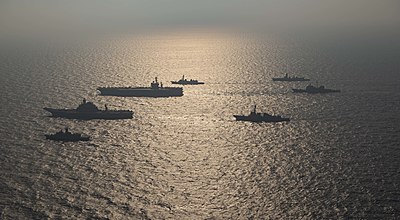
Two Royal Australian Navy ships




Genesis and Evolution
The Royal Australian Navy (RAN) was established in 1901 as the Commonwealth Naval Forces (CNF) through the amalgamation of Australia's colonial navies, coinciding with the federation of the continent. Initially conceived for local defense, its mandate rapidly expanded. The early RAN operated as a 'green-water' force, relying on the Royal Navy's 'blue-water' capabilities provided through the Australia Station.
However, this dependency began to shift by 1913 with the acquisition of its own naval vessels. The diminishing British imperial presence in the South Pacific necessitated a greater assumption of regional defense responsibilities by the RAN. This strategic evolution was crucial, transforming the CNF into a force capable of independent operations and projecting Australian influence beyond its immediate maritime borders, laying the groundwork for its modern global posture.
Operational Heritage
The RAN's operational history is a testament to its enduring commitment to national security and international stability. Its participation in major global conflicts, including World War I and World War II, highlights its role in pivotal naval campaigns and the protection of vital sea lanes. Beyond these world wars, the RAN has consistently engaged in regional security operations and multinational efforts.
Its involvement in the Korean War, the Malayan Emergency, the Indonesia-Malaysia Confrontation, and the Vietnam War underscores its adaptability and willingness to contribute to collective security. These extensive operational experiences have honed the RAN's combat readiness, strategic planning, and interoperability with allied forces, solidifying its reputation as a professional and effective naval service across diverse geopolitical landscapes.
Modern Naval Power
As of 2025, the Royal Australian Navy operates a sophisticated and modern fleet comprising 36 commissioned vessels and 12 non-commissioned vessels, supported by a dedicated personnel strength exceeding 16,000. This fleet represents a significant investment in advanced naval technology, including destroyers, frigates, amphibious assault ships, submarines, and maritime patrol aircraft. The RAN's strategic posture is characterized by a substantial presence in the South Pacific and a significant operational footprint in the Indian Ocean.
Its global reach enables participation in coalition operations, humanitarian assistance and disaster relief (HADR) missions, and counter-piracy patrols. This capability positions the RAN not only as a key component of Australia's defense but also as a vital contributor to regional maritime security and international order, demonstrating a commitment to projecting stability and influence.
The Human Element
The effectiveness of the Royal Australian Navy is fundamentally driven by its highly trained and professional personnel. Service in the RAN demands rigorous training across a spectrum of disciplines, from advanced seamanship and combat systems operation to complex engineering and logistics management. Sailors and officers undergo continuous professional development to maintain proficiency with cutting-edge naval technology and evolving operational doctrines.
The culture within the RAN emphasizes teamwork, discipline, resilience, and a strong sense of duty. This cohesive environment is crucial for operating in demanding high-stakes scenarios, whether in combat or during humanitarian missions. The Chief of Navy, a Vice Admiral, oversees this vast organization, jointly responsible to the Minister for Defence and the Chief of the Defence Force, ensuring the RAN aligns with national strategic objectives and maintains its esteemed position within the Australian Defence Force.
Strategic Imperatives
The Royal Australian Navy operates within a dynamic and increasingly complex geopolitical environment, particularly in the Indo-Pacific region. Its strategic importance lies in its capacity to safeguard Australia's extensive maritime interests, which include vast Exclusive Economic Zones, critical trade routes, and national security imperatives. The RAN's modern fleet and global reach are essential for deterring potential adversaries, reassuring allies, and responding effectively to a range of contingencies, from territorial defense to freedom of navigation operations.
Its role extends beyond military power projection; it is a key instrument of Australian foreign policy, fostering diplomatic relationships through joint exercises and port visits. The RAN's continued modernization and strategic engagement are vital for maintaining regional stability and advancing Australia's national interests in an evolving global order.
See also
Frequently Asked Questions
What is the Royal Australian Navy?+
When was the Royal Australian Navy founded?+
What kinds of ships does the Navy have?+
Why does the Navy help other countries?+
How many people work in the Royal Australian Navy?+
Based on content from Wikipedia · Licensed under CC BY-SA 4.0