

Romanos IV Diogenes
Images

Romano IV diogenes, histamenon, in oro, 1068-1071, recto con costanzio, michele VII e andronico 02


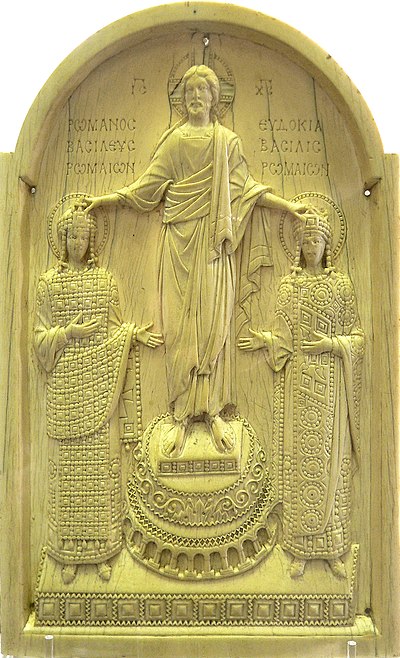


Ascension and Imperial Mandate
Romanos IV Diogenes emerged from the Cappadocian military aristocracy, a lineage steeped in service to the Byzantine state. His early career as an Akritai commander, defending the empire's frontiers in Syria and along the Danube, honed his military acumen. His rise to imperial power in 1068 was facilitated by his marriage to the empress Eudokia Makrembolitissa, a strategic move to legitimize his claim and provide stability after a period of turmoil.
Crowned emperor, Romanos inherited an empire facing significant internal and external pressures. The military, once the bedrock of Byzantine power, was in decline, and incursions by the Seljuk Turks into Anatolia posed an existential threat. Romanos's primary objective was clear: to reverse this decline, restore military strength, and secure the empire's territorial integrity.
He sought to emulate the great warrior emperors of the past, aiming to reassert Byzantine dominance in a rapidly changing geopolitical landscape. His reign, though brief, was marked by a determined effort to confront these challenges head-on.
The Cataclysm of Manzikert and its Immediate Aftermath
The pivotal event of Romanos IV Diogenes's reign, and indeed a turning point for the Byzantine Empire, was the Battle of Manzikert in 1071. Romanos personally led a large Byzantine army against the Seljuk forces under Alp Arslan. However, the army suffered from years of neglect, internal divisions, and questionable tactical decisions.
The battle proved to be a devastating defeat for the Byzantines. Romanos's army was routed, and he himself was captured by Alp Arslan. This capture was not merely a personal humiliation; it triggered a political crisis within the empire.
While Romanos was held captive, the powerful Doukas faction, rivals to Romanos's supporters, seized the opportunity. They orchestrated a coup, deposed Romanos, and proclaimed Michael VII Doukas as the new emperor. This internal power struggle severely undermined the empire's ability to respond to the Seljuk victory and its consequences.
Betrayal, Blinding, and a Tragic End
Upon his release by Alp Arslan, Romanos IV Diogenes returned to find his throne usurped. He attempted to rally support and confront the Doukas regime, but his forces were ultimately defeated in Cilicia. Forced to surrender, Romanos was promised leniency by the new emperor, Michael VII.
However, this promise was brutally broken. In a horrific act of political expediency and cruelty, Romanos was blinded and exiled to a monastery on the island of Prote in the Sea of Marmara. The blinding, a common practice for deposed rulers in the Byzantine era, was carried out with such severity that Romanos died from his wounds and the subsequent shock and suffering in 1072.
His tragic end marked the definitive conclusion of his imperial ambitions and highlighted the ruthless nature of Byzantine court politics.
The Enduring Legacy of a Failed Campaign
The defeat at Manzikert and the subsequent fall of Romanos IV Diogenes had profound and lasting repercussions for the Byzantine Empire. The battle is widely considered a critical moment that accelerated the empire's decline and the loss of Anatolia, its most populous and prosperous region. The Seljuk victory opened the floodgates for Turkic migration and settlement into Anatolia, initiating a process of cultural and demographic transformation that would eventually lead to the formation of the Ottoman Empire centuries later.
Romanos's reign, therefore, serves as a stark historical marker. It illustrates the vulnerability of even a seemingly powerful empire to internal strife and military setbacks, and it underscores how a single battle can irrevocably alter the course of history, leading to significant geopolitical shifts and the rise of new powers.
Historiographical Perspectives and Context
Historians debate the precise causes of the defeat at Manzikert and the role of Romanos IV Diogenes. Some emphasize the internal weaknesses of the Byzantine military and administration, arguing that Romanos inherited a system already in decay. Others focus on his personal leadership and tactical decisions, suggesting that a different approach might have yielded a different outcome.
The role of the Doukas faction in exacerbating the crisis through their coup is also a significant point of analysis. Furthermore, the Battle of Manzikert is often viewed through the lens of the Crusades, as the weakening of Byzantium created a power vacuum that later European powers sought to fill or exploit. Romanos's story is thus not just about a single emperor but about the complex interplay of military strategy, political intrigue, and long-term historical forces that shaped the medieval world.
See also
Frequently Asked Questions
Who was Romanos IV Diogenes?+
How did Romanos become emperor?+
What happened at the Battle of Manzikert?+
Why was Romanos captured by the Seljuks?+
What happened to Romanos after he was released?+
Based on content from Wikipedia · Licensed under CC BY-SA 4.0