

Pont du Gard
Images

Pont du Gard


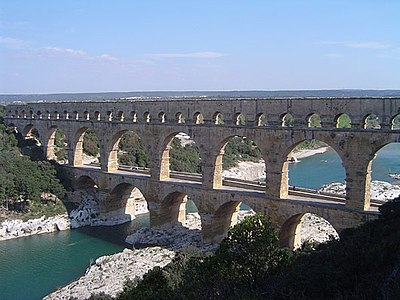
Geographical Context and Roman Urbanization
The Pont du Gard is situated in the Occitanie region of southern France, an area characterized by a Mediterranean climate with hot, dry summers and mild winters, conducive to agriculture and settlement. It crosses the Gardon River, a tributary of the Rhône, near the site of the Roman colony of Nemausus (modern Nîmes). The Romans strategically selected locations for their colonies based on access to resources, defensibility, and proximity to trade routes.
The construction of extensive infrastructure, such as aqueducts, was a hallmark of Roman expansion and urbanization, enabling them to establish and sustain large populations in new territories. The Pont du Gard exemplifies this, demonstrating the Romans' ability to overcome significant geographical challenges, like river crossings, to support their civic ambitions and provide essential services.
Architectural Ingenuity and Construction Techniques
Built in the first century AD, the Pont du Gard is a triumph of Roman architectural and engineering prowess. It is a three-tiered, arcaded structure, standing approximately 49 meters (160 feet) high. The aqueduct itself was designed to maintain a gentle gradient over its entire 50-kilometer (31-mile) length, ensuring a consistent flow of water to Nemausus.
The construction utilized precisely cut limestone blocks quarried locally, assembled with remarkable accuracy without the use of mortar in the visible sections. This dry-stone masonry technique, combined with the sophisticated understanding of load-bearing arches, allowed for the creation of a structure that is both aesthetically pleasing and incredibly durable. The design showcases a deep knowledge of hydraulics, structural mechanics, and material science, reflecting the advanced capabilities of Roman builders.
Historical Significance and Cultural Impact
The Pont du Gard served a vital function for the Roman city of Nemausus, supplying it with an estimated 20,000 cubic meters (5.3 million US gallons) of water per day. This water was crucial for public baths, fountains, private homes, and sanitation, contributing significantly to the quality of life and public health in the Roman city. Its exceptional preservation over nearly two millennia makes it an invaluable archaeological and historical resource.
In 1985, its significance was recognized globally when it was inscribed as a UNESCO World Heritage site, acknowledging its outstanding universal value as a masterpiece of ancient engineering and a testament to Roman civilization. It stands as a powerful symbol of Roman influence and the enduring legacy of their infrastructure projects.
Enduring Legacy and Modern Relevance
Beyond its historical importance, the Pont du Gard continues to captivate and educate. It serves as a tangible link to the past, offering insights into Roman daily life, technological achievements, and societal organization. The site is now a major tourist attraction and cultural center, drawing visitors from around the world who come to marvel at its scale and beauty.
Its preservation is an ongoing effort, highlighting contemporary challenges in heritage management and the importance of protecting ancient monuments. The Pont du Gard inspires modern engineers and architects, demonstrating timeless principles of design and construction. Its enduring presence underscores the profound and lasting impact that well-executed infrastructure can have on human civilization, influencing urban development and quality of life for centuries.
See also
Frequently Asked Questions
What is the Pont du Gard?+
How did the Romans build the Pont du Gard without mortar?+
Why was the Pont du Gard important for the city of Nîmes?+
Where is the Pont du Gard located?+
Is the Pont du Gard still standing today, and can people visit it?+
Based on content from Wikipedia · Licensed under CC BY-SA 4.0