

Photovoltaics: Sunshine Power!
Images

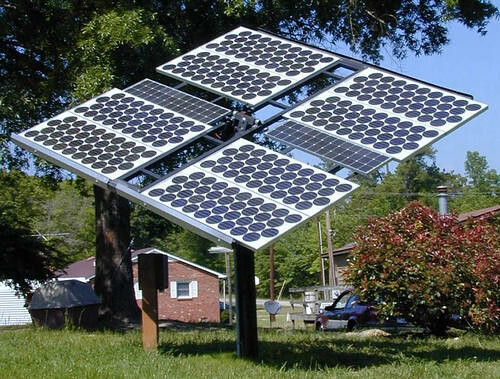
CAARNG photovoltaic fuel cell system



The Physics of Photovoltaics
Photovoltaics (PV) represents a sophisticated method of converting light energy directly into electrical energy through the photovoltaic effect. This effect is rooted in the quantum mechanical properties of semiconductor materials, most commonly silicon. When photons with sufficient energy strike a semiconductor's p-n junction, they excite electrons, freeing them from their atomic bonds and creating electron-hole pairs.
The built-in electric field at the p-n junction then separates these charge carriers, directing electrons to the n-type side and holes to the p-type side. This separation of charge creates a voltage difference across the cell. When an external circuit is connected, these separated charges flow, generating a direct current (DC).
A photovoltaic system typically comprises solar modules, each containing numerous solar cells interconnected to increase voltage and current output. These modules can be deployed in various configurations, including fixed mounts, solar trackers that follow the sun, and even floating platforms, optimizing energy capture and land use.
A Historical Trajectory
The scientific foundation for photovoltaics was laid in 1839 by Edmond Becquerel, who observed the photovoltaic effect in an electrolytic cell. However, the development of practical solid-state photovoltaic devices began much later. The first silicon solar cell was created by Bell Labs in 1954, initially for niche applications like powering satellites and remote telecommunication equipment due to their high cost. Mass production of PV modules commenced around the turn of the millennium, significantly boosted by government initiatives such as Germany's 'One Hundred Thousand Roofs Program' in 2000.
Subsequent decades witnessed a dramatic reduction in manufacturing costs, driven by economies of scale, massive investment in production capacity (particularly in China), and continuous improvements in manufacturing technology and cell efficiency. This cost reduction has been further supported by policies like net metering and feed-in tariffs, making solar PV increasingly competitive and a leading renewable energy source globally.
The Environmental Imperative
Photovoltaics play a critical role in mitigating climate change by offering a low-carbon alternative to fossil fuels. While the manufacturing and installation processes do involve some environmental impact and greenhouse gas emissions, these are a fraction of those produced by conventional energy sources over their lifecycle. Crucially, once operational, PV systems generate electricity with zero direct emissions of carbon dioxide, sulfur dioxide, nitrogen oxides, or particulate matter.
This clean operation significantly reduces air pollution and helps combat global warming. As PV capacity grows, it displaces electricity generation from dirtier sources, leading to substantial reductions in greenhouse gas emissions. The scalability of PV, from small rooftop installations to vast utility-scale farms, allows for flexible deployment to meet diverse energy demands and contribute significantly to decarbonization goals.
Challenges and Future Frontiers in Photovoltaic Technology
Despite its advantages, widespread adoption of photovoltaics faces several challenges. The intermittency of solar power, dependent on daylight and weather conditions, necessitates energy storage solutions (like batteries) or integration with robust grid infrastructure, such as high-voltage direct current (HVDC) transmission lines, to ensure a stable and reliable electricity supply. Competition for land use, particularly for large-scale solar farms, can also be a constraint.
Furthermore, the availability of certain materials required for PV system manufacturing, like silver, could potentially limit future growth, although research into alternative materials is ongoing. Nonetheless, continuous advancements in cell efficiency, new materials (like perovskites), and innovative system designs are constantly pushing the boundaries of what PV technology can achieve, promising even greater contributions to the global energy transition.
Global Impact and Economic Significance of Solar PV
The global impact of photovoltaic technology is profound and rapidly expanding. By 2022, worldwide installed PV capacity surpassed one terawatt (TW), meeting nearly two percent of global electricity demand. Photovoltaics now stand as the third-largest renewable energy source in terms of installed capacity, following hydropower and wind power.
Projections indicate continued exponential growth, with expectations for an additional terawatt of capacity to be added by 2027. In regions with high solar potential, PV has become the most cost-effective source of electricity, with bids as low as $0.015 per kilowatt-hour recorded. The International Energy Agency has highlighted that for projects with favorable financing and high-quality solar resources, solar PV represents the cheapest form of electricity generation in history.
This economic competitiveness is driving massive investment and accelerating the global shift towards a solar-powered future, creating jobs and fostering energy independence.
Go deeper
Frequently Asked Questions
What is a photovoltaic panel and how does it work?+
How did solar panels start being made for everyday use?+
Why do solar panels help the planet?+
Where can solar panels be put to get the most sunshine?+
What is a problem with solar power that scientists are working on?+
Based on content from Wikipedia · Licensed under CC BY-SA 4.0