

Phanerozoic: The Eon of Big Life!
Images

Phanerozoic






Defining the Phanerozoic
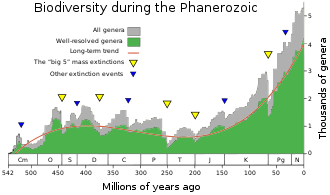
The Phanerozoic Eon, commencing approximately 538.8 million years ago and extending to the present, represents the most recent and currently ongoing eon of Earth's geologic timescale. Its name, derived from Greek for 'visible life,' aptly describes its defining characteristic: the proliferation, diversification, and widespread colonization of Earth's terrestrial and aquatic environments by abundant and complex life forms. This stands in stark contrast to the preceding Precambrian Supereon, which encompasses the Hadean, Archean, and Proterozoic eons, periods characterized by simpler, predominantly microbial life and a less robust fossil record.
The Phanerozoic's inception is marked by the Cambrian Explosion, a geologically rapid diversification event where most major animal phyla first appeared in the fossil record, often distinguished by the evolution of hard exoskeletons, shells, and internal skeletons, facilitating their preservation and study.
Chronicle of Eras
The Phanerozoic Eon is subdivided into three major eras, each representing distinct evolutionary and geological chapters. The Paleozoic Era (538.8 to 251.9 million years ago) witnessed the diversification of marine invertebrates, the evolution of fish, the colonization of land by plants and arthropods, and the emergence of early amphibians and reptiles. This era concluded with the Permian-Triassic extinction event, the most severe in Earth's history.
The Mesozoic Era (251.9 to 66 million years ago), often termed the 'Age of Reptiles,' was dominated by dinosaurs, alongside the evolution of early mammals, birds, and flowering plants. It ended with the Cretaceous-Paleogene extinction event, which wiped out the non-avian dinosaurs. The Cenozoic Era (66 million years ago to present), the 'Age of Mammals,' has seen the rise of mammals and birds to ecological dominance, the diversification of flowering plants, and the evolution of primates, including humans.
Each era is punctuated by significant evolutionary innovations and mass extinction events.
Ecological and Evolutionary Significance
The Phanerozoic Eon is of paramount significance as it laid the evolutionary and ecological groundwork for the planet's current biodiversity. The adaptive radiations and evolutionary innovations that occurred during this eon, such as the development of complex organ systems, terrestrial adaptations, and diverse reproductive strategies, have resulted in the vast array of species we observe today. Studying the Phanerozoic allows us to trace the lineage of modern organisms, understand the processes of speciation and extinction, and appreciate the interconnectedness of life.
Furthermore, the Phanerozoic provides a critical context for understanding evolutionary biology, paleontology, and the history of life on Earth. The fossil record from this eon is an invaluable archive, offering insights into past ecosystems, climates, and the long-term impacts of environmental change on life.
Geodynamic Processes
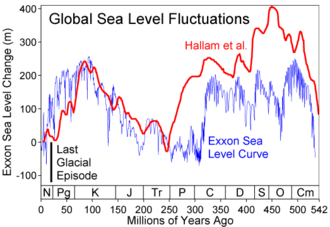
The Phanerozoic Eon was not only a period of biological revolution but also of profound geological dynamism. Plate tectonics played a crucial role in shaping Earth's surface, driving the movement and assembly of continents. A key feature of the Phanerozoic was the formation and subsequent breakup of supercontinents, most notably Pangaea, which existed during the late Paleozoic and early Mesozoic eras. The assembly of Pangaea created vast continental interiors with unique climates, influencing terrestrial evolution.
Its subsequent rifting and dispersal into the modern continental configuration created new ocean basins, altered ocean currents, and reshaped global climates, profoundly impacting both geological processes and the distribution and evolution of life. These continental shifts continue to influence modern geography, climate patterns, and the distribution of natural resources.
The Phanerozoic's Legacy
The Phanerozoic Eon's legacy extends far beyond its geological and biological history; it directly informs our understanding of contemporary environmental challenges and future possibilities. The study of past climate changes and extinction events within the Phanerozoic provides crucial data for modeling future climate scenarios and predicting the impacts of anthropogenic pressures on biodiversity. The fossil fuels we rely on today, such as coal, oil, and natural gas, are products of organic matter accumulated during specific Phanerozoic periods, highlighting our deep dependence on past life.
Understanding the long-term evolutionary trajectories and ecological dynamics of the Phanerozoic offers valuable lessons for conservation biology, resource management, and our stewardship of the planet in the face of ongoing global change. It underscores the resilience and vulnerability of life over vast timescales.
Go deeper
Based on content from Wikipedia · Licensed under CC BY-SA 4.0