

The Mighty Persian Empire!
Images

The monumental eastern staiway of the Apadana adorned with registers of relief sculpture that depicted representatives of the twenty-three subject nations of the Persian empire bringing valuable gifts as tribute to the king, Persepolis, Iran


The Genesis of Imperial Power
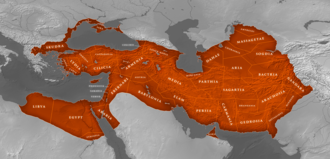
The term 'Persian Empire' encompasses a series of imperial states centered in Iran, with the Achaemenid Empire (c. 550–330 BC) serving as the foundational and most renowned example. Emerging from the region of Persis, Cyrus the Great unified disparate Median and Persian tribes, initiating an era of unprecedented expansion. This empire was characterized by its vast territorial reach, encompassing diverse ethnicities and cultures from the Balkans to the Indus Valley.
Following the Achaemenid collapse under Alexander the Great, subsequent Iranian dynasties, such as the Parthians and Sasanians, continued to assert imperial power, albeit with different structures and influences. The Pahlavi dynasty in the 20th century marked the final chapter of this long imperial tradition. Each iteration built upon, or reacted against, the precedents set by its predecessors, creating a complex tapestry of imperial ambition and governance rooted in Iranian civilization.
Architects of Order
The success of the Persian Empires, particularly the Achaemenids, was intrinsically linked to the vision and administrative acumen of its rulers. Cyrus the Great's policy of respecting local customs and religions, exemplified by his decree allowing the Jews to return to Jerusalem, fostered loyalty and stability within a multi-ethnic empire. Darius the Great further refined this imperial structure, dividing the vast territory into satrapies, each governed by a satrap responsible for administration, justice, and taxation.
He also implemented a standardized system of coinage and established the Royal Road, a sophisticated network that facilitated not only military movement but also rapid communication through a relay system of messengers. This administrative innovation was crucial for maintaining cohesion across such immense distances and diverse populations, setting a benchmark for imperial governance that would be emulated for centuries.
Cultural Synthesis and Infrastructural Marvels
Beyond military and administrative might, the Persian Empires were crucibles of cultural exchange and technological advancement. The Achaemenid Empire, in particular, facilitated a remarkable synthesis of artistic styles and architectural techniques drawn from its subject territories, evident in the monumental palaces of Persepolis and Susa. Their engineering prowess extended to sophisticated irrigation systems and the construction of qanats, underground water channels that sustained agriculture in arid regions.
The empire's infrastructure, including its extensive road networks and postal services, fostered trade and the dissemination of ideas, contributing to a vibrant cultural landscape. This era saw the interaction and blending of Zoroastrianism with other religious and philosophical traditions, influencing later monotheistic faiths.
Enduring Influence
The legacy of the Persian Empires is profound and far-reaching, impacting political, social, and cultural spheres for millennia. Their model of a centralized, bureaucratic empire managing diverse populations provided a blueprint for subsequent imperial powers, including the Hellenistic kingdoms, the Roman Empire, and even later Islamic caliphates. The concept of religious and cultural tolerance, pioneered by figures like Cyrus, though not always consistently applied, offered an alternative to more oppressive forms of rule and contributed to the long-term stability of their realms.
Furthermore, the extensive trade routes and communication networks established by the Persians fostered early forms of globalization, connecting disparate regions and facilitating the exchange of goods, knowledge, and innovations that shaped the trajectory of human civilization. Their impact is a testament to their organizational genius and their role in bridging ancient worlds.
The Persian Empire
Understanding the Persian Empire requires recognizing its nature as a continuum rather than a single monolithic entity. From the Achaemenids' vast dominion to the Parthian and Sasanian Empires' distinct identities, and culminating in the modern era with the Pahlavi dynasty, the concept of an Iranian-centered imperial power persisted for over two millennia. Each period faced unique challenges, from external invasions by Greeks, Arabs, and Mongols, to internal political dynamics.
Yet, the core elements of Persian culture, language, and administrative traditions often endured, adapting and reasserting themselves. This long historical arc highlights the resilience and adaptability of Iranian civilization and its persistent role as a major geopolitical and cultural force in the ancient and medieval world, leaving an indelible mark on the regions it governed and beyond.
Go deeper
Frequently Asked Questions
What was the Persian Empire and who started it?+
Why did Cyrus the Great make people feel safe in the empire?+
How did the Persian Empire keep such a big area together?+
What cool things did the Persian Empire build?+
Who followed after the Persian Empire and why is it still important?+
Based on content from Wikipedia · Licensed under CC BY-SA 4.0