

Olmec
Images

Olmec Head No. 1





Emergence and Geographical Context of the Olmec
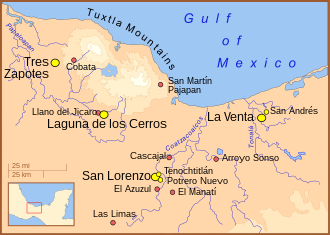
The Olmec civilization emerged in the geologically rich and ecologically diverse tropical lowlands of south-central Mexico, primarily in the modern states of Veracruz and Tabasco, around 1500 BCE. This region, characterized by its abundant rainfall, extensive river systems, and dense vegetation, provided both resources and challenges for early settlement. The Olmec strategically established major centers such as San Lorenzo Tenochtitlán, La Venta, and Tres Zapotes.
San Lorenzo, flourishing from approximately 1200 to 900 BCE, is considered one of their earliest major capitals, featuring impressive earthen mounds, drainage systems, and ceremonial structures. La Venta, prominent from 900 to 400 BCE, became a significant religious and political center, known for its Great Pyramid and elaborate jade mosaics. The Olmec's ability to harness the resources of their environment and organize large-scale labor for monumental construction underscores their advanced societal organization and engineering capabilities, setting a precedent for subsequent Mesoamerican civilizations.
Monumental Artistry
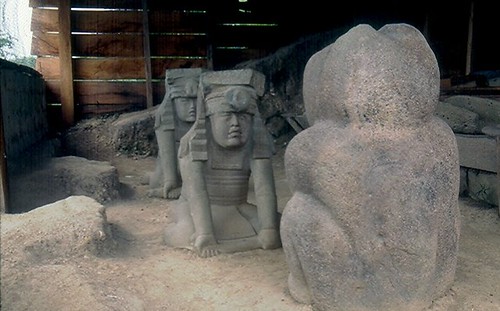
The Olmec are most renowned for their iconic colossal stone heads, monumental sculptures carved from massive basalt boulders, often transported over considerable distances. These heads, some standing over 9 feet tall and weighing up to 40 tons, are not mere portraits but are believed to represent specific rulers or important ancestors, distinguished by unique facial features, cranial deformation, and elaborate headdresses. The sheer scale and artistry involved in quarrying, transporting, and carving these stones without metal tools or the wheel represent a remarkable feat of engineering and logistical planning.
Beyond the heads, Olmec artistry extended to intricate jade carvings, finely crafted pottery, and anthropomorphic figurines, often depicting figures with distinctive 'jaguar' or 'were-jaguar' traits, suggesting a complex cosmology and religious system. These artifacts provide invaluable insights into their social hierarchy, belief systems, and artistic traditions.
Cultural and Intellectual Innovations
The Olmec are credited with pioneering many cultural and intellectual developments that became foundational for later Mesoamerican civilizations. They developed one of the earliest known calendar systems in the Americas, crucial for agricultural planning and ritual cycles. Evidence also suggests they created a form of hieroglyphic writing, a significant step in the development of complex communication. The Olmec are also strongly associated with the origins of the Mesoamerican ballgame, a ritualistic sport played with a rubber ball, which held deep religious and political significance across the region.
Furthermore, their sophisticated understanding of astronomy and mathematics likely influenced the calendrical and astronomical observations of subsequent cultures. Through extensive trade networks, the Olmec disseminated these innovations, along with their artistic styles and religious concepts, across a wide geographical area, solidifying their role as a 'mother culture'.
Socio-Political Structure and Economic Networks
The Olmec civilization was characterized by a stratified social hierarchy, with a ruling elite likely composed of shamans, rulers, and warriors who commissioned and controlled the monumental art and ceremonial centers. The construction of these large-scale projects required a significant mobilization of labor, suggesting a system of tribute or corvée labor drawn from agricultural populations. Their economy was primarily based on intensive agriculture, cultivating crops like maize, beans, and squash, supplemented by fishing and hunting.
Crucially, the Olmec established extensive trade networks that extended far beyond their core territory. They exchanged prestige goods such as jade, obsidian, serpentine, and pottery, facilitating the spread of their cultural influence and integrating diverse communities into a broader Mesoamerican economic and ideological sphere. This economic reach was instrumental in their cultural diffusion.
Legacy and Decline
The decline of the Olmec civilization, occurring gradually from around 400 BCE, is a subject of ongoing scholarly debate, with theories ranging from environmental changes and resource depletion to internal social unrest or the rise of competing centers. Despite their eventual decline, the Olmec left an indelible mark on Mesoamerican history. Their innovations in art, architecture, calendrics, writing, and ritual practices were adopted, adapted, and elaborated upon by subsequent cultures, including the Maya, Zapotec, and Teotihuacan.
The Olmec's monumental art, particularly the colossal heads, continues to fascinate and inspire, serving as powerful symbols of the region's ancient heritage. Understanding the Olmec is essential for comprehending the deep historical trajectory of complex societies in the Americas and appreciating the foundational contributions of this remarkable ancient civilization.
Go deeper
Based on content from Wikipedia · Licensed under CC BY-SA 4.0