

Mu'awiya I
Images

Sufyanid dynasty genealogy




From Meccan Elite to Caliphal Authority
Mu'awiya I's trajectory from a member of the Meccan aristocracy, initially opposed to Islam, to the founder and first caliph of the Umayyad Caliphate is a testament to his political acumen and adaptability. His family, the Banu Umayya, were influential figures in pre-Islamic Mecca. His initial opposition to Muhammad, alongside his father Abu Sufyan, placed him on the opposing side of the nascent Muslim community.
However, the capture of Mecca in 630 marked a turning point, leading to Mu'awiya's conversion and subsequent role as a scribe for the Prophet. This period was instrumental in his integration into the early Islamic leadership. His military career began in earnest under the first two caliphs, Abu Bakr and Umar, where he distinguished himself as a capable commander, particularly in the conquest of Syria.
His appointment as governor of Syria by Caliph Uthman, a fellow Umayyad, provided him with a power base from which he consolidated his influence. He skillfully cultivated alliances, most notably with the powerful Banu Kalb tribe, and fortified the region's defenses. His strategic direction of the war effort against the Byzantine Empire, including the pioneering of Muslim naval expeditions, showcased his innovative military thinking and ambition.
This period of governorship laid the groundwork for his eventual bid for the caliphate, positioning him as a formidable figure in the post-Uthmanic political landscape.
Establishing the Umayyad Caliphate
The establishment of the Umayyad Caliphate in 661, with Mu'awiya I as its first caliph, represented a significant institutional shift in Islamic governance. Unlike the Rashidun caliphs, who were closely tied to Muhammad's immediate circle, Mu'awiya represented a new political order, consolidating power in Damascus. His reign was marked by a series of administrative and military reforms designed to centralize authority and expand the empire.
Domestically, Mu'awiya relied on the loyalty of Syrian Arab tribes and adeptly utilized the existing Christian bureaucracy within Syria, demonstrating a pragmatic approach to governance that prioritized stability and efficiency. He is credited with establishing foundational government departments, including a sophisticated postal service (barid), a chancellery (diwan al-rasa'il), and a department for correspondence, which were crucial for managing a rapidly expanding state.
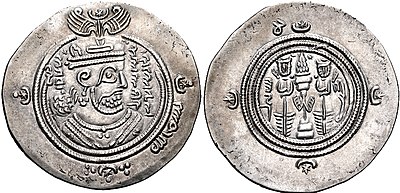
This era also saw the first appearance of the caliph's name on coins and inscriptions, signifying the growing distinctiveness and authority of the Umayyad state. Militarily, Mu'awiya sustained a policy of almost continuous engagement with the Byzantine Empire through annual land and sea raids, although the ambitious siege of Constantinople in 674-678 ultimately failed. He also oversaw the expansion of Islamic rule into North Africa (Ifriqiya) under commanders like Uqba ibn Nafi and resumed conquests in the eastern frontier regions of Khurasan and Sijistan, laying the groundwork for future territorial gains.
The Succession Question
Mu'awiya I's most enduring and controversial legacy lies in his decision to nominate his son, Yazid I, as his successor. This move fundamentally altered the nature of the caliphate, transforming it from a potentially elective office into a hereditary monarchy. This unprecedented step broke with the precedent set by the Rashidun caliphs and generated significant opposition from prominent figures within the Muslim community, including Husayn ibn Ali (son of Ali) and Abd Allah ibn al-Zubayr.
The resistance to Yazid's succession would ultimately contribute to the outbreak of the Second Muslim Civil War following Mu'awiya's death. While contemporary sources often laud Mu'awiya for his political skill, administrative foresight, and military successes, he has also been subject to considerable historical critique. Critics often contrast his rule with the perceived piety and justice of the Rashidun caliphs, arguing that he secularized the office of the caliphate and prioritized dynastic power over religious ideals.
Within Shia Islam, Mu'awiya is particularly reviled, viewed as a usurper who actively opposed Ali and is accused of complicity in the death of Hasan, Ali's elder son. Conversely, Sunni tradition generally honors him as a companion of Muhammad and a scribe of the Quran, acknowledging his pivotal role in establishing and consolidating the early Islamic state, despite the controversies surrounding his methods and succession plans. His reign thus represents a complex interplay of political pragmatism, imperial ambition, and theological debate that continues to shape historical interpretations.
The Umayyad State
Mu'awiya I's governance was characterized by a strategic blend of traditional Arab tribal structures and sophisticated administrative practices, laying the foundation for the Umayyad state. He skillfully managed the diverse populations within his realm, leveraging the military prowess of Syrian Arab tribes while incorporating the administrative expertise of existing bureaucracies, including Christian elements. This pragmatic approach allowed for the efficient management of vast territories and resources.
His commitment to expansion was evident in both land and sea operations. The naval campaigns, a novelty for the nascent Muslim state, were crucial in challenging Byzantine dominance in the Mediterranean and securing trade routes. On land, the conquests in North Africa and the eastern frontiers opened up new avenues for trade, resources, and further expansion, significantly increasing the caliphate's territorial reach and influence.
However, the most profound impact of his reign on the future of the caliphate was the establishment of hereditary succession. By designating his son Yazid as his heir, Mu'awiya introduced a dynastic principle that would define the Umayyad rule and create deep divisions within the Muslim community. This decision, while securing continuity for his dynasty, sowed the seeds of future civil wars and theological disputes, highlighting the complex legacy of a leader who was both a builder of empire and a catalyst for enduring political and religious schisms.
See also
Frequently Asked Questions
Who was Mu'awiya I?+
How did Mu'awiya I become a leader?+
What new things did Mu'awiya I introduce to the government?+
What wars did Mu'awiya I fight?+
Why is Mu'awiya I's decision about his son important?+
Based on content from Wikipedia · Licensed under CC BY-SA 4.0