

Mostar
Images

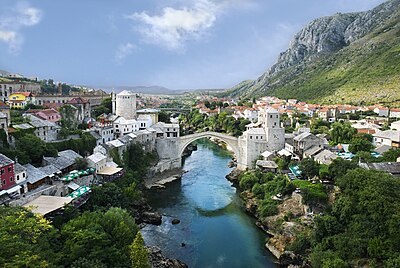
Mostar, View from the Minaret


The Genesis of Mostar
Mostar, the administrative center of the Herzegovina-Neretva Canton and the historical capital of Herzegovina within Bosnia and Herzegovina, is a city whose identity is inextricably linked to its geography and its past. Situated on the Neretva River, it is the fifth-largest city in the nation. The city's very name, derived from the Old Slavic word 'most,' meaning bridge, and the suffix '-ari' denoting keepers, points directly to its foundational element: the Stari Most.
During the Ottoman period, the 'mostari' were the vigilant guardians of this vital crossing, ensuring its security and functionality. This crucial role elevated the bridge and its keepers to such prominence that the burgeoning settlement around it adopted their designation, transforming a functional necessity into a lasting civic identity. This etymological link underscores how infrastructure and the human element in its maintenance can forge the very soul of a place.
The Stari Most
The Stari Most, or Old Bridge, is not merely a historical artifact but a profound statement of Ottoman architectural prowess in the Balkans. Commissioned by Sultan Suleiman the Magnificent in the 16th century, its construction was a monumental undertaking. The bridge is celebrated for its elegant, high arch, which spans the Neretva River with a graceful curve, a design that was both aesthetically pleasing and functionally superior for its time, allowing ample passage for river traffic.
Its construction utilized local stone, meticulously fitted to create a structure that was both robust and visually striking. Recognized globally for its significance, the Stari Most is designated as a UNESCO World Heritage Site, standing as a testament to the sophisticated engineering and artistic sensibilities of the Ottoman Empire, and serving as a prime example of Islamic architecture adapted to the Balkan landscape.
The Strategic and Cultural Significance of the Neretva Crossing
The location of Mostar on the Neretva River was strategically vital, serving as a critical transit point for trade and communication across the rugged Balkan terrain. The Stari Most, as the primary crossing, facilitated the movement of goods, people, and ideas, fostering economic growth and cultural exchange. Its construction under Ottoman rule was part of a broader effort to consolidate control and integrate the region into the empire's vast network.
The bridge became a symbol of this connection, linking diverse communities and cultures. The presence of the 'mostari' highlights the importance of maintaining such vital arteries, ensuring stability and prosperity. The city's development around this bridge reflects a long history of human adaptation and the creation of enduring landmarks that shape societal development.
Resilience and Reconstruction
The history of the Stari Most is also one of resilience. Tragically, the original bridge was destroyed during the Bosnian War in the 1990s, a devastating loss that symbolized the conflict's impact on cultural heritage. However, its destruction also galvanized international efforts for its reconstruction.
Using traditional techniques and materials, the bridge was meticulously rebuilt and reopened in 2004, a powerful symbol of reconciliation and the enduring spirit of Mostar. This reconstruction effort, supported by various international organizations, not only restored a physical landmark but also reinforced its status as a beacon of hope and a testament to the shared human desire to rebuild and preserve history. The modern Stari Most stands as a powerful reminder of the past while looking towards a future of peace and unity.
Mostar Today
Today, Mostar continues to draw visitors from around the world, captivated by its historical charm and the iconic Stari Most. The city offers a unique blend of Ottoman and Austro-Hungarian influences, visible in its architecture, bustling bazaars, and vibrant cultural scene. The tradition of bridge diving, where skilled divers leap from the Old Bridge into the Neretva below, continues to be a daring spectacle, connecting modern life with ancient customs.
Mostar serves as a crucial hub for tourism in Bosnia and Herzegovina, contributing significantly to the local economy and fostering an appreciation for its rich heritage. It stands as a living monument, inviting visitors to explore its storied past and experience its enduring allure.
See also
Frequently Asked Questions
What is the Old Bridge in Mostar?+
Why is the city called Mostar?+
How did the Old Bridge help people in the past?+
What happened to the Old Bridge during the war?+
When was the bridge rebuilt and why is it special?+
Based on content from Wikipedia · Licensed under CC BY-SA 4.0