

Microcontroller
Images
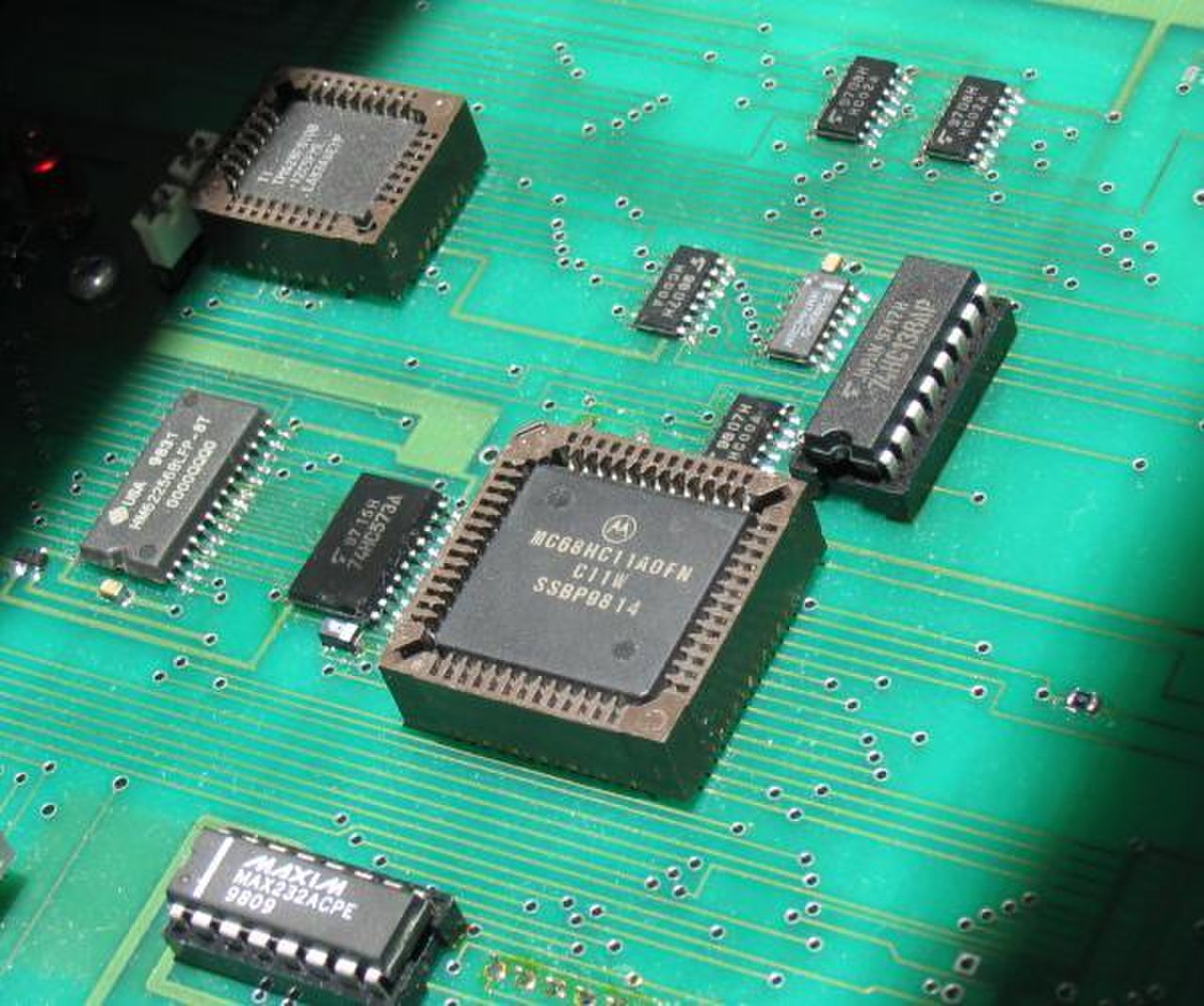
MC68HC11 microcontroller


Deconstructing the Microcontroller
A microcontroller unit (MCU) is a self-contained computer system fabricated on a single integrated circuit (IC). Its core architecture typically comprises a central processing unit (CPU) or multiple processor cores, a finite amount of random-access memory (RAM) for temporary data storage, and non-volatile program memory, often in the form of NOR flash, One-Time Programmable (OTP) ROM, or ferroelectric RAM. Crucially, MCUs integrate programmable input/output (I/O) peripherals that enable them to interface with the physical world.
These peripherals can include analog-to-digital converters (ADCs), digital-to-analog converters (DACs), timers, serial communication interfaces (like UART, SPI, I2C), and general-purpose I/O pins. Unlike microprocessors, which require external memory and peripherals, MCUs are designed for standalone operation within embedded applications, optimizing for size, cost, and power efficiency. This integration makes them ideal for dedicated tasks, contrasting with the versatility of microprocessors used in general-purpose computing.
The Genesis of Integrated Intelligence
The evolution of microcontrollers is a story of miniaturization and integration driven by the demand for more intelligent and cost-effective electronic devices. Prior to their widespread adoption, embedded control systems relied on numerous discrete logic chips and microprocessors, leading to bulky, expensive, and power-hungry designs. The concept of consolidating essential computing functions onto a single chip gained traction in the late 1960s and early 1970s.
The Intel 4004, often cited as the first commercial microprocessor, laid the groundwork. However, it was the development of devices like the Intel 8048 in 1976, which integrated a CPU, RAM, ROM, and I/O on one chip, that truly defined the microcontroller. This innovation democratized digital control, enabling its application in a vast array of consumer electronics, automotive systems, and industrial machinery, fundamentally reshaping product design and functionality.
The Indispensable Role of Microcontrollers in the Modern Technological Landscape
Microcontrollers are the bedrock of the vast 'Internet of Things' (IoT) and the backbone of countless automated systems. Their significance lies in their ability to bring digital intelligence to virtually any device at an economical price point. They are instrumental in reducing the complexity and cost of designs that previously required multiple chips, thereby making digital control practical for an exponentially larger number of applications.
From sophisticated automotive engine control units and implantable medical devices to everyday appliances, power tools, and toys, microcontrollers enable precise, responsive, and often autonomous operation. In the context of IoT, they serve as crucial edge devices, collecting data from sensors, performing local processing, and actuating physical processes, thereby bridging the gap between the digital and physical realms.
Operational Dynamics
The operation of a microcontroller is fundamentally driven by the execution of firmware, a program stored in its non-volatile memory. Upon power-up, the CPU fetches instructions from this memory and executes them sequentially. This program dictates the microcontroller's behavior, defining how it processes inputs and generates outputs. Input peripherals, such as ADCs and digital I/O pins, capture data from the environment or user interactions (e.g., sensor readings, button presses).
The CPU then processes this data according to the firmware's logic, often involving complex algorithms or state machines. Output peripherals, like DACs, PWM generators, and digital I/O pins, translate these processed results into physical actions, such as controlling motor speed, illuminating LEDs, or transmitting data over a communication bus. Many microcontrollers are designed for low-power operation, featuring sleep modes where the CPU and most peripherals are powered down, consuming only nanowatts, allowing battery-powered devices to operate for extended periods.
Ubiquitous Applications
The application spectrum of microcontrollers is extraordinarily broad, reflecting their versatility and cost-effectiveness. In the automotive industry, they are indispensable for managing engine combustion, braking systems (ABS), airbags, climate control, and infotainment. Medical devices, from pacemakers and insulin pumps to diagnostic equipment, rely on their precision and reliability.
Consumer electronics are saturated with MCUs; they control the functions of remote controls, washing machines, refrigerators, smart televisions, and gaming consoles. In industrial automation, they manage robotic arms, process control systems, and sensor networks. Even simple devices like electric toothbrushes and digital thermometers often incorporate microcontrollers.
The rise of the Internet of Things has further expanded their reach, with MCUs acting as the primary processing units in smart home devices, wearable technology, and environmental sensors, enabling unprecedented connectivity and data exchange.
Go deeper
Frequently Asked Questions
What is a microcontroller?+
How does a microcontroller make a toy smart?+
Why are microcontrollers smaller and cheaper than microprocessors?+
When did microcontrollers first appear?+
How does a microcontroller know what to do when it turns on?+
Based on content from Wikipedia · Licensed under CC BY-SA 4.0