

The Mayflower Compact: A Promise on a Ship!
Images
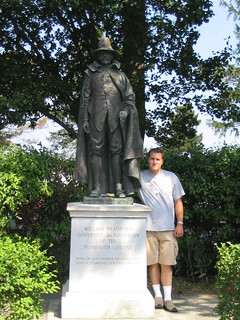
Ken, Statue to WIlliam Bradford, Plymouth, Massachusetts


Pilgrims, Adventurers, and the Perilous Voyage
The journey of the Mayflower in 1620 was not solely undertaken by religious zealots. While the Separatist Puritans, seeking to escape persecution and establish a society based on their strict religious beliefs, formed a significant portion of the passengers, they were joined by a diverse group of individuals. These included 'adventurers' who were investors hoping for economic returns, and 'tradesmen' such as carpenters, coopers, and weavers, essential for establishing a functional settlement.
The Mayflower itself was a merchant vessel, not designed for comfortable transatlantic travel, making the voyage of over 66 days a grueling ordeal. Upon nearing the North American coast, they discovered they had landed north of the Virginia Company's territory, the area for which they held a patent. This geographical displacement rendered their existing charter invalid, creating a legal and political vacuum.
The realization that they were outside the jurisdiction of English law and royal authority prompted an urgent need for a framework to maintain order and ensure the survival of the nascent community.
Forging a Covenant in the Face of Uncertainty
On November 21, 1620, while anchored in Provincetown Harbor, the 41 adult male passengers aboard the Mayflower convened to create and sign the Mayflower Compact. This document, originally titled 'The Agreement Between the Settlers of New Plymouth,' was a pragmatic response to their precarious situation. It was not a constitution in the modern sense, but a covenant, a solemn promise to unite and form a 'civil body politic.' This body would then have the authority to enact 'just and equal laws, ordinances, acts, constitutions, and offices' for the general good of the colony.
Crucially, the Compact included a pledge of loyalty to King James I, a strategic move to maintain a connection to England and legitimize their presence. However, the core innovation lay in its assertion of self-governance, deriving authority from the consent of the governed rather than solely from royal prerogative. This was a radical departure from the prevailing monarchical system.
The Compact's Enduring Significance
The Mayflower Compact holds profound historical significance as one of the earliest written agreements for self-governance in what would become the United States. Its importance lies not in its legal complexity, but in its foundational principle: that a community could establish its own governing structure through mutual consent. This concept of popular sovereignty, the idea that political power resides with the people, was revolutionary for its time.
While the Separatists' primary motivation was religious freedom, the Compact extended governance to all the male signers, regardless of their religious affiliation or social standing. This inclusive approach, however limited by modern standards (excluding women, children, and indentured servants), laid a crucial groundwork for future democratic developments. It demonstrated that a government could be formed by the will of the people, a notion that would profoundly influence later American political thought and revolutionary movements.
Mechanisms of Governance
The Mayflower Compact provided the essential framework for the initial governance of Plymouth Colony. Following its signing, the colonists proceeded to elect leaders, most notably John Carver as their first governor. The Compact mandated the creation of laws and the establishment of offices necessary for the colony's functioning.
This involved regular assemblies, often referred to as the General Court, where decisions were debated and voted upon by the freemen (adult male colonists). These meetings were instrumental in addressing the immediate challenges of survival, including resource management, defense, and establishing relations with the indigenous Wampanoag people. The Compact's emphasis on collective decision-making fostered a sense of shared responsibility and community cohesion, which were vital for overcoming the harsh realities of establishing a settlement in a new and often unforgiving environment.
It was a practical, albeit rudimentary, system of direct democracy in action.
Echoes Through American History
The Mayflower Compact's legacy extends far beyond the shores of Plymouth. It served as a potent symbol and a practical precedent for subsequent colonial charters and declarations of independence. The principles of consent of the governed, the establishment of a social contract, and the creation of a 'civil body politic' resonated throughout the colonial period and into the formation of the United States.
While later documents like the Declaration of Independence and the U.S. Constitution provided more detailed and expansive frameworks for governance, the Mayflower Compact represents the initial spark. It demonstrated that a group of disparate individuals could unite under a common agreement to create a society governed by laws of their own making, a foundational concept that continues to shape democratic ideals and practices worldwide.
Its historical significance lies in its pioneering assertion of a government founded not on divine right, but on the collective will of its people.
Go deeper
Frequently Asked Questions
What was the Mayflower Compact?+
Why did the Mayflower passengers need to write the Compact?+
Who signed the Mayflower Compact?+
Where was the Mayflower Compact signed?+
What did the Compact say about the king?+
Based on content from Wikipedia · Licensed under CC BY-SA 4.0